It's Elemental

Tag: Feedback

  • Feedback and levels of description, or: What MPEG2 compression can teach you about cybernetics and epistemology

    Feedback and levels of description, or: What MPEG2 compression can teach you about cybernetics and epistemology

    A fellow student pointed out recently to me that compression algorithms are an excellent way to see feedback at work, and used the example of mpeg2 video compression.  Here we have a system that utilizes multiple levels of abstraction and feedback in order to efficiently compress video data.

    I will give you a picture or two and quote some relevant explanations on the process as a basis for the following discussion.
    IPB_frame_example

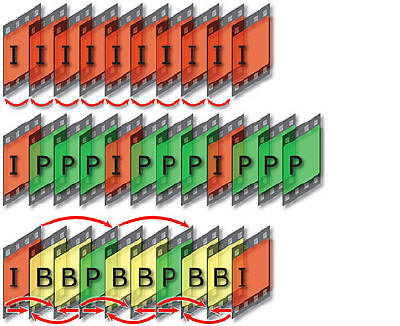
    “The result of the MPEG-2 encoding process is a video stream. The basic unit of the stream is a “Group of Pictures” (GOP), made up of three picture types: I, B, and P. I-pictures (intra) are compressed using intra-frame techniques only, meaning that the information stored is complete enough to decode the frame without reference to any adjacent frames. For B (bi-directional) and P (predictive) pictures, however, only “difference information” (frame-to-frame changes) is stored, which generates much less data. These pictures can only be reconstructed by referring to the I-pictures around them, which is why the different picture types are grouped into GOPs.”

    also:
    IPBFRAME

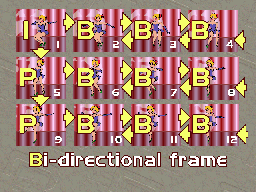
    “MPEG 2 provides for up to three types of frames called the I, P and B frames. The intra-frame, or ‘I’ frame, serves as a reference for predicting subsequent frames. ‘I’ frames, which occur on an average of one out of every ten to fifteen frames, only contains information presented within itself. ‘P’ Frames are predicted from information presented in the nearest preceding ‘I’ or ‘P’ frame. The bi-directional ‘B’ frames are coded using prediction data from the nearest preceding ‘I’ or ‘P’ frame AND the nearest following ‘I’ or ‘P’ frame.”

    So you have completely self-contained frames, appropriately called I-frames.  Then you have predictive-frames which contain information about DIFFERENCES ONLY, and which only have inputs from PAST I or P frames.  But then you have bidirectional frames, which are constructed out of BOTH past and future frames (either I or P), and which also only encode differences.

    This works because this type of compression operates on two levels simultaneously, the level of the FRAME CONTENT and the level of DIFFERENCES in frame content.  The language of differences is a completely different language than that of the content, and constitutes (I think) a higher order of language from the type of language that can appropriately describe the content.

    I’m only making this post because the content of the previous paragraph is generalizable to any system. Any system has a content-level which in some way encodes, describes, and utilizes a particular type of information (in this case, things like hue, lightness, and saturation). If the system never needed to interact with other systems (or itself in regards to this content), this would be enough.  But as soon as any communication of or reflection on this information is needed, it becomes terribly inefficient to only keep to content-level languages. So in communicating or transferring that information from one epistemological system to another (a system for which the information can be of significance, i.e. produce a change), it is much more efficient to utilize a higher-order language whose primary function is to describe the content in a new way.

    So this second-order language describes the description, or is information about the information.  What can this second-order language contain? Essentially it contains information about DIFFERENCES in the content-level, which are not contained in the content-level itself.  So I can’t describe the differences of hue, lightness, and saturation from one video frame to the next by using the language of hue, lightness, and saturation.  The answer to the question: “What is the difference between a lightness value of 10 and 90?” is not itself a unit of lightness, it is a DESCRIPTION of lightness; you can’t use the answer directly and unmodified as information in the content-level system.  You can’t tell your monitor to show a lightness value of “a difference of 80” DIRECTLY–you have to DECODE the difference back into the content-level language through a specific process.

    What gets REALLY interesting, however, is when this kind of decoding has built in to it processes which modify the content-level data not just on the basis of the second-order language of differences (as in mpeg2 compression), but on the basis of a THIRD-order language of the difference of differences.  This is like taking a description of the differences and feeding that information back into the system in a way that modifies the original information.  So you have something like:

    1) content-level (language of ‘raw’ data)
    2) process-level (language of differences in ‘raw’ data)
    3) meta-process level (language of differences of differences)

    How far can this go?  I have no idea; theoretically one can have an infinite number of levels, but practically I don’t think this is the case, and it has to do with the fact that there is a certain sort of separation between levels that has so far been assumed that is simply not the case.  In other words, these different levels are complexly intertwined, and not capable of being separated.  Each level is responsible for producing changes in other levels in various ways.  The process-level, by encoding differences in the content-level, can produce changes in the content-level through appropriate decoding procedures.  The same relation holds between the meta-process-level and the process-level.  This also means that the meta-process level can drastically change things at the content-level.  But additionally the content-level, by virtue of the type of information it contains, helps restrict the possible differences that can occur, and thus the possible ways of distinguishing differences in the process-level (it doesn’t make sense for a process-level language to encode differences about mood, temperature, or conductivity if the content-level doesn’t contain such information in the first place).  So each level is like a bidirectional-frame in our video compression example, in which changes come both from ‘above’ and ‘below’.

    What should be pointed out, however, is that there are SECONDARY effects which become possible with the utilization of any higher-order language.  Any higher order language IS higher order because it can apply to multiple differing types and systems of data.  A language of differences can be more or less strongly ‘coupled’ to a particular type of content.  The closer the coupling the less easily the language can be used for descriptions of different types of data systems.  The weaker the coupling, the more widely applicable the higher-order language can be to different data systems, but only at the cost of some potential loss of fidelity through the filtering out of SOME differences in favor of others.

    Now here is where it gets even more interesting.  The selective filtering of differences is another way of saying that each higher-order system embodies a particular epistemology.  Languages about data, about differences in data, and about the differences of differences are all specific embodiments of epistemological frames.  EVERY system has an epistemological frame: squirrels, lakes, crystals, and of course humans.  The epistemological frame is the meta-context which admits or denies differences of a given class (temperature, color, quantity, mood, awareness…) and includes specific relations between various classes. But the epistemological frame is embedded within, arises from, and also determines the data available to the system — there is no ultimate ability to distinguish between frames and data – they each mutually produce each other.

    What I distinguish distinguishes what I can distinguish.  Differences differentiate my differentiating.

    Epistemology determines the data available to a system for distinctions.  The data available to a system determines the possible epistemologies that can make distinctions about the data (yielding capta.  What is given determines what can be taken; what is taken then determines what can be given (the Latin root of data is ‘to give’, and of capta is ‘to take’).

    There is no escape: we live in and create a world of paradox, which is probably enough for now.

  • Thinking about thinking about feedback

    Thinking about thinking about feedback

    The One Is EverythingOk I’ve been thinking about feedback.

    One thing that struck me as interesting was that feedback, as a concept, seems to assume two things (and probably more): 1) step-wise time (and thus some kind of “state” in which a system can be identified, and thus 2) some kind of ‘levels’ within and between systems, in part based on their “state”.

    So feedback, at least in the way that I’ve been thinking about it up to now, is this idea that state A of a system precipitates state B in some way, but that state B has non-trivial links ‘back’ to processes that help create state A. But of course because we are talking about the evolution of systems, this idea of ‘back’ may be better understood inversely, as ‘forward’, in the sense that there is a real distinction between state A, state B(sub-A), which is the state of system B-as-influenced-by-A, and then state A(sub-B,sub-A) the state of A-influenced-by-B-which-is-already-influenced-by-A…. And this goes on, so we have something more like a system-of-relations (S) at various points, which are distinguished by virtue of the feedback relations between its states A and B.

    Here’s an attempt at a table explicating the pattern of what we mean by “feedback”:

    S1 A
    S2 B(A)
    S3 A(B(A))
    S4 B(A(B(A)))
    S5 A(B(A(B(A))))

    You can see the pattern unfolding infinitely — the thing is that when we think about it in this way, the pattern that is unfolding is one that does so on the basis of these ‘moments’ (S1, S2, …). But these moments are always arbitrary; there doesn’t seem to be any ontological significance to them outside of the context of their actual identification by someone thinking about cybernetics. Our knowledge of the system becomes apropos when we question it, when a need for knowledge arises… and not otherwise.

    If this is true, it’s kind of misleading to have the idea of “a system” that exists “in a state” and that this state influences some other system’s state, and so forth. It’s too reductive… and it seems to fall prey to Whitehead’s fallacy of misplaced concreteness. (Others familiar with quantum physics, and specifically the Einstein-Bohr debates may see some parallels with this line of thinking.)

    When thinking about TIME and evolving systems, we run into some serious complexities, because different information flows through a given portion of a system at different rates depending upon the nature of that part of the system and the nature of the information being carried. Heat flows at one speed through a specific material, at another speed through another material. Information carried by light moves still differently, as does linguistic meaning, different types of sensation, etc. etc. etc.. Just about every ‘channel’ of information has its own unique set of variables in this regard, so there is no way to divvy up a given system into “state A” or “state B” with complete certainty, because at any arbitrary snapshot point, an important bit of information from one part of the system might be ‘on its way’ but not yet resulting in any modification elsewhere in the system in a significant way — in other words feedback has an analog character. We can create digital systems in which feedback appears to operate step-wise, but this is always an oversimplification… (perhaps not if we get to the quantum level, but even then I have a suspicion that something, perhaps not either analog or digital, has a role to play in what is now left out of the loop entirely, i.e. is attributed to ‘randomness’). In any case any macroscopic digital process always (?) includes analog processes (on higher and lower levels). The point is that it is misleading to speak of “states” at all.

    So what? Well, our very ability to speak about feedback seems to presuppose a conceptual reliance upon “states”. Hmmmmm. What if we got rid of “states” and started to look more at the processes? What if we slipped out of the subtle reification of “statehood” and into the flowing of flows? The processes of processes? It seems then impossible to consider anything but the whole; everything is a whole, evolves-as-whole, is-always-whole-ing, and never ‘just is’.

    Mercury Thermostat
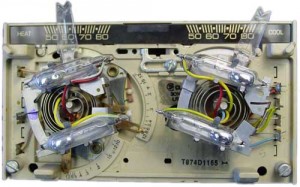
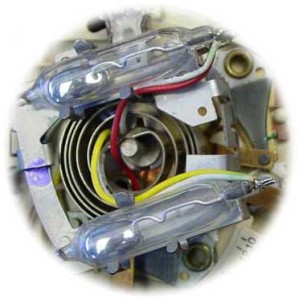
    For example in an old-style mercury thermostat, the state changes from “on” to “off” to “on” again. The way it does this is through a process of feedback between the temperature of the room and the curvature of a bi-metallic strip. When the temperature is too cold (given a specific calibration point to begin with), the bimetallic strip curves in on itself, causing mercury (a conductive liquid)to fall to one side of its containing vial, where it closes an electrical circuit, making the heater go on. When the temperature is warm enough, the bi-metallic strip expands and causes the vial to tilt the other way, so that the mercury ends up in the other side of the vial, breaking the circuit and causing the heater to go off. Wash, rinse, repeat, over and over.

    This is the ‘classic’ case of a feedback system. The system of the room+thermostat includes a feedback “mechanism” by which information ABOUT the “state” of the system is influential in determining the BEHAVIOR of the system. But there is something arbitrary about thinking of the system as composed of a room and a thermostat. We could divide things up into any number of different configurations, which would give slightly different perspectives on the whole. For example we can distinguish the temperature of different volumes of air, the internal components of the thermostat, the volume of air in the heating ducts and their placement, etc. “The thermostat” and “the room” are just cognitive shortcuts for more complex interrelations that, on the one hand, can be usefully summed up by such shortcuts, but which on the other hand deflects awareness from the process by which the making of the distinctions occurs, and its interactive, contingent, on-going nature. This is a general issue that crops up around epistemology.

    Exploring a bit further, it would then seem that if we take such an idea to heart, it becomes much more difficult to speak of “levels” that are clear and distinct (to borrow a pithy and dangerous phrase from Descartes)–for the basis for any such distinction is some clarity about difference, and the basis for clarity is the distinction of difference. Alchemically, this is like the operation of precipitation, where a flowing, dissolving, ever-changing substance becomes punctuated by moments of particularly which separate themselves off from the activity of being-in-process with the rest of the solution. Identity becomes not only possible but fitting: here we have the formation of a crystal. It is here, it is this size, it is moving like this, it is not any of these other equally separate and identifiable crystals. (In terms of the alchemical language of process, this is the Earth element at work.)

    In other words, the concept of feedback works well by virtue of its implicit reliance upon the tendency to make distinctions in complex wholes: this “part” of a system and that “part” of a system, this “state” at one time and some other “state” at another. Such distinctions may represent an a-ontological punctuation of difference within a field of activity that admits–without the activity of the distinguisher–of no such intrinsic difference. That is to say, distinctions have a certain amount of… freedom to them. Our distinguishing of one state or part of a system may not be rooted in some kind of ontologically independent “reality” which can, on its own hold up the validity of that distinction. Such validity always requires the situated contextuality of the distinguisher. (In terms of the alchemical language of process, this is the element of Water at work).

    Thermostat detailOne can think of the thermostat/room system as a homeostatic one, which brings the room temperature towards some specific target through negative feedback. But this ‘stasis’ is somewhat illusory; it is accomplished by continual change. No matter how the system is constructed, it is change that creates the stasis. So it’s more accurate to think of the thermostat/room system as evolving around a cyclic attractor, where the temperature regularly fluctuates above and below a certain average (the ‘target’ temperature). It is also the stasis that creates change; the curling and uncurling of the bimetallic strip can only occur if the ambient temperature has some aspect that is constant (in this case, that the temperature STAYS above or below the target value–you’ll notice that this is a case of higher-order constancy, a constancy that is possible on the basis of change that maintains a difference).

    So we sometimes make a distinction about levels: on a ‘higher’ level the system is essentially constant, while on a ‘lower’ level it is continually in flux. But again these are cognitive shortcuts for interweaving processes which do not admit of such self-distinction. The ‘levels’ are identified BY us FOR us. Just as the identification of ‘states’ is contextually contingent and not necessarily ontological, so it is with the identification of ‘levels’.

    This is not to say that our distinctions are completely unguided or arbitrary–because we can’t overlook the fact that we ourselves are involved in any system by virtue of our interaction with it. Even if we are ‘just looking’ at a system, we cannot but help look with eyes that see only particularities that evolve with our ability to distinguish them. Even our seeing is cybernetic, involved in recursive looping between the ‘out there’ and the ‘in here’. The seeing is not either ‘objective’ or ‘subjective’, but partakes of both aspects, being guided by outer processes and inner processes simultaneously, and which affects the ‘seeing system’ in multiple ways, some of which may be inconsequential, and some of which may make all the difference in the world.

  • Francisco Varela and Ethical Know-How

    Francisco Varela and Ethical Know-How

    This post is about bringing forth a different way of speaking about ethics, which is usually bogged down with a load of ridiculously unquestioned Western philosophical THOUGHT baggage, which keeps ethics locked nicely away in principles which themselves are never acted, only known.

    For this reason, Varela’s idea that perception is based in ACTION is profound.  Passive perception is not possible – we are not capable of being ‘only’ receivers; we are always embedded in our perception through its enactment.  This enactment helps co-create the very world that is perceived through its selection — through recurrent sensori-motor feedback loops — out of the infinitely vast number of possible ways to perceive.


    THEN: Thoughts are not divorced from the world either, but arise from the recurrence of sensori-motor feedback loops — the very same loops that constitute the enactment of our perception and the (re/co)discovery of the world, now not only perceptually, but CONceptually. The ability to perceptually guide action leads to the formation of CONCEPTS.  !?!?!?  “The cognitive self is its own implementation: its history and its action are of one piece.” (p. 54)

    Hence: “experience both makes possible and constrains conceptual understanding across a multitude of cognitive domains.” (p. 16)

    This provides the lynchpin by which Varela connects cognitive science to ethical know-how.  The coupling between self-world-percept-concept that occurs within our sensori-motor feedback loops provides a habitual basis for our future interactions with ourselves and the world.  We are autopoetical morphisms arising spontaneously in a given environment out of the evolving background of previous sensori-motor-cognitive couplings.  We continually enact our enactment… Varela calls these microworlds and microidentities, because they are completely context-dependent; the type of action, the mode of thinking, the quality of sensation: all these are predicated on their past instantiation.

    For this reason it is not enough to ‘think about’ ethics, for ethics can never be divorced from the acts which constitute it.  Each microworld calls forth something new (or something old) from our microidentities, just as our microidentities uniquely call forth new microworlds.  But to speak of microworlds and microidentities is too reifying.  There are no such things, as Varela well knows.

    Nevertheless, ethics requires cultivation.  We are gardens in which seeds for ethical know-how must be planted and grown with care; we cannot depend solely upon the coupling strategies we have inherited from our own past.  Cultivating ethical know-how is synonymous with the dispersal of our reliance upon these very couplings through the realization of their emptiness.  We move from unknown knowing to known knowing, and onward to unknowable knowing.  To get there (where there IS no there), requires practice.  Not practice of injunctions, but of their essential dissolution into the same emptiness that the self no longer occupies.

    How does this relate to ethical action? By allowing it to make its appearance out of the uniqueness of the moment.  When we are full of everything that we have been, we obscure what we might be; because we always encounter more in the world than we have put there ourselves, it is not enough to remain oneself.  By practicing the pattern of patternlessness, we become keyed to the unfolding of the uniqueness of the moment.  It is a paradox: we must habitute ourselves to ahabituation, we must practice not practicing…