It's Elemental

Tag: Eyes Ears

  • Projective Geometry – Harmonic Points Sequence

    Projective geometry offers a window into the human soul — not as a mere analogy, but directly: projective geometric processes are manifestations of the same archetypes that work through and within human experience.

    Doing projective geometry is to move your soul in accordance with these archetypes, and in so doing you start to train your soul so that it can begin to perceive the movement of these archetypes both in your own soul and in the world-processes around you.  In effect, projective geometry offers a path towards the development of organs of perception that operate not primarily in a physical way like your eyes or ears, but in a more subtle realm.  The development of these soul-organs opens up new realms to your perception, just as if you were in a dark room and then someone turned on a light: now you can see depth, color, and form, where before these were literally non-existent for you.

    In this spirit, I offer the following sequence of drawings that illustrate one process in projective geometry: that of Harmonic Points.  I suggest, before looking further, that you examine and follow the constructions on your own in this post:

    Harmonic Points and Lines, a Projective Geometric Exercise

    Once you have sufficient experience with the above, feel free to examine the following drawings.  Note the context given in this post and the above linked post, and see if you can discern, as an exact soul-perception, the moving gesture that accompanies the sequence, paying special attention to the ‘unique’ moments of the transformation.  Feel free to reply in comments to this post about your experience!

    Note: the drawings have been placed on a separate page, so that they can be presented unencumbered by the limitations of the blog theme.
  • Organs of Perception

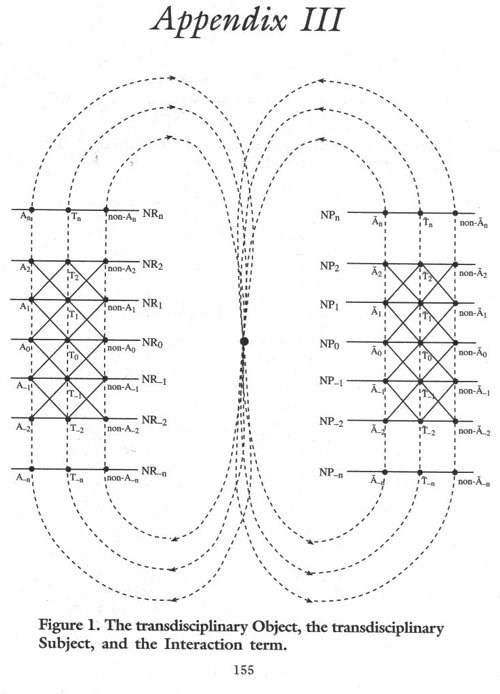
    Basarab Nicolescu is a physicist and proponent of transdisciplinarity.  In the book of the same name (which he edited), he speaks of multiple “levels of Reality”, which are accompanied by multiple “levels of perception”. These two complementary duals form, on the one hand, what he calls the “transdisciplinary object” and on the other the “transdisciplinary subject”.  These are united by a flow of “nonresistance to experience” he calls the sacred, which moves through all the levels.  See the picture from his book below:

    Transcendent Object/Subject and Sacred
    Transcendent Object/Subject and Sacred

    Although this view is a bit schematic, one of the things that Nicloescu includes which is often very lost in modern discussions about these sorts of things is the necessity for a corresponding “level of perception” when encountering various levels of reality.

    Specifically, this is something verifiable in my own experience: that it actually takes not just some kind of intellectual shift to see things from a new perspective, but rather the rhythmic development of new organs of perception in order to perceive new realities.  I’m speaking of ‘organs of perception’ because they are strictly analogous to real organs like our eyes and ears, but without physicality — they are, if you will, organs made ‘on the fly’ in the soul, which are capable of resolving details in a situation that otherwise would be lost.  Their constituency relies entirely upon the way in which they are themselves created — they form in the image of what they can thus perceive.  For example, a Waldorf teacher I know has developed in her contemplative work with children a soul-organ which can perceive movements of ‘warmth’ in ways that offer specific and practical information and actions regarding individuals — this is something experienced as eminently real and subtle, which would be lost on anyone who hadn’t done the same rhythmic work to create the relevant capacity for experience to hold that kind of perception.

    It seems we often expect that such perceptions should be contingent upon a primarily intellectual shift in understanding — and an understanding of outer phenomena in particular — as if it were only a question of having the right ideas about things that would allow us to perceive newly.  I think this is an error;  that kind of change is only preparation and accompaniment, but cannot fully constitute the necessary basis for actual perception of new realms.