This essay outlines connections between the Elemental Cycle as an archetype of transformation, transdisciplinarity, and cybernetics. A number of questions are addressed: the nature and importance of connecting these fields, an examination of resources and the dominant disciplinary discourses for the associated fields, and a critical examination of my assumptions, beliefs, and position.
Introduction
How often do we find ourselves in a position of not being able to see something unless it is first pointed out to us? This happens all the time with the visual and other physical senses, but of course also occurs in our thinking; certain concepts seem to hide in plain sight, and unless we are cued into where and how to look for (or to think about) them, they slide on by as a part of the undifferentiated background of conceptual life. Usually we are introduced to these sorts of concepts just like we are to new people, through a third party who is already familiar with each of us: “Seth, I’d like you to meet Recursion; Recursion, this is Seth.” Often with this sort of introduction comes an experience: “Oh hello Recursion! You know, I feel like you must hang out at some of the same coffee-shops as I do, but we’ve never been formally introduced.” And so a relationship begins with a concept, and just as with human beings, you can become more intimate and familiar, get into fights, seek new levels of understanding, and go on adventures. (more…)
2. Does the fractal model also work for dynamic, fluid or changing shapes?
Yes, in fact this is it’s most ‘natural home’ I think. The reason is that fractals are about processes, not things, and processes are just that: descriptions of changes, not of things, and changes have a way of, well, being DIFFERENT the next time you look at them. So there are ‘orders’ or ‘levels’ of change, described by the number of levels of description required to get to the point where the pattern is invariant.
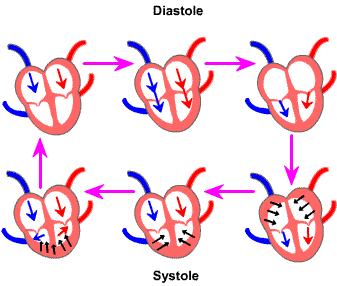
Your blood is constantly changing (systole, diastole), at this level of description there is no constant, because your blood pressure is constantly changing (lucky for us, or we’d be dead!). But at a higher level of description you get a pattern (high pressure, then lower pressure), that is invariant. You don’t get a systole and then another systole, or a succession of diastoles; they alternate. But this alternation is not constant either! The extent of the systole/diastole is ALSO constantly varying (also lucky for us, because this change, linked to what is known as ‘heart rate variability’, is strongly correlated with heart health), so it requires ANOTHER level of description to see how that is changing… and so on. At each level something ‘stays the same’ while other things ‘constantly change’. When we talk about change and constancy we have to be careful because we can never fully isolate one from the other; they are completely intertwined ‘all the way up and all the way down’.
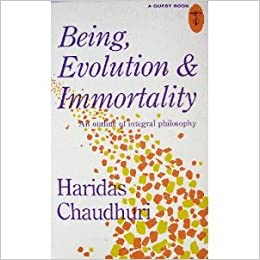
My general impression of this work was that Chaudhuri was writing in a very philosophical style about a topic which is far more than philosophical. The extent to which he took pains to delineate some various philosophical perspectives so that he could present the viewpoint of the integral yoga surprised me; I’m not sure exactly what I was expecting, but I kept feeling like I was back in my undergraduate philosophy program, reading and comparing different works. The intellectualism that accompanies the philosophical world has some excellent and unfortunate consequences.
In the case of this book, I felt that on the one hand it provided a strong case for the philosophical underpinnings of the integral yoga, which can be useful for those who work through and towards the difficult topics he discusses in an intellectual way. By doing this, it can be possible for the intellect to contextualize the various meanings and approaches to things like the Divine, to the Non-dual, Being, the Absolute, and so forth, in such a way as to allow the rest of the human being to begin to find a way of moving with the material at a different level. I find that sometimes the intellect, lacking this context or ability to engage, results in either an over or under-attachment to the real content that is attempting to be addressed through philosophical language. In other words, the philosophical nature of the presentation calls forth the part of ourselves that is capable of dealing with the concepts in a direct, wakeful, conscious manner, which helps to mitigate either sympathetic or antipathetic reactions which may otherwise arise in its absence.
On the other hand, presenting material like this through a philosophical standpoint also lessens its potential impact by restricting itself to a style of address whose major target is the mental part of the human being. This is true even if the content of the words include ideas like love, goodness, and so forth; what comes across is often only the shell of an experience, rather than words designed for the immediate evocation of the experience. This is not so much a criticism as just how things like this often go, because we can only write and express so much through words without seeming almost schizophrenic. It seems that Sri Aurobindo, the major synthesizer of Integral Yoga (in concert with The Mother) worked on both sides of this issue, writing both intellectually and poetically as the need arose.
In reading Being I felt like I was assuming the posture of a bird in flight, soaring over a vast landscape and beneath an even vaster sky. I had the sense of swooping down occasionally towards the Earth, or of straining my wings to fly ever higher… but never did I feel either truly connected to either the Earth or the Heavens, but rather somehow suspended in between, almost as if in a strange form of limbo. I really wanted Chaudhuri’s discussion to find much more direct and explicit contact with experiences and realities of daily life. There were a few moments where he began to speak along such lines, but I felt that he continually abandoned routes that would have put him in real connection with the “world”. This is to say that his language had a tendency to be either vague, general, or simply descriptive of classes (or classes of classes) rather than elements of classes. Take almost any paragraph as an example; these are pulled from a random 5 second search:
(Tending towards Heaven:) “Spiritual nondualism is inspired by the concept of the Absolute as supermind. The supermind is the sovereign dynamism of ultimate reality. it is the creative light of Being. It is the all-embracing consciousness, nondualistic in structure.” (p.60)
(Tending towards Earth:) “Immortality is an attribute of enlightened consciousness. All men therefore have the potentiality of immortality by virtue of their consciousness. When the personality of an individual is harmonized and integrated, he attains enlightenment. He gains insight into his existential oneness with the all-encompassing Being. The veil of ignorance and separative consciousness is lifted from his eyes. Feelings of fear and insecurity, anxiety and personal unworthiness, are overcome. There is an enlargement of Being and joyful participation in the life of the Infinite. In one word, an individual experiences immortality here and now.” (p. 139)
In the first case we have what may be the normal limit of intellectual presentation: pointing at the moon. Were he to go further he would likely need to adopt a completely different style, and for the purpose of a survey work, this may be too much to ask. In the second case, although Chaudhuri is speaking about experiences that concern the transformation of the human being from existing in an ‘everyday’ state to one that exists in constant transformation and unfolding in the light of the Divine, he never gives much more detail than is apparent here. It’s hard to describe, because it is difficult to have clear and exact words about vagueness, but I get the feeling that almost the entire bottom foundation of the integral yoga is just missing from this book. How exactly does one practice integral yoga? What does the student encounter along the way? What exactly is happening to the student when his or her consciousness begins to transform, from the perspective of the multidimensionality of the human being, and how does this relate to advancement along the path? In other words, having read this book, I do not feel I have any clear answers to these questions.
Not knowing the context around the genesis of this book, it’s hard to know why he chose to approach it as he did, but he must have had a particular audience in mind. I keep having to remind myself that this was written around 1967; I wonder how he would have approached the same central task today? Nevertheless, as a philosophical outline it succeeds admirably, and this is ostensibly (given the title) its major purpose, so I would definitely call this book a succes.
A friend of mine pointed out that Chaudhuri puts forth a certain strength in the presentation of ideas about things which are more than ideas, given an impression that “this is how it is”, with no room for argument. I have a sense of how this happens (although whether this describes Chaudhuri’s case I have no idea, I’m only providing this perspective as my own). It’s not so much that the often absolutist tone of the presentation is meant to discount or override any alternate conception so much as it is an expression of the minds inability to fully conceptualize the extent of the topic that it is dealing with. This results in the mind reaching its limits; our words too, reach their limits. The experiences that lie beneath the philosophical considerations, and which give rise to them, although having a ‘word-like’ nature (logos), are not words in the normal sense. Thus all philosophical expression, when placed in service of what lies forever beyond it, can only be a sort of veil that covers what is otherwise unknown. But in the process, the veil assumes a certain shape, and certain tendencies for motion, as it falls lightly or heavily across the Mystery. Good philosophical discourse will be like a supple silk, capable of shifting delicately in response to its wearer (the Divine, or Being in Chaudhuri’s case) without either falling off, being too transparent and thus difficult to see, or too thick as to obscure what lies beneath — all while remaining self-connected, strong, and breathable.
But once a fabric is chosen, certain limits are necessarily adopted. In other words, getting into the frame of mind in which the human being is pouring attention into the intellectual contextualization of spiritual topics leads the mind into areas that it would not otherwise go; it is creating a space and exploring it at the same time, on the one hand coming up against its own limitations while discovering its own movements through a kind of self-necessity (in the clearest cases, this is expressed as “logic”). (Re: p.48, “Thought is not a mere process of mirroring. It is a creative function. In distinguishing definable features of reality, it also creates them in a profound sense.) Once certain choices have been made as regards to the style of approach, much of the rest ‘falls out’ in a way that is unavoidable; when standing within the perspective it seems directly and manifestly obvious that specific conceptions require a certain kind of expression. It just seems natural. So we end up with things like: “[Ideas] are not unalterably fixed truths.” (p. 49) and “The truth is that Being is multidimensional.” Each statement is formed and expressed from a perspective which gives rise to the necessity of each, while taken together they indicate that the chosen approach is self-limited (for those of you that are familiar with Goedel’s incompleteness theorem, this is an example of how it occurs linguistically).
This post is already too long, but this gives some general impressions. There are many details that I have comments or questions about, but I’ll leave these aside. I can add in closing that the philosopher in me found this work engaging, and it invites much in the way of philosophical discussion. For example, he has a tendency to simply state, almost by fiat, that such and such divisions or dualisms expressed elsewhere are overcome or united within integral nondualism… but the philosophical details he gives to back up his claims are far less detailed and clear than I would like them to be. I suspect this also may be due to the introductory nature of the work, and he has others which hopefully fill this gap.
Much is owed to the ideas of Thomas Kuhn and his thoughts on science, which rightfully and helpfully recontextualize the practice of science in light of wider realities of human complexity. However, flowing out of postmodern trends, it is easy to then think of science as completely relative and just like any other knowledge domain. Similarly, those interested in alternative ways of knowing, such as mystical, shamanic, and spiritual, may make similar claims, pointing out that science is heavily dependent upon processes that are not as objective as we once assumed.
This is all well and good, a necessary stage on the path to a wider and deeper way of knowing that is not restricted to any singular method now present. I would therefore like to offer, on one side, something of a picture of science that is less characterizational and hopefully more subtle than might often be found in the debates surrounding this issue, in an attempt to keep us from overcategorizing and oversimplifying what are very complex and subtle realms.
It is true that there are limits to the practice of science: personal, cultural, psychological, economic, etc., and that these limits do have some relationship to the content of the science performed. However, the claims concerning the complete relativism of scientific knowledge are too strong. The arguments which support that view are selective and do not do justice to the features that make scientific knowledge different than other forms of sociologically constructed knowledge.
In the first place, we must be clear that the knowledge claims made by science are always and intrinsically (if not explicitly in their actual communication) tentative, at least to some extent. Science makes no claims to absolute knowledge beyond all possible modification; rather it offers conceptualizations that are continually taken through a highly refined process whereby those ideas that have the support of the greatest diversity and depth of experimental and logical lines of reasoning are held to be the most likely version of events.
Key to this process is the continual and purposeful reintroduction of the possibility for falsity through experiment. Kuhn is able to write his critique of science preciselybecause science is built to overturn itself. It is this very feature which allows it to continue its almost complete dominance in providing practical, testable, and predictiveknowledge claims concerning the physical world. Such dominance is not simply a measure of cultural values, although these play a part. Rather, its dominance is due %(primarily) to the fact that it provides a method for the generation of ideas which have direct, testable links to patterns in human experience. In other words, it works; it suggests solutions and provides a foundation upon which such solutions can be approached.
Science has a firm basis in empirical experience. It is true that were human beings constituted differently, with different sensory capacities, we would experience the world quite differently. However, to say that these differences would lead to a radically different set of ideas about the nature and operation of the world at a very fundamental level is not only not necessarily true, but likely simply wrong. Indeed, one of the reasons for the continued demonstrable power of the scientific process is precisely that it is capable of moving beyond human sensory capacities to a more general set of relationships between abstract properties (say, the property of quantum spin). We are capable of forming new ideas which, through their connection with other ideas, leads to propositions which have definite, falsifiable results in a public arena. Every time a new idea is tested experimentally and not found to contradict predictions, evidence for the validity of both the individual idea and the underlying connections the formed the basis for the new idea in the first place mounts. This does not mean that such an idea is taken to be absolute or objectively true; rather, it means that until we have a better idea, which has more explanatory and practical value, there is no sufficient reason to not use this idea as a foundation for the continued process of scientific exploration. Whether or not the idea is “true” in some ultimate sense is, frankly, beyond the scope of science. Unfortunately, it is the misunderstanding of this subtle point upon which much of the criticisms of science are based. Equally unfortunately, even plenty of scientists seem to live under the same misapprehension, at least unless pressed, so the error is widespread.
It bears pointing out that the process upon which science relies does not restrict science to exploring only physically testable propositions. The scientific process lends itself very well to a study of the material world, but is in no way limited to this domain; it is founded upon an epistemology of human experience, not an ontology. For this reason, the content of any idea is potentially amenable to scientific exploration, including ideas that arise from experiences that are considered spiritual in nature. The question is not whether the content of the ideas link directly to any material conception, but rather whether or not it is possible for the ideas to be falsifiable, repeatable, and capable of being linked coherently to the content of other ideas which enjoy the same benefits. It is one of the most powerful features of science that ideas which do not fit this description are not held up as representing scientific claims to knowledge. In other words, unlike many other disciplines, the criterion for selection of scientific ideas is very strict. This results in both a vast arena of ideas that are simply not capable of acting in a scientific capacity (“Betty Crocker has the best cookbook”), while at the same time requiring more robustness of the ideas that are admitted (“two masses attract each other in exact accordance with their relative masses, the square of their distance from each other, and a ratio which is constant in all situations”). Thus, scientific knowledge achieves a level of generic applicability that far outstrips knowledge claims made by (arguably) any other discipline that claims to produce knowledge.
Science concerns itself, in the broadest way, with questions concerning the nature of the universe, its parts, their behaviors and interrelationships, and the discovery of patterns that are thus manifested. The fact that we do discover — I emphasis discover even though arguments have been made to the effect that all discovery is invention — regular patterns in our directed experience of the world is remarkable. Even though the perception of these patterns requires some very particular sensory apparatus, the patterns thus revealed do not seem to rely solely on the particular approach made to them. Thus a more generalized concept is reached which links a variety of different avenues of evidence into a coherent whole which has consequences for each of the various domains which it touches. Most often this takes the form of mathematical relationships, but not always.
It should also be admitted that the scientific process is restricted to those parts of the universe which can submit themselves to conceptualization in the human mind. It is simply beyond the capacity of science to reach into non-conceptual domains, although these may very well be part of human experience in general. At the same time, it is not therefore the case that science cannot say anything about such experiences. This would only follow if it was the case that there were no links between such experiences and the parts of the universe which were amenable to conceptualization. Whether this is the case or not is a question for metaphysics, or perhaps for direct spiritual apprehension, but certainly not for science. But it is precisely on the basis of these non-scientific types of perception that the likeliest answer to this question is that such linkages do exist, and that the universe is vastly interconnected amongst all its levels. In this case, science can serve as a supplementary support to experiences which lie outside its normal domain, by offering up to such experience the relationships and patterns that are found to hold in its more restricted domain.
For this reason, science and spirituality indeed can — and even must — live together in mutual support. It is always possible to hold a different paradigm, with different knowledge claims and a different epistemology, and within such different systems the world appears differently. However, despite the relative and contextual nature of differing epistemologies, it is not therefore necessarily valid to say that all epistemologies are ‘essential equal’, which is the same thing as saying that they are all equally arbitrary. For some purposes, chosen by human agents, some epistemologies are vastly superior to others.
Just as science has real difficulty in dealing with experiences that do not have a strong or identifiable basis within the physical part of reality when compared to metaphysical or spiritual systems, so too metaphysical or spiritual systems have real difficulty in dealing with the very obstinate details of physical experiences. Each tends to shuffle the claims of the other into a sort of quarantine bin, where it is dealt with in a way that does not do justice to the depth and breadth of the other’s experience. It is very difficult to coherently cross this dissolute but entrenched lined: the bulk of our scientific knowledge does not come from meditative or transcendent experience, and the bulk of our spiritual knowledge does not come from scientific experience. Of course claims can be made that, in India in particular, something of a spiritual-science has been more or less continually developed for thousands of years, but the object of this type of science is quite far removed from the goals and achievements of modern science. The point is simply that as advanced as any system of spiritual science might be, none has yet produced knowledge claims that are as far reaching, inter- and intra-coherent, evidentially supported from multiple, diverse disciplines, and practically efficacious as that produced by modern science.
I wonder about the extent to which dichotomous thinking is either hard-wired or at least dependent on completely non-social forces. It seems almost to be a thermodynamic question, that is, a question of trying to optimize the amount of energy spent in thinking for a given situation. Thinking is a very expensive activity, physiologically speaking – it is essentially a catabolic process which relies upon the breakdown of molecules for their energy.
Evolution isn’t usually needlessly extravagant – in fact it’s kind of lazy, if you don’t mind the anthropomorphism. It seems that in a broad sense, there is a sort of law of diminishing returns for the energy investment required for thinking. In other words, if you encounter a situation in which some kind of action or distinction is called for, you get the most bang for your buck by quickly assessing things according to an either/or model. Identify one aspect, which automatically calls up some kind of opposite, and make a determination on the basis of this division. It’s quick, dirty, and effective for generating actions, feelings, and new thoughts. If the feelings, actions, etc. that result from this distinction are ‘good enough’ then there is little reason/pressure to continue the act of thinking about it in a way that calls into question the basic assumptions of the underlying duality. In other words, it’s easy to make and maintain the most basic of distinctions, those of duality.
So it seems to me that it is largely social factors that mitigate this tendency. Trying to think through the layers and layers and layers of connection that inevitably describe EVERY situation is simply not practical energy-wise, and thus requires very significant counter-pressure for its activation. We must run into situations in which our original duality is experientially shown to be inadequate for there to be a commitment to another round, or three or ten, of thinking over and through a given situation. At some point things seem to just get too complex and we give up, and the point at which we abandon the process relates to the level of depth and complexity we are able to experience.
This is why I really like Kwame Anthony Appiah’s appeal to respectful experience with people not like us, i.e. through conversation: “Conversation doesn’t have to lead to consensus about anything, especially not values; it’s enough that it helps people get used to one another” (Appiah, 2006, p.85). At a very basic level, time spent with others presents us with countless variations on the experience of discovering that our implicit or explicit distinctions are not always shared. This presents (often, but maybe not often enough?) a kind of social pressure to go through a second round of thinking about our primary distinctions, the effect of which at least sets up a greater likelihood that we can ‘get used to’ differences which before were causes for anxiety.
In any case, it seems that there is a certain amount of ‘going against the biological grain’ required to produce people like Morin, Bernstein, or Appiah. Luckily it’s not all biology! Of course, applying this little analysis to itself, I should be wary of relying upon the duality of biology/sociality, because, following Morin, ‘it isn’t quite that simple’. Round 1 over.
 Abstract