Are you fascinated by the beauty of forms in the natural world? Do you sense something amazing at work out there, like an intelligence that lies just beneath the surfaces of things? Then I invite you to read a new essay that explores the building of a new aesthetic consciousness that seeks to connect us with natural processes in a way that is truly transformative. I follow threads from alchemy into the genius of Goethe, and end with intimations brought forth by Rudolf Steiner, and even include some home-made animations as a part of a practical exercise for you to work with. You are invited to come and participate in opening a new set of eyes…
The problem and the solution share an epistemological context, each helping drive the other.
Second ‘phase’ (to the right): In this context ‘more of the solution’ creates ‘more of the problem’ through a symmetrical relationship. The SAME problem is produced by the SAME solution. No real transformation is forthcoming from within the system, because it perpetuates itself from both sides.
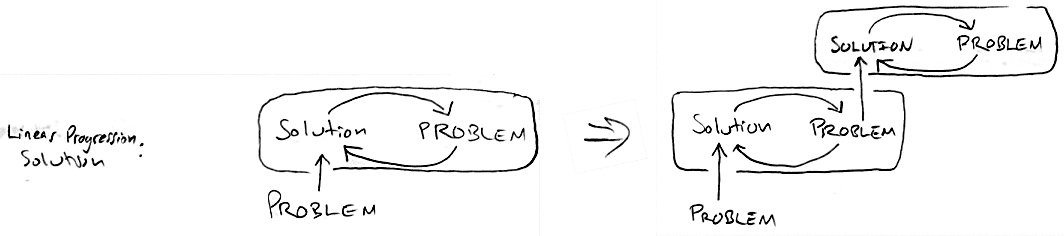
Linear-Progressive Solution:
Linear-Progressive Solution
A solution to a problem is found that does not perpetuate the original problem, but this creates a new problem (or problems) of its own, likely at the same level (with the same form) as the original, although with different content or within a different arena (problem ‘leaking’).
Second ‘phase’ (to the right): This leads to a potential proliferation and regress of problems, because the epistemological context is never addressed at any level. DIFFERENT problems are produced by DIFFERENT solutions OF THE SAME ORDER. Transformation is possible but likely occurs with great difficulty and haphazardly, if at all.
Second-order Solution:
Second-Order Solution
The epistemological context of the first order is seen as problematic, becoming the basis for a second-order solution that relies upon different epistemological distinctions. It is “second-order” because it explicitly recognizes the cyclic recapitulation of the first-order problem-solution system’s epistemological distinctions, and chooses not to participate by making different distinctions. Thus the problem-solution system becomes a new problem that is of a directly higher order.
Second ‘phase’ (to the right): The solution to the original problem-solution system creates a new problem of a higher order (this would be the third-order problem), necessitating the uncovering of the epistemological limitations in the second-order problem-solution system (which now becomes the third-order problem). HIGHER-ORDER problems are created by HIGHER-ORDER solutions. Continuing in this way leads to higher-order levels of recursivity, but after only a few levels a practical limit is reached, and the system becomes to expansive and diffuse to affect transformation by itself.
Simple Multivariant Ecology of Solutions:
Multivariant Ecology of Solutions
In an example of a more realistic (and complex) setting, a problem may be addressed with a “problematic solution” while at the same time efforts are made to seek a solution of a lineal type, which may create its own problem while being taken at the object of a second-order solution.
Second ‘phase’ (to the right): The system of systems can evolve as a self-embedded ecology, where new opportunities for feedback become inevitable. The network continues to evolve, involve, devolve, and revolve, all at once.
Projective geometry offers a window into the human soul — not as a mere analogy, but directly: projective geometric processes are manifestations of the same archetypes that work through and within human experience.
Doing projective geometry is to move your soul in accordance with these archetypes, and in so doing you start to train your soul so that it can begin to perceive the movement of these archetypes both in your own soul and in the world-processes around you. In effect, projective geometry offers a path towards the development of organs of perception that operate not primarily in a physical way like your eyes or ears, but in a more subtle realm. The development of these soul-organs opens up new realms to your perception, just as if you were in a dark room and then someone turned on a light: now you can see depth, color, and form, where before these were literally non-existent for you.
In this spirit, I offer the following sequence of drawings that illustrate one process in projective geometry: that of Harmonic Points. I suggest, before looking further, that you examine and follow the constructions on your own in this post:
Once you have sufficient experience with the above, feel free to examine the following drawings. Note the context given in this post and the above linked post, and see if you can discern, as an exact soul-perception, the moving gesture that accompanies the sequence, paying special attention to the ‘unique’ moments of the transformation. Feel free to reply in comments to this post about your experience!
Note: the drawings have been placed on a separate page, so that they can be presented unencumbered by the limitations of the blog theme.
WARNING: PROJECTIVE GEOMETRY MAY PUT HOLES IN YOUR BRAIN. YOUR MIND MIGHT LEAK OUT – IF YOU WANT YOUR MIND IN YOUR BRAIN STOP READING NOW.
Okay, here is a geometric exercise that I find very interesting (for some context about WHY it is interesting, look here).
It is, however, more complicated than the previous one and will likely require you to actually take out a pencil (not a pen, please, and go for mechanical – 0.5mm lead… do it for me), a ruler, and unlined paper.
HARMONIC POINTS – Phase 1
The short setup first, then construction hints, then process, then comments:
I’d like to make a contribution with regards to circularity/linearity, from a geometrical standpoint. If you don’t like geometry, stop reading, or better yet, read with increased intensity.
The polarity between circle/line is one that is fundamental to many geometries – they are taken to be quite different logical entities. Primarily this arises because of (in a move parallel to Russel’s need to introduce the Theory of Types to avoid paradox) a limited way of dealing with infinity. Cybernetics shows us, by providing a wider view (attention to relations, recursions, and thus relations of relations, etc.) that the Theory of Types is unnecessary and points towards a more flexible and mysterious understanding of paradox. In the same way, projective geometry provides a way of dealing with infinity that encompasses, expands, and re-frames the conventional geometric view. (more…)
 Are you fascinated by the beauty of forms in the natural world? Do you sense something amazing at work out there, like an intelligence that lies just beneath the surfaces of things? Then I invite you to read a new essay that explores the building of a new aesthetic consciousness that seeks to connect us with natural processes in a way that is truly transformative. I follow threads from alchemy into the genius of Goethe, and end with intimations brought forth by Rudolf Steiner, and even include some home-made animations as a part of a practical exercise for you to work with. You are invited to come and participate in opening a new set of eyes…