Every moment of transformation enacts an epistemology. Part of what it means to be human is to have the potential to awaken to this fact, and more: to recognize that the recognition of the inescapable relation between action and epistemology leads to the unfolding of a life-long quest and question: how do I know? Exploration of this question, always implicitly present but seldom asked, yields consequences for the entirety of human life, from the most mundane actions to the deepest soul struggles. Once one sees that it is impossible, as a living system, to escape epistemological concerns at even the most trivial level, such concerns form an ever-present background to the unfolding of one’s life. (more…)
Tag: evolution
-

Thinking about thinking about feedback
Ok I’ve been thinking about feedback.One thing that struck me as interesting was that feedback, as a concept, seems to assume two things (and probably more): 1) step-wise time (and thus some kind of “state” in which a system can be identified, and thus 2) some kind of ‘levels’ within and between systems, in part based on their “state”.
So feedback, at least in the way that I’ve been thinking about it up to now, is this idea that state A of a system precipitates state B in some way, but that state B has non-trivial links ‘back’ to processes that help create state A. But of course because we are talking about the evolution of systems, this idea of ‘back’ may be better understood inversely, as ‘forward’, in the sense that there is a real distinction between state A, state B(sub-A), which is the state of system B-as-influenced-by-A, and then state A(sub-B,sub-A) the state of A-influenced-by-B-which-is-already-influenced-by-A…. And this goes on, so we have something more like a system-of-relations (S) at various points, which are distinguished by virtue of the feedback relations between its states A and B.
Here’s an attempt at a table explicating the pattern of what we mean by “feedback”:
S1 A
S2 B(A)
S3 A(B(A))
S4 B(A(B(A)))
S5 A(B(A(B(A))))You can see the pattern unfolding infinitely — the thing is that when we think about it in this way, the pattern that is unfolding is one that does so on the basis of these ‘moments’ (S1, S2, …). But these moments are always arbitrary; there doesn’t seem to be any ontological significance to them outside of the context of their actual identification by someone thinking about cybernetics. Our knowledge of the system becomes apropos when we question it, when a need for knowledge arises… and not otherwise.
If this is true, it’s kind of misleading to have the idea of “a system” that exists “in a state” and that this state influences some other system’s state, and so forth. It’s too reductive… and it seems to fall prey to Whitehead’s fallacy of misplaced concreteness. (Others familiar with quantum physics, and specifically the Einstein-Bohr debates may see some parallels with this line of thinking.)
When thinking about TIME and evolving systems, we run into some serious complexities, because different information flows through a given portion of a system at different rates depending upon the nature of that part of the system and the nature of the information being carried. Heat flows at one speed through a specific material, at another speed through another material. Information carried by light moves still differently, as does linguistic meaning, different types of sensation, etc. etc. etc.. Just about every ‘channel’ of information has its own unique set of variables in this regard, so there is no way to divvy up a given system into “state A” or “state B” with complete certainty, because at any arbitrary snapshot point, an important bit of information from one part of the system might be ‘on its way’ but not yet resulting in any modification elsewhere in the system in a significant way — in other words feedback has an analog character. We can create digital systems in which feedback appears to operate step-wise, but this is always an oversimplification… (perhaps not if we get to the quantum level, but even then I have a suspicion that something, perhaps not either analog or digital, has a role to play in what is now left out of the loop entirely, i.e. is attributed to ‘randomness’). In any case any macroscopic digital process always (?) includes analog processes (on higher and lower levels). The point is that it is misleading to speak of “states” at all.
So what? Well, our very ability to speak about feedback seems to presuppose a conceptual reliance upon “states”. Hmmmmm. What if we got rid of “states” and started to look more at the processes? What if we slipped out of the subtle reification of “statehood” and into the flowing of flows? The processes of processes? It seems then impossible to consider anything but the whole; everything is a whole, evolves-as-whole, is-always-whole-ing, and never ‘just is’.
For example in an old-style mercury thermostat, the state changes from “on” to “off” to “on” again. The way it does this is through a process of feedback between the temperature of the room and the curvature of a bi-metallic strip. When the temperature is too cold (given a specific calibration point to begin with), the bimetallic strip curves in on itself, causing mercury (a conductive liquid)to fall to one side of its containing vial, where it closes an electrical circuit, making the heater go on. When the temperature is warm enough, the bi-metallic strip expands and causes the vial to tilt the other way, so that the mercury ends up in the other side of the vial, breaking the circuit and causing the heater to go off. Wash, rinse, repeat, over and over.This is the ‘classic’ case of a feedback system. The system of the room+thermostat includes a feedback “mechanism” by which information ABOUT the “state” of the system is influential in determining the BEHAVIOR of the system. But there is something arbitrary about thinking of the system as composed of a room and a thermostat. We could divide things up into any number of different configurations, which would give slightly different perspectives on the whole. For example we can distinguish the temperature of different volumes of air, the internal components of the thermostat, the volume of air in the heating ducts and their placement, etc. “The thermostat” and “the room” are just cognitive shortcuts for more complex interrelations that, on the one hand, can be usefully summed up by such shortcuts, but which on the other hand deflects awareness from the process by which the making of the distinctions occurs, and its interactive, contingent, on-going nature. This is a general issue that crops up around epistemology.
Exploring a bit further, it would then seem that if we take such an idea to heart, it becomes much more difficult to speak of “levels” that are clear and distinct (to borrow a pithy and dangerous phrase from Descartes)–for the basis for any such distinction is some clarity about difference, and the basis for clarity is the distinction of difference. Alchemically, this is like the operation of precipitation, where a flowing, dissolving, ever-changing substance becomes punctuated by moments of particularly which separate themselves off from the activity of being-in-process with the rest of the solution. Identity becomes not only possible but fitting: here we have the formation of a crystal. It is here, it is this size, it is moving like this, it is not any of these other equally separate and identifiable crystals. (In terms of the alchemical language of process, this is the Earth element at work.)
In other words, the concept of feedback works well by virtue of its implicit reliance upon the tendency to make distinctions in complex wholes: this “part” of a system and that “part” of a system, this “state” at one time and some other “state” at another. Such distinctions may represent an a-ontological punctuation of difference within a field of activity that admits–without the activity of the distinguisher–of no such intrinsic difference. That is to say, distinctions have a certain amount of… freedom to them. Our distinguishing of one state or part of a system may not be rooted in some kind of ontologically independent “reality” which can, on its own hold up the validity of that distinction. Such validity always requires the situated contextuality of the distinguisher. (In terms of the alchemical language of process, this is the element of Water at work).
One can think of the thermostat/room system as a homeostatic one, which brings the room temperature towards some specific target through negative feedback. But this ‘stasis’ is somewhat illusory; it is accomplished by continual change. No matter how the system is constructed, it is change that creates the stasis. So it’s more accurate to think of the thermostat/room system as evolving around a cyclic attractor, where the temperature regularly fluctuates above and below a certain average (the ‘target’ temperature). It is also the stasis that creates change; the curling and uncurling of the bimetallic strip can only occur if the ambient temperature has some aspect that is constant (in this case, that the temperature STAYS above or below the target value–you’ll notice that this is a case of higher-order constancy, a constancy that is possible on the basis of change that maintains a difference).So we sometimes make a distinction about levels: on a ‘higher’ level the system is essentially constant, while on a ‘lower’ level it is continually in flux. But again these are cognitive shortcuts for interweaving processes which do not admit of such self-distinction. The ‘levels’ are identified BY us FOR us. Just as the identification of ‘states’ is contextually contingent and not necessarily ontological, so it is with the identification of ‘levels’.
This is not to say that our distinctions are completely unguided or arbitrary–because we can’t overlook the fact that we ourselves are involved in any system by virtue of our interaction with it. Even if we are ‘just looking’ at a system, we cannot but help look with eyes that see only particularities that evolve with our ability to distinguish them. Even our seeing is cybernetic, involved in recursive looping between the ‘out there’ and the ‘in here’. The seeing is not either ‘objective’ or ‘subjective’, but partakes of both aspects, being guided by outer processes and inner processes simultaneously, and which affects the ‘seeing system’ in multiple ways, some of which may be inconsequential, and some of which may make all the difference in the world.
-
Chaos theory and fractals – 5/4 (!?!)
A response to the question: “How is chaos theory non-determinant?”
This is an interesting question, because I think it might normally be asked in the opposite way: “How is chaos theory DETERMINANT?”, because chaos theory is, well, chaotic, so it seems more logical to connect chaos with non-determinancy than with determinancy.
So to explore the question that wasn’t really asked:
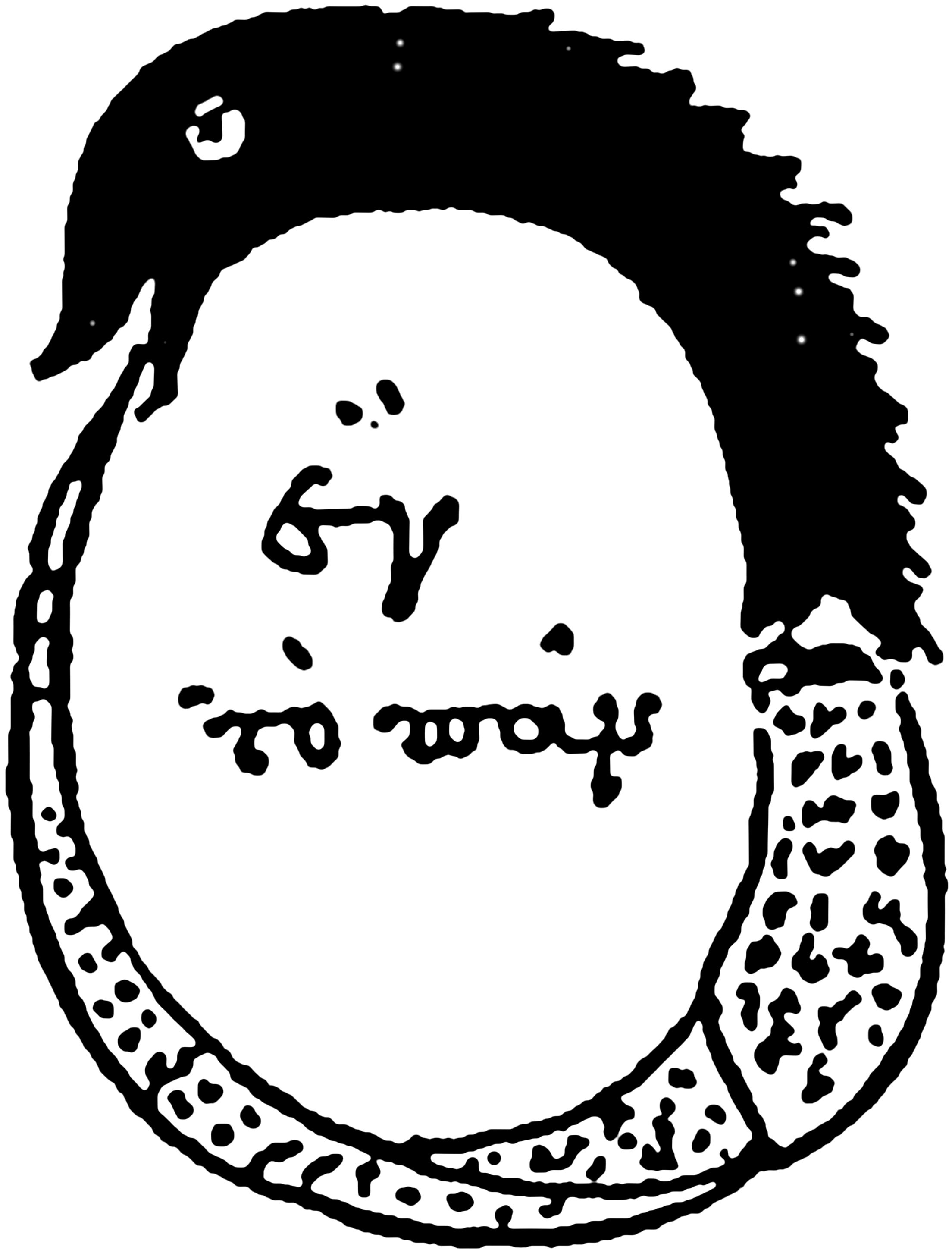
The techniques which we have discovered that allow us to analyze systems that exhibit chaotic behavior are completely deterministic: they are mathematical in nature, having the feature of acting like an Ouroboros, where the output becomes the input in a recursive cycle. We can start with even very very simple systems, and show how chaotic behavior results when the system evolves, when that system’s evolution takes place in ways describable by this type of recursive mathematics (not all systems are so describable). Really the MATH isn’t the thing here, it’s rather the RECURSIVE PROCESS, RULE, or PROTOCOL that is important. The math is just a really nice and clean way of expressing the essence of what happens when a system evolves by following a recursive rule.So chaos THEORY is determinant in that the rules which it utilizes to describe evolving systems have the potential to be calculated EXACTLY from iteration to iteration. In other words, if we had a computer that could deal with an infinite number of digits we could theoretically pinpoint the next iteration describing the state of a system at the next moment with complete precision. BUT, there are serious caveats to this when applied to anything beyond the purely mathematical formulations themselves. REAL systems may be more or less calculable, more or less complex, and more or less willing to submit to the precision capable in theory. The determinacy of chaos theory is therefore more like a theoretical determinacy, having a dubious ontological status. I won’t get into the very crazy and amazing philosophical arguments that whirl around such things, to your immense relief. Suffice it to say that THE WORLD IS MYSTERIOUS, and we have to be careful when dealing with the connection between our thinking and our observing.The ‘problem’ with chaos theory is that we can’t observe closely enough to know where to START our calculations, so we ALWAYS know that they are ‘wrong’ when dealing with the actual observable world. This is that ‘sensitive dependence upon initial conditions’ thing again: there is no lower limit at which a difference does not potentially make a difference, even ALL the difference. In other words, even the smallest possible change cannot be ignored. The thing is that we can never know ahead of time when such a difference may be either influential or inconsequential – we have to let the system evolve in actuality in order to find out. We can’t calculate the future states of the system (which are theoretically determined!) with much success because (depending upon the system’s complexity and initial state) as soon as we get a few iterations under our belts our calculations tend to diverge from other initial states that were infinitesimally close to the one we are actually calculating. So our results tend to be so far off from what we will later actually observe that we start calling the whole thing a theory of CHAOS, even though every step in the process is ‘determined’; hence “deterministic chaos”. So even today a large bulk of weather predictions are based not off of complex theories of high pressure and low pressure zones, temperature gradients, moisture content, and such, but rather simply off of a comparison with past ACTUALITIES. Predictions START with a comparison of the averages for a particular place for that same day in previous years, because this is often a better predictor than if we were to try and start with vastly incomplete current data. The best predictions, of course, blend the two methods, but you’ll notice that nobody (okay, this isn’t true, but such people have completely different methods for prediction) is giving weather predictions much beyond a week or two at best. This isn’t just a fault of our weather theory, but is a consequence of the RECURSIVE NATURE OF NATURE.
So what is interesting is that our understandings from quantum physics put us in the strange position of having to admit that WE CAN NEVER HAVE PERFECT KNOWLEDGE of the state of any system – no matter how simple. So we can’t even hold on to some ‘theoretical’ exactness that would be possible if only we had better instruments, or more complete observations. THERE IS NO SUCH THING AS A COMPLETE OBSERVATION — at least in the sense of what had been the promise and holy grail of physics before the s**t hit the fan with relativity, quantum mechanics, Gödel, and chaos theory. It turns out we live in a dirty universe, which is much more crazy and mysterious than we had imagined or hoped.
But what is key here is that chaos is not a result of linear progressions, but is more or less inherent (in systems with almost any level of complexity) when the Ouroboros steps in and finds its tail: recursion yields chaos. I find this fascinating, because so many (all?) parts of the natural world utilize recursion as a technique — particularly in the living realm, but even in the purely mineral realm as well. Whenever nature comes up with a new process it tends to repeat itself if the conditions allow it. This repetition can easily become recursive, where some aspect of the process acts upon or is acted upon by some other aspect of the process. When this happens you usually either get a complete breakdown or cessation of the process (a sort of suicide process, sometimes through growth), or you get emergent complexity, homeodynamic systems, self-regulating organization, and the basis for higher-level recursions.
At the same time, every recursive process is — although perhaps potentially infinite — embedded in a contextual situation that provides limits and boundaries to the system’s evolution. Sometimes it happens via a law of physics, sometimes as a consequence of mathematical relations in the context of physical laws (as in the increase in volume with the cube and the surface area with the square), and sometimes it’s just the seemingly contingent facts of context (it doesn’t rain that year, the food runs out, the salinity changes slightly, and so forth). The point is that these contextual limitations are not usually a part of the chaotic models proper. Rather, the chaotic models become themselves modified by through a corresponding synthetic analysis of contextual facts. The Mandelbrot fractal is what it is because it does not have to evolve in the context of anything REAL; it is an ideal form through and through. This is why we only find approximate fractals in nature, forms which approach the self-similar repetition of mathematical models. But rather than say that nature’s forms approximate mathematical laws, maybe we should say that our mathematical laws approximate nature’s forms. Maybe the laws we use to think about these forms are one of the ways that nature involves itself in a sort of grand recursion; the mathematical laws are like a high-level iteration of a process which at a lower level is much more messy and dynamic, but now has the benefit of taking place completely within the consciousness of a human being, thus allowing it to reach a new level of emergent complexity, i.e. the laws of emergent complexity themselves.
-
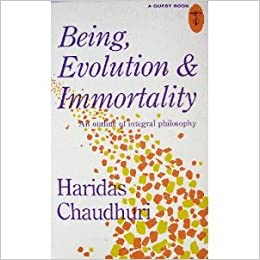
Informal review of Being, Evolution, and Immortality: An Outline of Integral Philosophy, by Haridas Chaudhuri
My general impression of this work was that Chaudhuri was writing in a very philosophical style about a topic which is far more than philosophical. The extent to which he took pains to delineate some various philosophical perspectives so that he could present the viewpoint of the integral yoga surprised me; I’m not sure exactly what I was expecting, but I kept feeling like I was back in my undergraduate philosophy program, reading and comparing different works. The intellectualism that accompanies the philosophical world has some excellent and unfortunate consequences.
In the case of this book, I felt that on the one hand it provided a strong case for the philosophical underpinnings of the integral yoga, which can be useful for those who work through and towards the difficult topics he discusses in an intellectual way. By doing this, it can be possible for the intellect to contextualize the various meanings and approaches to things like the Divine, to the Non-dual, Being, the Absolute, and so forth, in such a way as to allow the rest of the human being to begin to find a way of moving with the material at a different level. I find that sometimes the intellect, lacking this context or ability to engage, results in either an over or under-attachment to the real content that is attempting to be addressed through philosophical language. In other words, the philosophical nature of the presentation calls forth the part of ourselves that is capable of dealing with the concepts in a direct, wakeful, conscious manner, which helps to mitigate either sympathetic or antipathetic reactions which may otherwise arise in its absence.
On the other hand, presenting material like this through a philosophical standpoint also lessens its potential impact by restricting itself to a style of address whose major target is the mental part of the human being. This is true even if the content of the words include ideas like love, goodness, and so forth; what comes across is often only the shell of an experience, rather than words designed for the immediate evocation of the experience. This is not so much a criticism as just how things like this often go, because we can only write and express so much through words without seeming almost schizophrenic. It seems that Sri Aurobindo, the major synthesizer of Integral Yoga (in concert with The Mother) worked on both sides of this issue, writing both intellectually and poetically as the need arose.
In reading Being I felt like I was assuming the posture of a bird in flight, soaring over a vast landscape and beneath an even vaster sky. I had the sense of swooping down occasionally towards the Earth, or of straining my wings to fly ever higher… but never did I feel either truly connected to either the Earth or the Heavens, but rather somehow suspended in between, almost as if in a strange form of limbo. I really wanted Chaudhuri’s discussion to find much more direct and explicit contact with experiences and realities of daily life. There were a few moments where he began to speak along such lines, but I felt that he continually abandoned routes that would have put him in real connection with the “world”. This is to say that his language had a tendency to be either vague, general, or simply descriptive of classes (or classes of classes) rather than elements of classes. Take almost any paragraph as an example; these are pulled from a random 5 second search:
(Tending towards Heaven:)
“Spiritual nondualism is inspired by the concept of the Absolute as supermind. The supermind is the sovereign dynamism of ultimate reality. it is the creative light of Being. It is the all-embracing consciousness, nondualistic in structure.” (p.60)(Tending towards Earth:)
“Immortality is an attribute of enlightened consciousness. All men therefore have the potentiality of immortality by virtue of their consciousness. When the personality of an individual is harmonized and integrated, he attains enlightenment. He gains insight into his existential oneness with the all-encompassing Being. The veil of ignorance and separative consciousness is lifted from his eyes. Feelings of fear and insecurity, anxiety and personal unworthiness, are overcome. There is an enlargement of Being and joyful participation in the life of the Infinite. In one word, an individual experiences immortality here and now.” (p. 139)In the first case we have what may be the normal limit of intellectual presentation: pointing at the moon. Were he to go further he would likely need to adopt a completely different style, and for the purpose of a survey work, this may be too much to ask. In the second case, although Chaudhuri is speaking about experiences that concern the transformation of the human being from existing in an ‘everyday’ state to one that exists in constant transformation and unfolding in the light of the Divine, he never gives much more detail than is apparent here. It’s hard to describe, because it is difficult to have clear and exact words about vagueness, but I get the feeling that almost the entire bottom foundation of the integral yoga is just missing from this book. How exactly does one practice integral yoga? What does the student encounter along the way? What exactly is happening to the student when his or her consciousness begins to transform, from the perspective of the multidimensionality of the human being, and how does this relate to advancement along the path? In other words, having read this book, I do not feel I have any clear answers to these questions.
Not knowing the context around the genesis of this book, it’s hard to know why he chose to approach it as he did, but he must have had a particular audience in mind. I keep having to remind myself that this was written around 1967; I wonder how he would have approached the same central task today? Nevertheless, as a philosophical outline it succeeds admirably, and this is ostensibly (given the title) its major purpose, so I would definitely call this book a succes.
A friend of mine pointed out that Chaudhuri puts forth a certain strength in the presentation of ideas about things which are more than ideas, given an impression that “this is how it is”, with no room for argument. I have a sense of how this happens (although whether this describes Chaudhuri’s case I have no idea, I’m only providing this perspective as my own). It’s not so much that the often absolutist tone of the presentation is meant to discount or override any alternate conception so much as it is an expression of the minds inability to fully conceptualize the extent of the topic that it is dealing with. This results in the mind reaching its limits; our words too, reach their limits. The experiences that lie beneath the philosophical considerations, and which give rise to them, although having a ‘word-like’ nature (logos), are not words in the normal sense. Thus all philosophical expression, when placed in service of what lies forever beyond it, can only be a sort of veil that covers what is otherwise unknown. But in the process, the veil assumes a certain shape, and certain tendencies for motion, as it falls lightly or heavily across the Mystery. Good philosophical discourse will be like a supple silk, capable of shifting delicately in response to its wearer (the Divine, or Being in Chaudhuri’s case) without either falling off, being too transparent and thus difficult to see, or too thick as to obscure what lies beneath — all while remaining self-connected, strong, and breathable.
But once a fabric is chosen, certain limits are necessarily adopted. In other words, getting into the frame of mind in which the human being is pouring attention into the intellectual contextualization of spiritual topics leads the mind into areas that it would not otherwise go; it is creating a space and exploring it at the same time, on the one hand coming up against its own limitations while discovering its own movements through a kind of self-necessity (in the clearest cases, this is expressed as “logic”). (Re: p.48, “Thought is not a mere process of mirroring. It is a creative function. In distinguishing definable features of reality, it also creates them in a profound sense.) Once certain choices have been made as regards to the style of approach, much of the rest ‘falls out’ in a way that is unavoidable; when standing within the perspective it seems directly and manifestly obvious that specific conceptions require a certain kind of expression. It just seems natural. So we end up with things like: “[Ideas] are not unalterably fixed truths.” (p. 49) and “The truth is that Being is multidimensional.” Each statement is formed and expressed from a perspective which gives rise to the necessity of each, while taken together they indicate that the chosen approach is self-limited (for those of you that are familiar with Goedel’s incompleteness theorem, this is an example of how it occurs linguistically).
This post is already too long, but this gives some general impressions. There are many details that I have comments or questions about, but I’ll leave these aside. I can add in closing that the philosopher in me found this work engaging, and it invites much in the way of philosophical discussion. For example, he has a tendency to simply state, almost by fiat, that such and such divisions or dualisms expressed elsewhere are overcome or united within integral nondualism… but the philosophical details he gives to back up his claims are far less detailed and clear than I would like them to be. I suspect this also may be due to the introductory nature of the work, and he has others which hopefully fill this gap.
-
concerning the evolution of consciousness
Earth –> Day-waking (i.e. ‘normal’ adult) consciousness
Water –> Imaginative consciousness
Air —-> Inspirational consciousness
Fire —> Intuitive consciousnessEarth –> Thinking ‘about’ – object-oriented
Water –> Thinking ‘with’ – process oriented
Air —-> Thinking ‘between’ – polarity-oriented, (Brad exemplifies this very well)
Fire —-> Thinking ‘as’ – whole-orientedFurther, considering that all thinking is relational, and all relations are between beings:
Earth –> consciousness of other as if the other was an object (separation)
Water –> consciousness of other as if you were dreaming into the other’s experience, as if you were ‘seeing’ in an inner way the other’s perspective
Air —-> consciousness of other “as if” you were the other from the inside, as if you were ‘hearing’ in an inner way the tonality of the other’s experience
Fire —> consciousness of other AS the other, as if the other were living through and into you directly, with almost no distinction between who is whoThe sequence is one which lays out the polarities between separation and coincidence of self and other. Goethe made a strong case for the Water, or process, level of experiencing with his morphological studies of plants and his scientific work (particularly optics).
Earth, Water, Air, and Fire



 So chaos THEORY is determinant in that the rules which it utilizes to describe evolving systems have the potential to be calculated EXACTLY from iteration to iteration. In other words, if we had a computer that could deal with an infinite number of digits we could theoretically pinpoint the next iteration describing the state of a system at the next moment with complete precision. BUT, there are serious caveats to this when applied to anything beyond the purely mathematical formulations themselves. REAL systems may be more or less calculable, more or less complex, and more or less willing to submit to the precision capable in theory. The determinacy of chaos theory is therefore more like a theoretical determinacy, having a dubious ontological status. I won’t get into the very crazy and amazing philosophical arguments that whirl around such things, to your immense relief. Suffice it to say that THE WORLD IS MYSTERIOUS, and we have to be careful when dealing with the connection between our thinking and our observing.