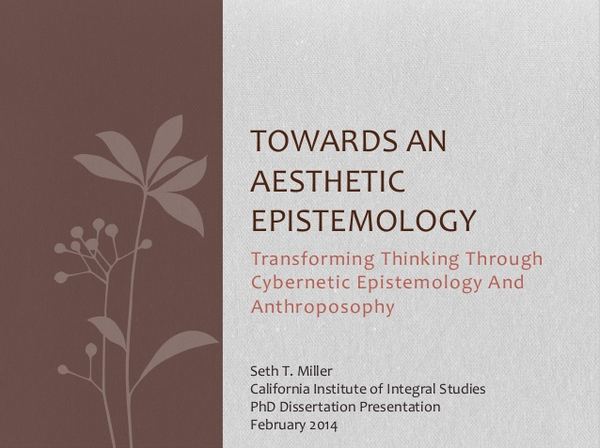
In February 2014 I successfully defended my PhD dissertation, titled “Toward an Aesthetic Epistemology: Transforming Thinking through Cybernetic Epistemology and Anthroposophy.”
The following is the abstract and a slideshow presentation that pulls out the crux of my arguments.
Abstract
The complexity, subtlety, interlinking, and scale of many problems faced individually and collectively in today’s rapidly changing world requires an epistemology—a way of thinking about our knowing—capable of facilitating new kinds of responses that avoid recapitulation of old ways of thinking and living. Epistemology, which implicitly provides the basis for engagement with the world via the fundamental act of distinction, must therefore be included as a central facet of any practical attempts at self/world transformation. We need to change how we think, not just what we think. The new epistemology needs to be of a higher order than the source of the problems we face.
This theoretical, transdisciplinary dissertation argues that such a new epistemology needs to be recursive and process-oriented. This means that the thoughts about thinking that it produces must explicitly follow the patterns of thinking by which those thoughts are generated. The new epistemology is therefore also phenomenological, requiring the development of a reflexivity in thinking that recursively links across two levels of order—between content and process. The result is an epistemology that is of (and for) the whole human being. It is an enacted (will-imbued) and aesthetic (feeling-permeated) epistemology (thinking-penetrated) that is sensitive to and integrative of material, soul, and spiritual aspects of ourselves and our world. I call this kind of epistemology aesthetic, because its primary characteristic is found in the phenomenological, mutually fructifying and transformative marriage between the capacity for thinking and the capacity for feeling.
Its foundations are brought forward through the confluence of multiple domains: cybernetic epistemology, the esoteric epistemology of anthroposophy (the spiritual science of Rudolf Steiner), and the philosophy of the implicit as developed by Eugene Gendlin.
The practice of aesthetic epistemology opens new phenomenal domains of experience, shedding light on relations between ontology and epistemology, mind and body, logic and thinking, as well as on the formation (and transformation) of identity, the immanence of thinking in world-processes, the existence of different types of logic, and the nature of beings, of objects, and most importantly of thinking itself and its relationship to spirit.
Keywords: anthroposophy, autopoiesis, cognition, cybernetic epistemology, distinction, epistemology, esotericism, logic, recursion, Rudolf Steiner, second-order cybernetics, spirituality, thinking
Slideshow
 Please note that Slideshare translated the Greek letter Theta into the letter Q. This is unfortunate, because I used the Greek letter for its geometric shape, pictured correctly at left.