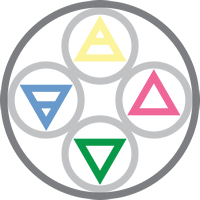
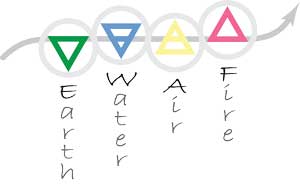
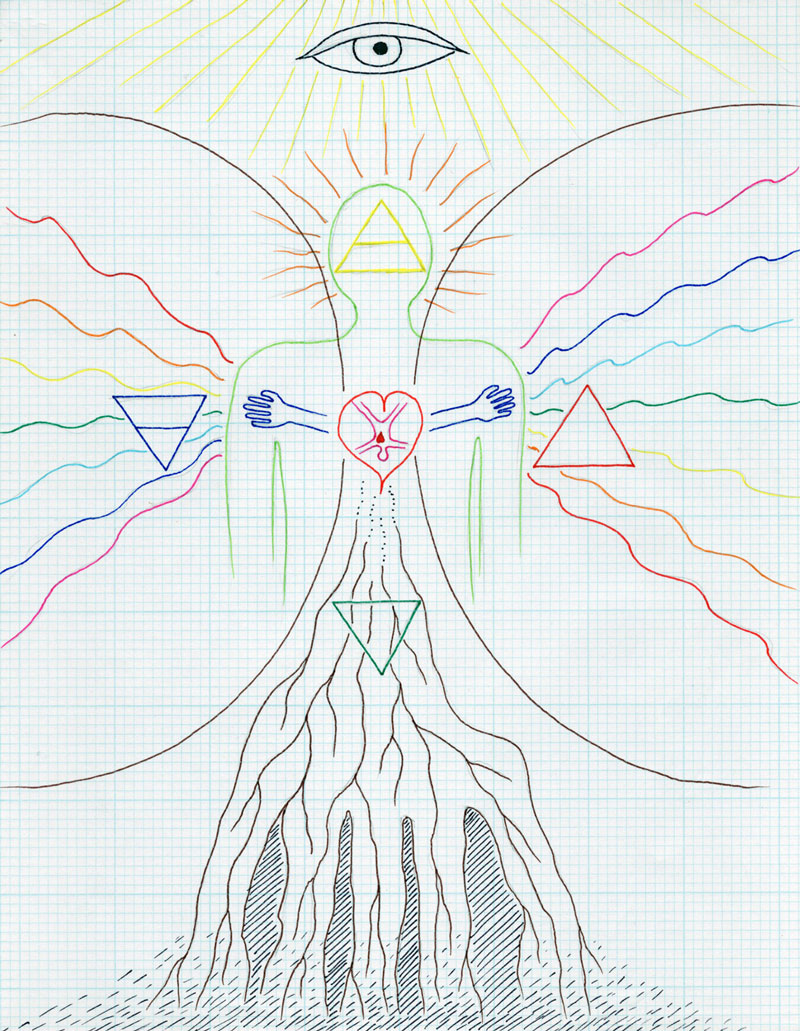
This essay outlines connections between the Elemental Cycle as an archetype of transformation, transdisciplinarity, and cybernetics. A number of questions are addressed: the nature and importance of connecting these fields, an examination of resources and the dominant disciplinary discourses for the associated fields, and a critical examination of my assumptions, beliefs, and position.
Introduction
How often do we find ourselves in a position of not being able to see something unless it is first pointed out to us? This happens all the time with the visual and other physical senses, but of course also occurs in our thinking; certain concepts seem to hide in plain sight, and unless we are cued into where and how to look for (or to think about) them, they slide on by as a part of the undifferentiated background of conceptual life. Usually we are introduced to these sorts of concepts just like we are to new people, through a third party who is already familiar with each of us: “Seth, I’d like you to meet Recursion; Recursion, this is Seth.” Often with this sort of introduction comes an experience: “Oh hello Recursion! You know, I feel like you must hang out at some of the same coffee-shops as I do, but we’ve never been formally introduced.” And so a relationship begins with a concept, and just as with human beings, you can become more intimate and familiar, get into fights, seek new levels of understanding, and go on adventures. (more…)
We ended the last installment noting that the first distinction must be of distinction, but this must be considered as a complex, recursive creation and simultaneous crossing of a boundary that is just precisely the boundary between that very activity of its creation and the fact of it as created.
To get at this another way, we can point out that the Glanville has actually hit on elements in this direction already, but (it seems) hasn’t quite put it together in the same way. Remember that the whole time we have been talking about the first distinction we are also talking about “the observer”, which we could call a “self”. It may even be worth revisiting some of the above text with that implicit translation in mind. I remind you of this because, Glanville, in his essay The Self and the Other: The Purpose of Distinction, is exploring solutions to the problem of infinite regression that arise when the mark doesn’t distinguish itself from its value, and he uses “self” and “other” to hold the logic of “mark” and “value”, which is perfectly fine.
Glanville notes that we have a set of relations that are implicit in each other: that between self and other: “the fundamental distinction between self and other [read: between the mark and its value] cannot be more fundamental than the distinction of the self, nor can it be less so: another circularity, another reduction of hierarchy” (p. 3).
Except that this isn’t a reduction of hierarchy. It is actually (more…)
Unfortunately, the workshop has been cancelled.
It will be rescheduled this Summer; keep an eye out here for the announcement!
Form / Re-Form / In-Form / Trans-Form
Elemental Transformation: Changing How We Work with Change
A hands-on/minds-on workshop with Frank Chester and Seth Miller
Saturday, March 20th
9 am – 5 pm
Live Oak Charter School Petaluma, CA
Pre-registration is required.
All workshop materials provided. Cost: $100
This all-day workshop will combine hands-on geometry with dynamic presentations and experiential exercises designed to help you deepen your relationship with transformation. You will leave this workshop with a physical form of your own creation and a more subtle and complex understanding of how transformation unfolds according to the archetypal patterning of the four elements: Earth, Water, Air, and Fire. Our goal is to inspire you and enliven your own everyday transformative work. This workshop is perfect for parents, teachers, therapists, social workers, and anyone interested in transformation. There will be a one hour period for lunch. You can bring your own lunch or drive off-site for lunch.
Frank Chester is an artist, sculptor, geometrician, and teacher based in San Francisco. He has been working with the four elements for over 10 years, having used them as an integral part of the research that led him to the discovery of a brand-new seven-sided form that has deep connections to the human heart. Frank travels widely, giving dynamic presentations connecting form, geometry, and spirit.
Seth Miller has taught physics and many other subjects in Waldorf schools across the West. With a Master’s degree in consciousness studies, he is passionate about bringing forth tools for transformation; his specialty is the alchemy of the four elements. He is currently developing this work in a PhD dissertation, which weaves together alchemy, cybernetic epistemology, Goethean phenomenology, and anthroposophy.
(Note, the Blackfoot people have a process-oriented language, which is much more strongly verb-based, while English and most other languages are object/noun based.)
Blackfoot Indian Brave
A friend of mine asked:
Do the Blackfoot people go through a phase where they need to have conceptual boxes, and then learn to transcend the need to reify these artificial demarcations, or do they simply use a different process all together from the very start? So much of western development theory assumes that moving beyond nice neat conceptions is a phase that we can move beyond, but assumes it is a necessary phase; perhaps it is only necessary for those who are raised to think in a linear fashion?
Which prompted the following response:
I have this feeling that on a macrocosmic scale, humanity does have to “go through” a stage of categorical reification and abstraction in order to develop certain potentials relating to our “task” if you will, of becoming beings of freedom and love. However, this doesn’t mean that every single human being has to do this, or in the same way (ex: the West has played such a huge role in this particular part of the human drama, while other areas have different things to bring to the play).
I imagine that it would be possible to ‘use different processes from the start’, and while there will be similarities in developmental stages, these won’t always match up exactly depending upon what is being brought forth by the language, culture, and individual elements, and so forth. It’s not like a Blackfoot can’t identify ‘a chair’ if they don’t want to… it’s just that doing so is a reduction or rather abstraction from a different way of understanding, just like if I were to reduce you to a particular image I had of you that came from one specific interaction, and then communicated only this aspect of you when I spoke about you to others or thought of you myself.
Both the ‘objective’ or reified view of we weirdo Westerners, AND the process or time-sensitive view of people like the Blackfoot are ‘correct’. The question is more, to me, about the overall appropriateness of each view given microcosmic and macrocosmic pictures of individual and collective development. Sometimes, identifying “this chair” as a completely abstracted and separate, non-evolving object is appropriate. Sometimes, seeing the flow of events that entwine themselves into the constantly becoming activity and relations that make up the chair through time is more appropriate.
BUT, the imporant thing is that we develop the capacity to have both these (and other) options open to us, so we aren’t locked in by our habits of perception. We — humanity as a whole — has won the capacity to objectify the world through a long and arduous and pain-filled path. It is something that we shouldn’t abandon — rather we need to learn how to use this capacity responsibly, ultimately in service to the development of our freedom to become beings who can love not by virtue of a given nature (this would describe an angel), but through what has come to us only by virtue of the path we have walked, i.e. in freedom.
Our experience of ourselves is in many ways completely mediated by aspects which are located beyond the normal boundary of the “I”. I’d like to offer one possible way of looking at the issue.
I approach this question concerning the boudaries of the “I” by taking into account the transformations of the “I” as it works through and within the physical body and the soul body on its path from death to life to death to life. To do so requires distinction between the ideas we have about our “I” and our unmediated, direct experience of our “I”, and more importantly between our “I” and what we can call our ego, on the basis of the usage of this term in the Western traditions (particularly psychology, which deals almost exclusively with the ego).
When incarnating, the human “I” experiences a period of darkness, which only gradually lifts throughout life, until (perhaps around the age of 21 or so) the first glimmerings of what I am referring to as the “I” become available to the experience of the ego, which is a structure that is present much earlier on, and is built up through a variety of relations between the burgeoning activities of the physical/soul bodies and the ‘outer’ worlds.
The incarnation of the “I” takes place not at birth, but much later, and sometimes not at all; this despite the fact that we each have the constructed ego that is constantly built up as a semi-permanent dialog between the inner activities of the body/soul and the various bodily and ensouled elements of our environment. This ego includes the remnants of the activity which is rightfully regarded as the spiritual activity of the “I” – thinking. Thus the ego becomes filled with thoughts but lacks the awareness of whence these thoughts originate. In the meantime (in accord with all the social, cultural, historical, familial, etc. ‘forces’ at work around all the activities of the aspects of the human being which are not the “I”) the ego maintains the false impression that it is the one doing the thinking.
This then leads us to the question about how we draw the boundary around what we consider to be our “I”, which turns out more often than not to be a question to the ego about the ego. There are no boundaries to the “I” in the normal sense, the “I” is a spiritual activity, a process. It is a wonderful aspect of the spiritual world that “I’s” are capable of penetrating and moving with each other; their activities can merge, coincide, and diverge. The idea of boundaries of the “I” only arises when we take our experience of the rules at work in the realm of physical bodies and our sense life and apply them to an arena in which no physical bodies or physical sense organs exist. In other words, it is like asking about the flavor of a trapezoid.
We can have ideas, thoughts about the boundaries of our ego, but the activity upon which such ideas are based rests only in the “I”. We can have the thought “My physical body only works because it includes trillions of bacteria and other organisms which I do not directly experience, but which science tells me are required for my process of digestion; if these microorganisms did not permeate my gut, I would be incapable of digesting my food.” This leads us to the thought that perhaps I’d better take a look at what I consider to be my ‘self’ – shouldn’t it include all the aspects necessary to maintain the activities of my physical body, which support then my capacity to think and experience?
We can thus, in our thought-life (not our thinking-life) come to the idea that the normal drawing of the boundary between ‘self’ and ‘other’ is in some ways quite spurious. There is then an attempt to fill the gap thus created (in thought) with other thoughts, which try to reorganize the connections made in thinking. So we say things, perhaps, like “Well, yes, ‘I’ really must include the bacteria in my gut” and so forth.
But all the while we are missing the very activity that is the source of all of these reconfigurations of our thought-life; our thinking. It is when we turn our attention to the thinking process itself that we start to come directly into contact with the “I” itself. This experience, the recognition of the “I” by the “I”, is not a thought, but is what can occur when thinking takes itself as its own object. In such a case, a completely different set of experiences become possible with respect to the question of the ‘boundaries’ of the self.
Moreover, what our ego keeps hidden from consciousness directly affects our perceptions and assumptions. It seems that the ego, in a sense, precisely constitutes its boundaries by this very omission. What I feel coming from my ego changes dramatically from situation to situation, not on the basis of what is included so much as on the basis of what is left out, and what’s more, on how it is left out.
The ‘mood’ around the process of the ego’s self-entrainment says more about my deeper nature than its explicit self-identifications ever could.
The role of destruction, and of the working out of polarities, is a subject that has been dealt with an the alchemical tradition for a very long time. Alchemically, it is understood that the issue you are dealing with, in which you find yourself (the prima materia) MUST go through a process of putrefaction, of fermentation… the individual elements cannot by themselves produce a work of lasting value (a Great Work), but must be destroyed in order to be refined. The refined elements then have the capacity to ‘marry’ the other elements to form a higher, more integrated, more complex and simple unity which ennobles and embodies the transformation of the worst parts of ‘the matter’.
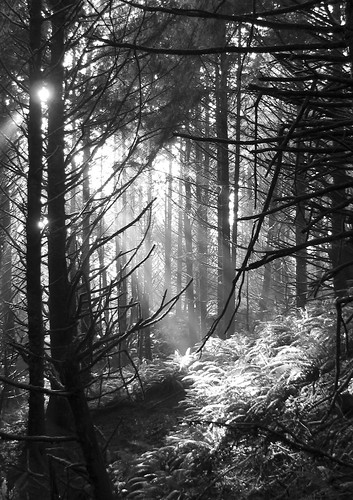
All diagnoses are misdiagnoses because they stay at the level of the overt fact, and do not take into account the necessary inclusion of relationship, reversal, and the whole. The image of the fireweed and the pinecone are examples in nature of the aspect of the Fire element in which destruction is required for new life. In this sense, the destruction is viewed not as a negative process but as a transformative one, in which the potentials of the lower state are realizable only through their passing away, and indeed, it is their very passing away which creates the space (Air element) into which the potential new state can flow, because room is made for it.
The same pattern occurs in the human being all the time – we do not transform without the heat of the Fire, also known as the Will – but not a will directed towards a specific absolute (an Earth), but what is known as an ‘open will’, which is just the part which maintains itself by transforming itself through its own death into a new state…
 Abstract