It's Elemental

Tag: earth

  • Patterns in Process: Transdisciplinarity as a Background for Working with the Elemental Cycle of Transformation

    Patterns in Process: Transdisciplinarity as a Background for Working with the Elemental Cycle of Transformation

    Elemental Cycle Abstract

    This essay outlines connections between the Elemental Cycle as an archetype of transformation, transdisciplinarity, and  cybernetics.  A number of questions are addressed: the nature and importance of connecting these fields, an examination of resources and the dominant disciplinary discourses for the associated fields, and a critical examination of my assumptions, beliefs, and position.

    Introduction

    How often do we find ourselves in a position of not being able to see something unless it is first pointed out to us?  This happens all the time with the visual and other physical senses, but of course also occurs in our thinking; certain concepts seem to hide in plain sight, and unless we are cued into where and how to look for (or to think about) them, they slide on by as a part of the undifferentiated background of conceptual life.  Usually we are introduced to these sorts of concepts just like we are to new people, through a third party who is already familiar with each of us: “Seth, I’d like you to meet Recursion; Recursion, this is Seth.”  Often with this sort of introduction comes an experience: “Oh hello Recursion!  You know, I feel like you must hang out at some of the same coffee-shops as I do, but we’ve never been formally introduced.”  And so a relationship begins with a concept, and just as with human beings, you can become more intimate and familiar, get into fights, seek new levels of understanding, and go on adventures. (more…)

  • Blow your mind with epistemology and ontology!

    Blow your mind with epistemology and ontology!

    To begin in the middle:

    –          There is no “it”, but there is talk about “it”.  Ultimately the talk about “it”, the pointing to “it”, is more fundamental to “it” than anything else, because it is the RELATIONS that are primary: thingness is a subset of relatedness.  Relations are not between two “things” but are recursively self-generated between other relations – things fall out of relations (things = Earth, relations = Water).  Relations themselves are a precipitate of tension between complementarily opposing potentials (Air).  Relations are to opposing potentials as things are to relations.  Opposing potentials are themselves a precipitate of the whole, and work alongside each other within the whole simultaneously.  Each step from the whole is a step-down transformation, we could say that beginning with level N, we move to level N-1.  Each level is pulled out of simultaneity by an act of distinction within the whole, of the whole, by the whole.  A cascading of levels of distinction yields the ontology of “things”, and simultaneously an epistemology of “knowing” activity, which together yield the whole of cosmology.

    –          This can be approached in another way.  We can begin first with a problem of the modern condition, made apparent most strongly by both postmodernism and deconstructionism.  The problem is that language is (more…)

  • a tiny window

    a tiny window

    a tiny window gathers the world
    echoes morning’s rush of life
    amazingly, my fingers trace your carved shoulder
    like they have never known geometry
    somebody somewhere is getting coffee,
    walking the dog, dressing for a long day –
    but not we, whose worlds have just collided
    under the gaze of a tiny window
    that no one is looking through
    because we are beyond ourselves now
    and I know this by the way your hair
    threads lightly across the bow of your cheek
    by the way every gesture becomes music
    and because when you smile I am lost
    again, you have taken my watch, and found forever in the bargain –
    I pretend to be offended because my world is now upside down
    and I can’t understand why everything else isn’t falling
    drawn inexorably by the velvet honey of your eyes
    this must be what yes is
    this must be the future twining round our ankles
    lacing up our hands in unspoken prayer
    while beyond our reach the coiled leopard of time
    anchors claws to earth for its inevitable leap
    why should time be linear anyway?
    for it is the timeless in us that is now rejoicing
    in this spiraling pressing of bodies and souls
    upwards into the long arms of the sky
    through a tiny window

    1w


    a tiny window gathers the world
    echoes morning’s rush of life
    amazingly, my fingers trace your carved shoulder
    like they have never known geometry

    somebody somewhere is getting coffee,
    walking the dog, glancing at a watch –
    but not we, whose worlds have just collided
    under the gaze of a tiny window
    that no one is looking through

    because we are beyond ourselves now
    and I know this by the way your hair
    threads lightly across the bow of your cheek
    by the way every gesture becomes music
    and because when you smile I am lost

    again, you have taken my watch, and found forever in the bargain – 
    I pretend to be offended because my world is now upside down
    and I can’t understand why everything else isn’t falling
    drawn inexorably by the velvet honey of your eyes

    this must be what yes is
    this must be the future twining round our ankles
    lacing up our hands in unspoken prayer
    while beyond our reach the coiled leopard of time
    anchors claws to earth for its inevitable leap

    we care not of its landing
    for it is the timeless in us now rejoicing
    in this spiraling pressing of bodies and souls
    upwards into the long arms of the sky
    through a tiny window

  • on destruction

    The role of destruction, and of the working out of polarities, is a subject that has been dealt with an the alchemical tradition for a very long time.  Alchemically, it is understood that the issue you are dealing with, in which you find yourself (the prima materia) MUST go through a process of putrefaction, of fermentation… the individual elements cannot by themselves produce a work of lasting value (a Great Work), but must be destroyed in order to be refined.  The refined elements then have the capacity to ‘marry’ the other elements to form a higher, more integrated, more complex and simple unity which ennobles and embodies the transformation of the worst parts of ‘the matter’.

    All diagnoses are misdiagnoses because they stay at the level of the overt fact, and do not take into account the necessary inclusion of relationshipreversal, and the whole.  The image of the fireweed and the pinecone are examples in nature of the aspect of the Fire element in which destruction is required for new life.  In this sense, the destruction is viewed not as a negative process but as a transformative one, in which the potentials of the lower state are realizable only through their passing away, and indeed, it is their very passing away which creates the space (Air element) into which the potential new state can flow, because room is made for it.

    The same pattern occurs in the human being all the time – we do not transform without the heat of the Fire, also known as the Will – but not a will directed towards a specific absolute (an Earth), but what is known as an ‘open will’, which is just the part which maintains itself by transforming itself through its own death into a new state…

    20050601-img_3750

  • concerning the evolution of consciousness

    Earth –> Day-waking (i.e. ‘normal’ adult) consciousness 
    Water –> Imaginative consciousness 
    Air —-> Inspirational consciousness 
    Fire —> Intuitive consciousness  

    Earth –> Thinking ‘about’ – object-oriented 
    Water –> Thinking ‘with’ – process oriented 
    Air —-> Thinking ‘between’ – polarity-oriented, (Brad exemplifies this very well) 
    Fire —-> Thinking ‘as’ – whole-oriented  

    Further, considering that all thinking is relational, and all relations are between beings:  

    Earth –> consciousness of other as if the other was an object (separation) 
    Water –> consciousness of other as if you were dreaming into the other’s experience, as if you were ‘seeing’ in an inner way the other’s perspective 
    Air —-> consciousness of other “as if” you were the other from the inside, as if you were ‘hearing’ in an inner way the tonality of the other’s experience 
    Fire —> consciousness of other AS the other, as if the other were living through and into you directly, with almost no distinction between who is who  

    The sequence is one which lays out the polarities between separation and coincidence of self and other.  Goethe made a strong case for the Water, or process, level of experiencing with his morphological studies of plants and his scientific work (particularly optics).


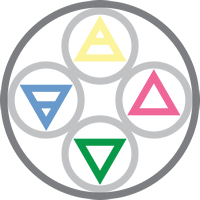
    Earth, Water, Air, and Fire
    Earth, Water, Air, and Fire