It's Elemental

Tag: Distinctions

  • Cybernetics of problems and solutions – an exercise in thinking complexly

    Cybernetics of problems and solutions – an exercise in thinking complexly

    First-order Solution:


    First Order Solution
    First Order Solution


    The problem and the solution share an epistemological context, each helping drive the other.

    Second ‘phase’ (to the right): In this context ‘more of the solution’ creates ‘more of the problem’ through a symmetrical relationship. The SAME problem is produced by the SAME solution. No real transformation is forthcoming from within the system, because it perpetuates itself from both sides.


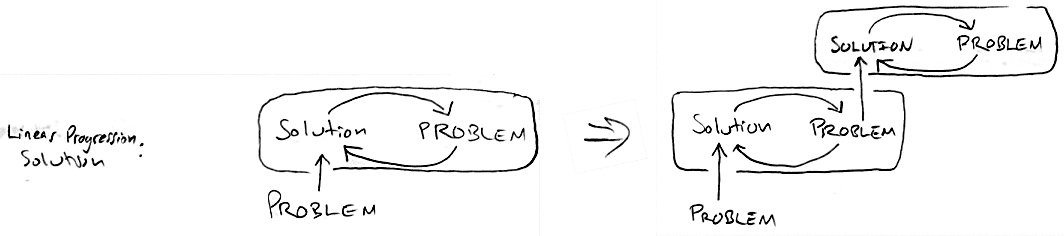
    Linear-Progressive Solution:

    Linear-Progressive Solution
    Linear-Progressive Solution


    A solution to a problem is found that does not perpetuate the original problem, but this creates a new problem (or problems) of its own, likely at the same level (with the same form) as the original, although with different content or within a different arena (problem ‘leaking’).

    Second ‘phase’ (to the right): This leads to a potential proliferation and regress of problems, because the epistemological context is never addressed at any level. DIFFERENT problems are produced by DIFFERENT solutions OF THE SAME ORDER. Transformation is possible but likely occurs with great difficulty and haphazardly, if at all.


    Second-order Solution:


    Second-Order Solution
    Second-Order Solution


    The epistemological context of the first order is seen as problematic, becoming the basis for a second-order solution that relies upon different epistemological distinctions. It is “second-order” because it explicitly recognizes the cyclic recapitulation of the first-order problem-solution system’s epistemological distinctions, and chooses not to participate by making different distinctions. Thus the problem-solution system becomes a new problem that is of a directly higher order.

    Second ‘phase’ (to the right): The solution to the original problem-solution system creates a new problem of a higher order (this would be the third-order problem), necessitating the uncovering of the epistemological limitations in the second-order problem-solution system (which now becomes the third-order problem). HIGHER-ORDER problems are created by HIGHER-ORDER solutions. Continuing in this way leads to higher-order levels of recursivity, but after only a few levels a practical limit is reached, and the system becomes to expansive and diffuse to affect transformation by itself.


    Simple Multivariant Ecology of Solutions:


    Multivariant Ecology of Solutions
    Multivariant Ecology of Solutions


    In an example of a more realistic (and complex) setting, a problem may be addressed with a “problematic solution” while at the same time efforts are made to seek a solution of a lineal type, which may create its own problem while being taken at the object of a second-order solution.

    Second ‘phase’ (to the right): The system of systems can evolve as a self-embedded ecology, where new opportunities for feedback become inevitable.  The network continues to evolve, involve, devolve, and revolve, all at once.

    Here’s a picture of them all together:


    Orders of Solutions
    Orders of Solutions


  • is reliance upon dualism hardwired?

    I wonder about the extent to which dichotomous thinking is either hard-wired or at least dependent on completely non-social forces.  It seems almost to be a thermodynamic question, that is, a question of trying to optimize the amount of energy spent in thinking for a given situation.  Thinking is a very expensive activity, physiologically speaking – it is essentially a catabolic process which relies upon the breakdown of molecules for their energy.   

    Evolution isn’t usually needlessly extravagant – in fact it’s kind of lazy, if you don’t mind the anthropomorphism.  It seems that in a broad sense, there is a sort of law of diminishing returns for the energy investment required for thinking.  In other words, if you encounter a situation in which some kind of action or distinction is called for, you get the most bang for your buck by quickly assessing things according to an either/or model.  Identify one aspect, which automatically calls up some kind of opposite, and make a determination on the basis of this division.  It’s quick, dirty, and effective for generating actions, feelings, and new thoughts.  If the feelings, actions, etc. that result from this distinction are ‘good enough’ then there is little reason/pressure to continue the act of thinking about it in a way that calls into question the basic assumptions of the underlying duality.  In other words, it’s easy to make and maintain the most basic of distinctions, those of duality.  

    So it seems to me that it is largely social factors that mitigate this tendency.  Trying to think through the layers and layers and layers of connection that inevitably describe EVERY situation is simply not practical energy-wise, and thus requires very significant counter-pressure for its activation.  We must run into situations in which our original duality is experientially shown to be inadequate for there to be a commitment to another round, or three or ten, of thinking over and through a given situation.  At some point things seem to just get too complex and we give up, and the point at which we abandon the process relates to the level of depth and complexity we are able to experience.   

    This is why I really like Kwame Anthony Appiah’s appeal to respectful experience with people not like us, i.e. through conversation: “Conversation doesn’t have to lead to consensus about anything, especially not values; it’s enough that it helps people get used to one another” (Appiah, 2006, p.85).  At a very basic level, time spent with others presents us with countless variations on the experience of discovering that our implicit or explicit distinctions are not always shared.  This presents (often, but maybe not often enough?) a kind of social pressure to go through a second round of thinking about our primary distinctions, the effect of which at least sets up a greater likelihood that we can ‘get used to’ differences which before were causes for anxiety.  

    In any case, it seems that there is a certain amount of ‘going against the biological grain’ required to produce people like Morin, Bernstein, or Appiah.  Luckily it’s not all biology!  Of course, applying this little analysis to itself, I should be wary of relying upon the duality of biology/sociality, because, following Morin, ‘it isn’t quite that simple’.  Round 1 over.

    20080507-IMG_6045


  • on distinction

    Trying to summarize:

    The drawing of a distinction is a formative act.  Drawing a distinction FORMS the space, constellates the infinitely possible unknown into spaces which are shaped by the particular WAY in which the distinction is drawn.  The resulting spaces can not help but take the complementary shape of the distinction that defines them.


    The drawing of a distinction is an INformative act.  Drawing a distinction INFORMS the observer to distinguish the space like this.  The resulting shape of any possible knowledge within the space cannot help but be informed (formed-in) by the particular way in which the distinction is drawn.


    The distinction is an epistemological act that creates itself, and in so doing, is also the creation of the space in which the distinction occurs, as well as of the observer who makes the distinction.


    There are levels of distinction; distinctions can be made about distinctions, and distinctions can be made about those distinctions…


    Distinctions are atemporal and aspatial.  They are the primitive act.  The distinction between the distinction, the space, and the observer are all formally equivalent, just as the three interior angles of a triangle are all formally equivalent.  In other words, they are interchangeable in any process that specifies ANGLE. 


    The only process that specifies distinction, space, and observer is DISTINCTION.  The form (which is the same thing as the LAW of form) is an ouroboros.


    Consciousness is the consciousness of distinction.  That is to say, consciousness is distinction; it cannot be other than consciousness of distinction. Therefore consciousness is co-extensive with all distinction.  What is distinguished is conscious of its distinction; this is why there is distinction; this is why there is consciousness.


    Time is a higher order distinction that requires recursivity.  It is a distinction about a distinction.  Time is dependent upon the oscillation of distinction between two states made by that distinction.  Time is the injunction to cross the boundary between the states, and once crossed, to cross again.  The crossing is atemporal.  Only the distinction of the crossing is temporal.  The distinction of the crossing of the distinction is time.


    <—————-distinction—————->

    Now, I have no idea if any of the above is sensible or insensible <crossing boundary: its sensibility or insensibility is only possible on the basis of the distinction as such.  In itself it is neither sensible nor insensible, but what it would be if it could> but it has raised some questions for me:


    Is distinction ONLY binary?  Is distinction always between this state and that state, that is, between one and another?  Is it possible to distinguish not just between one:one, but between one:many, between one and another+another+another?  In other words is this a binary reductionism? <crossing boundary: yes, if this binary distinction is made.  now make another distinction.>


    Okay, but what about the, um, distinction in quantum mechanics of the possible eigenstates of the wave function?  There are an infinite number of possible eigenstates for any given system (even the simplest), and they must ALL be taken into account (their probabilities must be worked in to the equation). Then, out of the whole field of possibilities, ONE is observed.  In the observation, all the other possible values have a probability of zero, while the observed value has a probability of one.   This sounds an awful lot like the idea that the fundamental act of distinction creates the space and thus the values of any distinction in the space thus created.  Does this have any validity, either as an analogue or at least a metaphor? <X: Do you distinguish it as such?>


    Okay I have another question.  What happens if we DON’T DISTINGUISH?  I mean, we don’t un-distinguish and we don’t distinguish.  Without distinction… what happens?  Is this (GSB language) a marked empty mark? 


    Crap!  And can making a distinction of a distinction actually be the same as not making a distinction in the first place?


    Please, anyone, help?!

    <X:                 >

    20080507-IMG_6032

  • observing the observer

    So then to begin in the middle I have many questions: 
      
    What constitutes an observer? How do we think about what an observer is/does? Is it as simply complex as the recursive: “An observer creates distinctions; distinctions create observers.”? 
      
    What is a distinction? In order for it to occur, does it require only an observer, or is there also an ‘observed’? If so, what constitutes the observed if we are speaking of it before the act of observation? Or is there no such thing as an ‘observed’ before its being observed? Is it possible for the specific distinction within the observed to be meaningless before observation while still maintaining on a higher order level that there is a realm of the ‘unobserved-observed’? 
      
    I mean to think about this issue as much as possible without the benefit of assumptions, knowing this is impossible. 
      
    Does the concept of the complementarity of field/wave in quantum physics help conceptualize this problem? Physicists can speak of descriptions of … using words that evoke particulate metaphors or wave-like metaphors. The … is always …, although some like to speak of wavicles to try and express the idea that beneath (?) the individual descriptions of what happens in particle physics experiments as either particle-like or wave-like, some more encompassing ‘reality’ is manifesting in an either/or fashion while remaining singular in itself. 
      
    The epistemological issue of the observer/observed qua cybernetics thus seems analogically exact to the epistemological dilemmas raised in our attempts to understand the quantum mechanics. Both point to some aspect of recursion as a central feature of any potential ordering of knowledge.

    There's a Light Inside

  • Concerning functionalism

    I have this feeling that appeals to functional equivalence (or even similarity) are somehow, well, disrespectful, or at least intrinsically misleading.  Functional appeals ‘work’ because they abstract very specific relations from an otherwise fully real and completely embedded situation, and show how regardless of how those relations come about, if they do, then for the purposes of our inquiry, we are satisfied of their equivalence.  In other words, if I want my taxes done, I don’t care whether it is done by a computer, a certified tax accountant, or a 5-year old prodigy, as long as I pay the same amount and get the same results.  

    My problem with functionalism (in all its forms, not just with respect to functional theories of the mind), is that function accounts necessarily reject aspects of a whole system which,given a different approach, would render any initial functional consideration of equivalence not equivalent.  

    In other words, given the example above, although considered solely and specifically for the very restricted purpose of ‘having my taxes done’, they three systems are functionally equivalent, the computer, the tax accountant, and the 5-year old are equivalent only in a functional sense.  By being only functionally equivalent, and only in this very specific situation and for a very specific purpose, we see that a certain violence is being done with respect to the constancy of the respective wholes under (or rather not under) consideration.  There are secondary, tertiary, and n-iary non-trivial effects consequent in each case that are different.   

    When seen as complex, relational wholes with inextricable and unique qualitative embeddedness in a multilayered and recursively evolving world dialogue, the functional relations identified by functional appeals are revealed as non-generalizable reflections of some particular set of distinctions which, if they were different, would necessitate different functional relations.  

    More simply, functionalism has no ontology and ignores epistemology.  

    This is not to say that appeals to functionalism are to be avoided.  On the contrary, what makes functional appeals so powerful is precisely their ability to ignore everything that is determined to be unimportant for a given system in order to reveal some higher-order similarity.  The problem arises in that functionalist explanations are not very good explanations, because they always avoid asking the question “Who?”  That is, who is making the determination concerning the particular functional relation to be considered in a specific circumstance?  There is always someone who must initially decide – upon a basis not explicable from within a functionalist standpoint – what the criteria are for a given system to meet a particular functional definition.   

    This functional blind spot is very similar to the way in which the classic scientific method includes an aspect which is manifestly non-scientific: the hypothesis.  In giving a name to this undetermined, mysterious and non-controllable source from which all of its knowledge  comes from and returns to, the logic of science seemingly ‘co-opts’ this ‘hole’ in its otherwise orderly workings through a process of more or less complete ignorance.  Where hypotheses come from and what they consist of has nothing whatsoever to do with the scientific method, but determines every single piece of scientific knowledge it produces and the entire course of science as a whole.  Functional explanations are similar in that they ignore the source of the distinctions upon which every functional identification rests.  Science can only say that ‘given such and such a hypothesis, the following logical relations would hold’, just as functional explanations can only say that ‘given such and such a functional role, system A and system B have functional equivalence’.  But because every system is non-arbitrarily intra and interconnected, the choice of what constitutes a given function has non-arbitrary consequences that are ignored at the peril of the coherence of the very functional similarity proposed.  

    Thus functionalism is disrespectful in that it does openly include and account for the source of its functional determinants.  When functional appeals are used in a manifestly pragmatic way, I can forgive this oversight.  But when functional appeals are used as explanations, I object, because in such cases functionalism begins to overstep itself by disingenuously posing itself in an ontological persona, leading to claims such as “if a computer functions in just the same way as a human being, then it must have a mind, because this is how we explain what a mind is.’  This is ontological violence pure and simple, and basically amounts to saying that to have a mind is to function as if one had a mind.  But the hidden move here is one which necessarily already assumes – without any justification whatsoever – the particular distinctions (and not others) which account for what it means to ‘function as a mind’.   

    In other words, functional appeals are a mask for our ignorance.  They are useful because when we are in a state of ignorance, they allow us to make distinctions which ground further thinking, but they outlive their usefulness when the relations they propose are ossified at the expense of the potential – always inherent in any real system – for multiply alternative distinctions to serve as the basis for completely different relations