
It's Elemental

Tag: Darkness

  • Ahriman and the Internet: Is there a third path?

    Ahriman and the Internet: Is there a third path?

    Context:

    The following post is prompted by discussion of a recent response I made concerning two essays: the first by Sergei Prokofieff, entitled “The Being of the Internet”, in which he argued that the digital media are carriers of such darkness that they are unredeemable, and the second, a reply to Prokofieff, in an article by Eugene Schwartz entitled “Anthroposophy and Waldorf Education: The Web as Will and Idea”,  The reader will likely get more out of the following if both the original essays are read, as well as my original post.
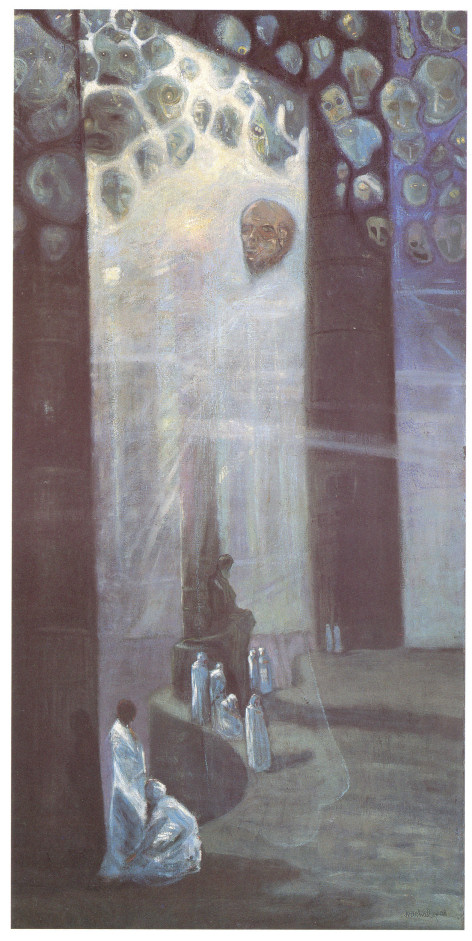
     

    The Cult of Ahriman - Josef VáchalIn Sergei Prokofieff’s essay on “The Being of the Internet”, he states that:

    “If one looks behind the being of the computer on this basis, i.e. to the way information is processed and stored, then one discovers that everything is built on the duad which can endlessly and quantitatively be multiplied through repetition and differing compositions.”

    also:

    “In contrast the Internet or DVD puts everything on the level of purely abstract information that in addition comes in “bites [sic],” (this brings up the picture of Osiris cut into pieces by Typon) and thus is spread amongst mankind in a way towards which no ‘reverent feeling’ is possible.”

    I wholeheartedly disagree with this statement.   I think Prokofieff is confusing “how” with “what” in this case, and is using the term “abstract information” in a potentially (although likely unintentionally) misleading way.  What makes information abstract is primarily the human being’s relationship to it, not the specific storage mechanism.  For example, braille is a way of communicating written information that is entirely dependent upon a binary system of bumps and flat spaces.  Does this make all information communicated through braille “abstract”; no, the notion is silly.

    Simply placing information on a DVD or on the internet does not by itself change the nature of that information: what is required is an understanding of the whole system, which includes also the human (or other) beings doing the communicating, their intentions, their capacities, and so forth.  Indeed, it is probably misleading to speak of “the nature of information” at all, because there is no such thing by itself.  There is no “information” somehow “out there” independently of a system for which that information becomes useful.  Information is always “information FOR” some system which can perceive and act or otherwise change because of this perception.  As you can see, the whole concept of “information” is tricky, because the word has many meanings and is used in a variety of contexts.

    I think Prokofieff is focusing too intently on the mechanism of storage (“how”).  To declare that because information is communicated through digital means, it is therefore rendered into a state “which no ‘reverent feeling’ is possible” is not only a sweeping overgeneralization, but is simply not true; direct experiences of myself and countless others show this to be the case.  I have been involved in many purely online interactions which have been transformative in a healthy sense, which have opened my heart to the other (and the other to me), which have broken barriers of abstraction, and which have connected me to another person, or even many people, in ways that I can confidently say further the Christ-impulse.  In these moments I have a reverence for the other, for the space in between us, and for the unfolding of something new and completely NOT abstract: a living relationship.  I have experienced love flowing through the internet–because human beings made the effort to do so.

    “Already today one can find the most awful and defamatory attacks on Rudolf Steiner, Anthroposophy, Waldorf Schools and other institutions connected with Anthroposophy on the Internet. And this widespread effect is not comparable to that of print. There is no doubt that this will increase in future particularly with the publication of the collective works on the internet and DVD because then all alleged “vulnerable passages” in the collective works will be easily and quickly accessible.”

    That attacks on Steiner and Anthroposophy and so forth are more common on the internet than in print is true, but I don’t think that this fact supports Prokofieff’s point that that internet is irredeemable.  Something about the way Prokofieff states this rubs me the wrong way, as if his motivation is based on a fear of such criticism, and a desire to secretize what may invite such criticism, rather than meeting the criticism in a way that demonstrates in the action itself the worth of anthroposophical wisdom.  Steiner is in no way infallible, and he said some things which were wrong, and other things which were ill-phrased or confusing.  Thank God: he is human.  Anthroposophists should be continually striving to develop and change, and to develop and change anthroposophy as well.  Any living system that does not transform with its environment will die, and anthroposophy is no exception to this; it MUST change.  Like any living system, some parts of it must decay and fall away, so that new growth can take hold and flower.  I say this as a general response to the impulse to keep some information out of the stream of evolution and interaction simply because it is difficult to meet the task of transforming such information, of upholding what is appropriate and letting go what is not.  This is not to say that ALL information should be available to all; simply that when the impulse to keep it secret is based on fear I become very suspect.

    “If man wants to maintain his autonomy over the world of the computer then he has to differentiate between what objectively offers pure technical aid for his work and where he oversteps the mark behind which, at first unnoticeable, the ahrimanic seduction starts to take control.”

    This is an excellent point, and is one that we cannot pay too much attention to.  Here I see a glimmer of hope in Prokofieff’s words, because he at least indicates that there is a potential to use technology as a “technical aid”, and that this is different from being seduced by it into a kind of ahrimanic entrainment.  But I would say that it is not enough simply to use technology as a “pure technical aid” for one’s work: we should use it as a means to further Michael’s mission, to manifest the impulse of Love, and to transform ourselves in progressive ways.

    Now I would like to say that I primarily disagree only with Prokofieff’s conclusion that the internet is irredeemable and that it is solely the province of Ahriman.  He paints only a partial picture–a valuable picture, but one that if taken by itself can be misleading.  Prokofieff simply doesn’t speak to what human beings CAN do with these technologies, and to what the human being’s task is in relation to these creations.  He only states that:

     “What has been said does not mean, however, that one should therefore refrain from using a computer or the Internet. They belong to our civilisation and at the same time to the greatest ahrimanic provocations which mankind faces and will have to face increasingly in the future.”

    I agree with this statement, in particular that it provides the greatest ahrimanic provocation which humankind has ever seen.  The fact that we will have to face this more and more in the future, and he indicates, only makes his omission of any forward looking advice all the more confusing.  That the internet (and its related technologies) offers a massive domain within which ahrimanic beings can do their work is something I won’t contest.  But I’m not sure that I agree with Prokofieff’s indication that:

    “Crucial is however, as with many similar problems, which we are faced with in today’s civilisation, whether man controls the computer and the internet or they man.”

    Couching the issue as one of control, and offering only a binary opposition of outomes, seems to play right into the hands of the very beings he is ostensibly seeking to avoid.  Attempts at increased control can be just as damaging as complete lack of control.  As Prokofieff indicates, it is the introduction of a third option (or many “third options”) that is needed.  Not control, and not abandonment.  For me the third option is one that arises from the creative transformation of the will around the technologies in question. Steiner has offered us a fantastic bunch of advice on this very point.  In my experience one of the most powerful ways of counteracting the ahrimanic tendencies is through the training of Goethean-style observation.  This involves awakening a sensitivity to the movement of wholes, to their form, patterning, gesture, and meaning.  This is not the space to give details on this way of walking a middle path, but at the very least I can indicate something of what I am referring to by linking to a recent essay on Goethe and a new aesthetic consciousness.

    Prokofieff states that:

    “Here the attempt is made in purely ahrimanic form to create a worldwide web that connects as many people as possible but in a way that mankind becomes increasingly separated from the cosmos and the hierarchies and thus is bound up with what was described above as an ahrimanic spider web.”

    Earlier he quotes Steiner as saying that man will have to unite with the beings of the ahrimanic spider web.  My sense is that if such a fate is in store for us (and it does certainly look as if we are going this way), then isn’t it important to build the capacities now that will help us in the future?  Shouldn’t we learn how to keep ourselves connected with the impulses of the Michaelic school in the context of the first glimmerings of this spider web that takes the form of the internet today?  Why shouldn’t we be active in doing what we can to make it possible to keep our spiritual evolution from future (and present!) stagnation?  Should we leave the internet, its development, its adoption, and its various methods of capturing the will and intention of human beings up to those who have no esoteric understanding of what the consequences may be?   Should we grant Ahriman his domain, bowing to get out of his way as he reaches his fingers further and further into our modes of perception and communication?

  • A response to: “Anthroposophy and Waldorf Education: The Web as Will and Idea” – Can Digital Media be Redeemed?

    Web Internet SpiderThe following is my response to a recent article by Eugene Schwartz entitled “Anthroposophy and Waldorf Education: The Web as Will and Idea”, which is Eugene’s response to an article by the renowned anthroposophist Sergei Prokofieff, who wrote a remarkable article entitled “The Being of the Internet”, in which he argued that the digital media are carriers of such darkness that they are unredeemable.  The following will make the most sense if Eugene’s article (and ideally Prokofieff’s as well) is read first, but can still stand on its own as my opinion.

    Eugene has written a timely and well-considered article. As someone who has “grown up” (at the time of this writing I’m currently 33) watching and participating fully in the birth of the internet (I had an email address years before the world wide web existed), I am disheartened when anthroposophists shy away from what I consider to be an important task: the appropriate usage of these new kinds of technology.

    By appropriate, I mean utilizing the technology as a means of furthering a progressive human development. Of course what constitutes “progressive” or “development” can be hotly debated, but for me this involves not just empowering people through providing access to information of an esoteric nature that they might not otherwise have, but in providing the context for the shared creation of meaning in ways that are dynamically capable of leading towards real transformation.

    The ahrimanic nature of the internet lies primarily in the way that supports the decontextualization of meaning-making from the soul lives of its human participants. It allows us to abstract too easily, to decontextualize parts of ourselves in ways that challenge a healthy development. But at the same time the internet is the potential carrier of both luciferic impulses (getting willfully lost in online environments, expressions of rage, rampant self-satisfaction seeking opportunities, etc.) and Christ impulses as well.

    As always, the Christ-like impulses are a bit more subtle, a little less oriented towards appearing with a particular veneer, but no less powerful for all that. I am speaking of how the internet is used to help bring groups of people together in ways that fosters both community and action, and which promote love and change. This occurs not merely through sharing information, but in the literal creation of an in-between space which can be filled with the soul-activity and spirit-light of individual wills. This, I think, is what it looks like to “redeem” the internet. It happens when people are given tools to become active participants in the dynamic creation of meaning that fosters transformation and love.

    The challenge, as with the bringing into one’s heart of any Christ impulse, is that it occurs not by default, and not by control, but through a conscious surrendering of one’s will to a higher will, which is experienced both as a suffering and a redemption. Ahriman, I imagine, would like us to use the internet to manipulate and control so that we forget the much greater power available through this kind of conscious suffering, while Lucifer would be happy if we continued to use the internet to satisfy our desires and create infinite personalities for ourselves.

    The alchemists understood that nothing could go untransformed if the magnum opus is to be achieved. Their saying “As above, so below; as below, so above” was not an academic one about correlation; it meant that in order to reach the highest potential available to us, we had to transform our lowest aspects. This applied too to the outer world: nothing could ultimately go unredeemed, and if we ever decide to “write off” some aspect of reality as beyond hope, beyond action, and beyond transformation, then the forces of darkness will claim a victory.

    We must work together to build the world we wish to live in. It is a horrible mistake to try and divorce technology from morality, and to claim that “it’s all in how it is used.” Some technologies are more evil than others, but the internet is not an atomic bomb. The development of the internet, although beginning as a defense-oriented technology (not incidentally as a technology to help counter the potential effects of nuclear weapons), almost immediately was taken up and used for other means; primarily education. There are countless ways in which both the development and usage of the internet fosters healthy development of human beings–in ways not completely without strings, of course, but also not in ways that make its usage “unredeemable.”

    What we cannot do is let the regressive impulses have their way with the internet and co-opt the minds and souls of human beings for their own uses without a Michaelic challenge, a challenge for the creation of spirit-based groups of individuals (which are different than just ‘groups’), a challenge to permeate the spiritual spaces of the internet with transformed will, with conscious sacrifice, with love of transformation and a transformation of love.

  • distinguishing between the ego and “I”


    Our experience of ourselves is in many ways completely mediated by aspects which are located beyond the normal boundary of the “I”.  I’d like to offer one possible way of looking at the issue.  

    I approach this question concerning the boudaries of the “I” by taking into account the transformations of the “I” as it works through and within the physical body and the soul body on its path from death to life to death to life.  To do so requires distinction between the ideas we have about our “I” and our unmediated, direct experience of our “I”, and more importantly between our “I” and what we can call our ego, on the basis of the usage of this term in the Western traditions (particularly psychology, which deals almost exclusively with the ego).  

    When incarnating, the human “I” experiences a period of darkness, which only gradually lifts throughout life, until (perhaps around the age of 21 or so) the first glimmerings of what I am referring to as the “I” become available to the experience of the ego, which is a structure that is present much earlier on, and is built up through a variety of relations between the burgeoning activities of the physical/soul bodies and the ‘outer’ worlds.  

    The incarnation of the “I” takes place not at birth, but much later, and sometimes not at all; this despite the fact that we each have the constructed ego that is constantly built up as a semi-permanent dialog between the inner activities of the body/soul and the various bodily and ensouled elements of our environment.  This ego includes the remnants of the activity which is rightfully regarded as the spiritual activity of the “I” – thinking.  Thus the ego becomes filled with thoughts but lacks the awareness of whence these thoughts originate.  In the meantime (in accord with all the social, cultural, historical, familial, etc. ‘forces’ at work around all the activities of the aspects of the human being which are not the “I”) the ego maintains the false impression that it is the one doing the thinking.  

    This then leads us to the question about how we draw the boundary around what we consider to be our “I”, which turns out more often than not to be a question to the ego about the ego.  There are no boundaries to the “I” in the normal sense, the “I” is a spiritual activity, a process.  It is a wonderful aspect of the spiritual world that “I’s” are capable of penetrating and moving with each other; their activities can merge, coincide, and diverge.  The idea of boundaries of the “I” only arises when we take our experience of the rules at work in the realm of physical bodies and our sense life and apply them to an arena in which no physical bodies or physical sense organs exist.  In other words, it is like asking about the flavor of a trapezoid.  

    We can have ideas, thoughts about the boundaries of our ego, but the activity upon which such ideas are based rests only in the “I”.  We can have the thought “My physical body only works because it includes trillions of bacteria and other organisms which I do not directly experience, but which science tells me are required for my process of digestion; if these microorganisms did not permeate my gut, I would be incapable of digesting my food.”  This leads us to the thought that perhaps I’d better take a look at what I consider to be my ‘self’ – shouldn’t it include all the aspects necessary to maintain the activities of my physical body, which support then my capacity to think and experience?  

    We can thus, in our thought-life (not our thinking-life) come to the idea that the normal drawing of the boundary between ‘self’ and ‘other’ is in some ways quite spurious.  There is then an attempt to fill the gap thus created (in thought) with other thoughts, which try to reorganize the connections made in thinking.  So we say things, perhaps, like “Well, yes, ‘I’ really must include the bacteria in my gut” and so forth.  

    But all the while we are missing the very activity that is the source of all of these reconfigurations of our thought-life; our thinking.  It is when we turn our attention to the thinking process itself that we start to come directly into contact with the “I” itself.  This experience, the recognition of the “I” by the “I”, is not a thought, but is what can occur when thinking takes itself as its own object.  In such a case, a completely different set of experiences become possible with respect to the question of the ‘boundaries’ of the self. 


    Moreover, what our ego keeps hidden from consciousness directly affects our perceptions and assumptions.  It seems that the ego, in a sense, precisely constitutes its boundaries by this very omission.  What I feel coming from my ego changes dramatically from situation to situation, not on the basis of what is included so much as on the basis of what is left out, and what’s more, on how it is left out.  

    The ‘mood’ around the process of the ego’s self-entrainment says more about my deeper nature than its explicit self-identifications ever could. 


    Cannon Beach Jan 2008-12

  • the world, seeking

    shadows fall on shadows, aghast at their own darkness
    times keep falling out of place, surprising themselves,
    trailing numberless atrocities like the dust of a comet
    sweeping ominously across a shrouded, weeping planet

    the forces are arrayed, the engines started
    words have been spoken, in earnest, in fear, in foreboding
    the percolating matrix of desire is abroad
    spewing the churned filth of age upon age

    grasping through coated vision, sickly sweet with unknown blood
    mine? or is that just the fading of words in the rain
    a forgotten calligraphy of music and coincidence
    swept into the tragic dust of memory

    we are all the friends of death
    we have slipped our milky white hands in his
    threaded our fingers into the dying bones of the future
    and now hold on for dear life

    know then benevolence, you royal heir, the polarity of spirit
    awakening with the sound of inversion upon inversion
    every coming forth speaking through white knuckles
    shaking your being, lighting it on fire

    death isn’t waiting for you
    you are the one who shall transform
    you are the one to phosphoresce in embrace
    while all the world casts off from your shore

    unshackle your breath
    unmoor yourself from the known
    take wing, rise up,
    you are the gift