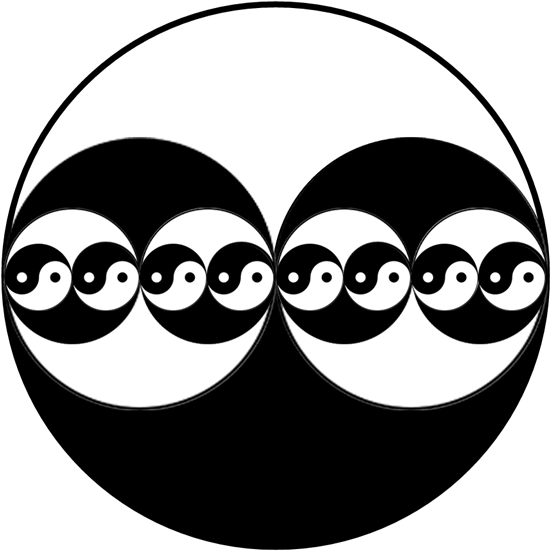
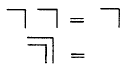
We ended the last installment noting that the first distinction must be of distinction, but this must be considered as a complex, recursive creation and simultaneous crossing of a boundary that is just precisely the boundary between that very activity of its creation and the fact of it as created.
To get at this another way, we can point out that the Glanville has actually hit on elements in this direction already, but (it seems) hasn’t quite put it together in the same way. Remember that the whole time we have been talking about the first distinction we are also talking about “the observer”, which we could call a “self”. It may even be worth revisiting some of the above text with that implicit translation in mind. I remind you of this because, Glanville, in his essay The Self and the Other: The Purpose of Distinction, is exploring solutions to the problem of infinite regression that arise when the mark doesn’t distinguish itself from its value, and he uses “self” and “other” to hold the logic of “mark” and “value”, which is perfectly fine.
Glanville notes that we have a set of relations that are implicit in each other: that between self and other: “the fundamental distinction between self and other [read: between the mark and its value] cannot be more fundamental than the distinction of the self, nor can it be less so: another circularity, another reduction of hierarchy” (p. 3).
Except that this isn’t a reduction of hierarchy. It is actually (more…)
We take as given the idea of distinction and the idea of indication, and that we cannot make an indication without drawing a distinction. We take, therefore, the form of distinction for the form.
If this doesn’t strike you as having a “mystical” flavor, then you are drinking the wrong concoction. I’m not going to try to explain this, but rather I’m going to try to re-frame it; you could say, in GSB-approved language, that I’m going to re-mark it. The important thing to note about this, the very first “official” sentence of the LoF, is that it is recursive. Let’s be clear: the Laws of Form (not the book, the LAWS) are only possible because of a recursion, a throwing back on itself of itself. But a throwing back of what onto itself?
Well, “nothing”, of course; but nothing understood as what everything would be if it were.
But of course nothing doesn’t remain nothing (well, it does, but it doesn’t), because here we are. The question GSB is really attempting to get at is the question: (more…)
The following is my response to a recent article by Eugene Schwartz entitled “Anthroposophy and Waldorf Education: The Web as Will and Idea”, which is Eugene’s response to an article by the renowned anthroposophist Sergei Prokofieff, who wrote a remarkable article entitled “The Being of the Internet”, in which he argued that the digital media are carriers of such darkness that they are unredeemable. The following will make the most sense if Eugene’s article (and ideally Prokofieff’s as well) is read first, but can still stand on its own as my opinion.
Eugene has written a timely and well-considered article. As someone who has “grown up” (at the time of this writing I’m currently 33) watching and participating fully in the birth of the internet (I had an email address years before the world wide web existed), I am disheartened when anthroposophists shy away from what I consider to be an important task: the appropriate usage of these new kinds of technology.
By appropriate, I mean utilizing the technology as a means of furthering a progressive human development. Of course what constitutes “progressive” or “development” can be hotly debated, but for me this involves not just empowering people through providing access to information of an esoteric nature that they might not otherwise have, but in providing the context for the shared creation of meaning in ways that are dynamically capable of leading towards real transformation.
The ahrimanic nature of the internet lies primarily in the way that supports the decontextualization of meaning-making from the soul lives of its human participants. It allows us to abstract too easily, to decontextualize parts of ourselves in ways that challenge a healthy development. But at the same time the internet is the potential carrier of both luciferic impulses (getting willfully lost in online environments, expressions of rage, rampant self-satisfaction seeking opportunities, etc.) and Christ impulses as well.
As always, the Christ-like impulses are a bit more subtle, a little less oriented towards appearing with a particular veneer, but no less powerful for all that. I am speaking of how the internet is used to help bring groups of people together in ways that fosters both community and action, and which promote love and change. This occurs not merely through sharing information, but in the literal creation of an in-between space which can be filled with the soul-activity and spirit-light of individual wills. This, I think, is what it looks like to “redeem” the internet. It happens when people are given tools to become active participants in the dynamic creation of meaning that fosters transformation and love.
The challenge, as with the bringing into one’s heart of any Christ impulse, is that it occurs not by default, and not by control, but through a conscious surrendering of one’s will to a higher will, which is experienced both as a suffering and a redemption. Ahriman, I imagine, would like us to use the internet to manipulate and control so that we forget the much greater power available through this kind of conscious suffering, while Lucifer would be happy if we continued to use the internet to satisfy our desires and create infinite personalities for ourselves.
The alchemists understood that nothing could go untransformed if the magnum opus is to be achieved. Their saying “As above, so below; as below, so above” was not an academic one about correlation; it meant that in order to reach the highest potential available to us, we had to transform our lowest aspects. This applied too to the outer world: nothing could ultimately go unredeemed, and if we ever decide to “write off” some aspect of reality as beyond hope, beyond action, and beyond transformation, then the forces of darkness will claim a victory.
We must work together to build the world we wish to live in. It is a horrible mistake to try and divorce technology from morality, and to claim that “it’s all in how it is used.” Some technologies are more evil than others, but the internet is not an atomic bomb. The development of the internet, although beginning as a defense-oriented technology (not incidentally as a technology to help counter the potential effects of nuclear weapons), almost immediately was taken up and used for other means; primarily education. There are countless ways in which both the development and usage of the internet fosters healthy development of human beings–in ways not completely without strings, of course, but also not in ways that make its usage “unredeemable.”
What we cannot do is let the regressive impulses have their way with the internet and co-opt the minds and souls of human beings for their own uses without a Michaelic challenge, a challenge for the creation of spirit-based groups of individuals (which are different than just ‘groups’), a challenge to permeate the spiritual spaces of the internet with transformed will, with conscious sacrifice, with love of transformation and a transformation of love.
The drawing of a distinction is a formative act.Drawing a distinction FORMS the space, constellates the infinitely possible unknown into spaces which are shaped by the particular WAY in which the distinction is drawn.The resulting spaces can not help but take the complementary shape of the distinction that defines them.
The drawing of a distinction is an INformative act.Drawing a distinction INFORMS the observer to distinguish the space like this.The resulting shape of any possible knowledge within the space cannot help but be informed (formed-in) by the particular way in which the distinction is drawn.
The distinction is an epistemological act that creates itself, and in so doing, is also the creation of the space in which the distinction occurs, as well as of the observer who makes the distinction.
There are levels of distinction; distinctions can be made about distinctions, and distinctions can be made about those distinctions…
Distinctions are atemporal and aspatial.They are the primitive act.The distinction between the distinction, the space, and the observer are all formally equivalent, just as the three interior angles of a triangle are all formally equivalent.In other words, they are interchangeable in any process that specifies ANGLE.
The only process that specifies distinction, space, and observer is DISTINCTION.The form (which is the same thing as the LAW of form) is an ouroboros.
Consciousness is the consciousness of distinction.That is to say, consciousness is distinction; it cannot be other than consciousness of distinction.Therefore consciousness is co-extensive with all distinction.What is distinguished is conscious of its distinction; this is why there is distinction; this is why there is consciousness.
Time is a higher order distinction that requires recursivity.It is a distinction about a distinction.Time is dependent upon the oscillation of distinction between two states made by that distinction.Time is the injunction to cross the boundary between the states, and once crossed, to cross again.The crossing is atemporal.Only the distinction of the crossing is temporal.The distinction of the crossing of the distinction is time.
<—————-distinction—————->
Now, I have no idea if any of the above is sensible or insensible <crossing boundary: its sensibility or insensibility is only possible on the basis of the distinction as such.In itself it is neither sensible nor insensible, but what it would be if it could> but it has raised some questions for me:
Is distinction ONLY binary?Is distinction always between this state and that state, that is, between one and another?Is it possible to distinguish not just between one:one, but between one:many, between one and another+another+another?In other words is this a binary reductionism? <crossing boundary: yes, if this binary distinction is made.now make another distinction.>
Okay, but what about the, um, distinction in quantum mechanics of the possible eigenstates of the wave function?There are an infinite number of possible eigenstates for any given system (even the simplest), and they must ALL be taken into account (their probabilities must be worked in to the equation).Then, out of the whole field of possibilities, ONE is observed.In the observation, all the other possible values have a probability of zero, while the observed value has a probability of one.This sounds an awful lot like the idea that the fundamental act of distinction creates the space and thus the values of any distinction in the space thus created.Does this have any validity, either as an analogue or at least a metaphor? <X: Do you distinguish it as such?>
…
Okay I have another question.What happens if we DON’T DISTINGUISH?I mean, we don’t un-distinguish and we don’t distinguish.Without distinction… what happens?Is this (GSB language) a marked empty mark?
Crap!And can making a distinction of a distinction actually be the same as not making a distinction in the first place?