How you use your attention in waking life has definite effects in your dreaming life. The following is my distillation of some insights from anthroposophy in this regard, which I offer as one way of looking at this phenomenon, specifically around the issue of video games and dreaming. This post should provide an appropriate background if necessary.
If people are comfortable with the terms, we can talk about how the astral body (the subtle body that allows something outside to become something for us inwardly; i.e. the sense-body, which we share with animals) gains its content in large part by reflecting itself off of the etheric body (the less subtle body that keeps your body from becoming a corpse, which we share with the plant realm).
When you spend hours of time focusing your senses on particular stimuli (i.e. a video game) your are patterning your etheric body through physiological repetitions: the movements of your eyes, hands, breathing, etc., and more importantly in the endocrine responses and other physiological changes that go along with the particular game experience. Knowing why this is important needs a little background first.
When you go to sleep, and you are no longer imposing your astral body on your etheric (i.e. choosing where to direct your attention and what sensations you will seek and avoid) your etheric body starts to (more…)
What Julian Assange COULD have said to 60 Minutes’ host Steve Kroft’s question: “Are you a subversive?”
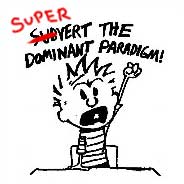
Assange: Am I a subversive? Not at all; in fact, you can say that I’m a superversive. Do you know where the word “subversive” comes from? It’s from the Latin sub + vertio. Sub means “underneath” or “below”, and vertio means both “to turn around” and “to understand and upset”. Hence the meaning is usually given as “to overthrow” or “destroy”.
The key to subversion is that it is carried out underneath, in secret, below the radar. The real subversion is the act of keeping important truths hidden. By hiding important information concerning corrupt practices, corporations, governments, and individuals cannot be held accountable for their actions. In this sense, it is precisely the corrupt practices of such entities that can rightfully be called subversive, because they turn around, rout, and overthrow the public’s ability to respond to their behavior. Keeping corrupt practices secret subverts our consciousness by putting forth a façade that is not commensurate with the actual behavior. This is the tactic almost universally employed by corrupt organizations, governments, and individuals: to maintain (more…)
Everyone dreams, but few people find sufficient interest in their dreams to move beyond mere curiosity at their strange contents. Even many who work with dreams as a part of a transformative practice usually concentrate on their content, and only more rarely question their form, ontology, and origins. Exploring these aspects, however, can help provide a context that helps orient dreamers to some of the esoteric underpinnings of dream etiology (their meaningful origins), and can help enliven dream-based transformative practices. This article is an attempt to show how a spiritually-oriented understanding of the makeup of the human being gives a context for understanding different types of dreams, their origins, and some associated consequences for dreamwork.
The language of spiritual science, also called anthroposophy (human wisdom) will be of help in this endeavor, because it maintains its cogency across multiple phenomenal realms (such as those of sleeping and waking), and because it has as its aim the ability to make clear and coherent processes which work within the physical realm but have their source beyond it, in the spiritual worlds. Fundamental anthroposophical terminology will not be explained in this article for reasons of space, and neither will the basic anthroposophical view of dreaming in general. For a brief introduction, I highly recommend that readers peruse this article: Sleep and Dreams in Anthroposophy, which provides the context (more…)
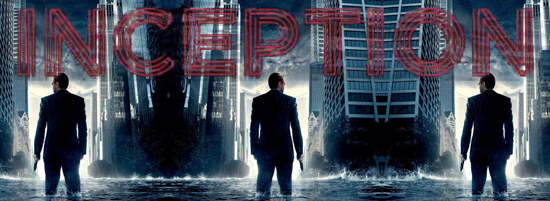
The movie Inception is the best “question reality” movie since the Matrix (ultimately the Matrix is better, in my opinion), and it raises many fascinating questions having to do with the differences between the two primary states of consciousness available to humans today: waking and dreaming.
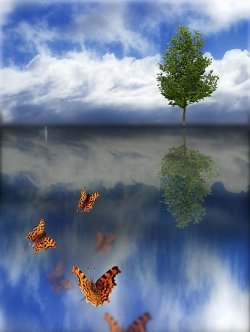
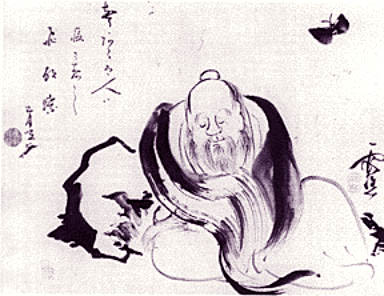
This issue has been around for about as long as recorded history, and has formed a central piece of some very detailed philosophical considerations. It shows up in the 4th Century B.C.E. in the famous Taoist Zuangzi’s “butterfly dream”:
“Once Zhuangzi dreamt he was a butterfly, a butterfly flitting and fluttering around, happy with himself and doing as he pleased. He didn’t know he was Zhuangzi. Suddenly he woke up and there he was, solid and unmistakable Zhuangzi. But he didn’t know if he was Zhuangzi who had dreamt he was a butterfly, or a butterfly dreaming he was Zhuangzi. Between Zhuangzi and a butterfly there must be some distinction! This is called the Transformation of Things.”
It also forms a central part of Indian philosophy, especially advaita vedanta, which explores cosmological questions through the exploration of (more…)
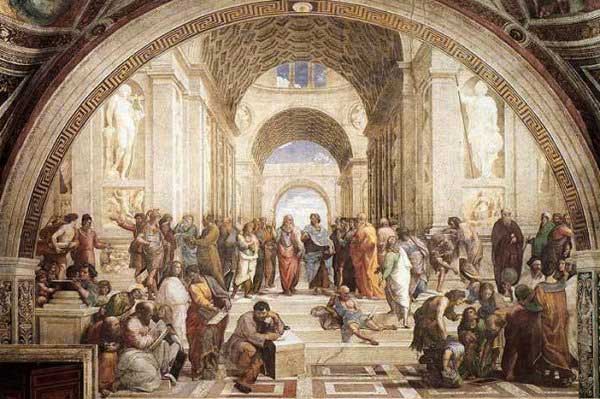
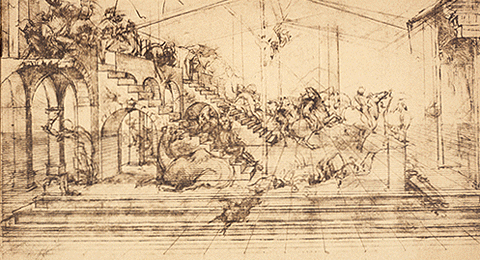
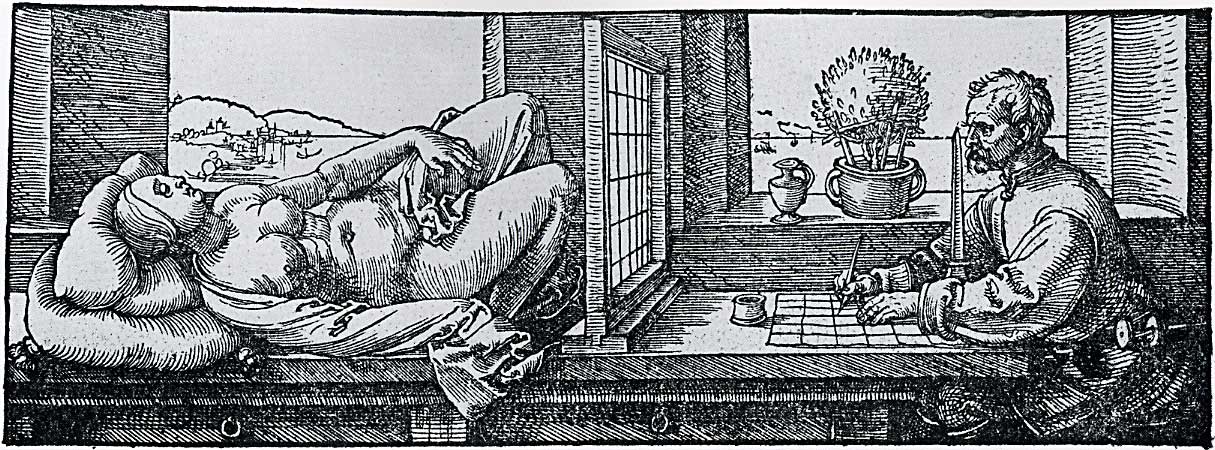
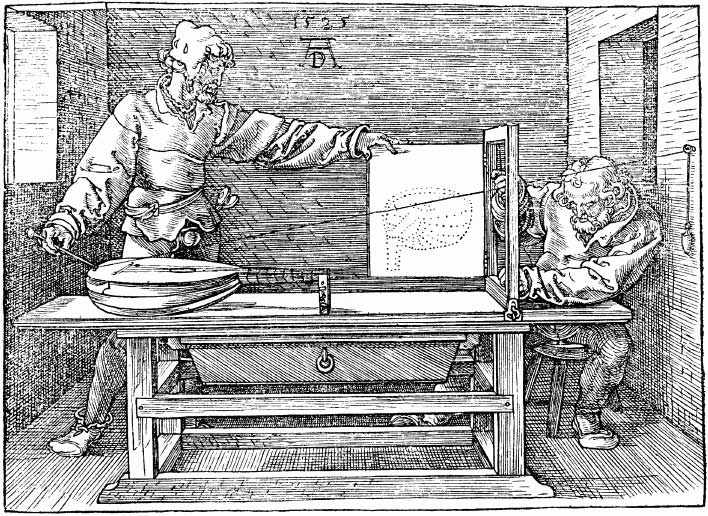
The “discovery” of perspective was a radical point (pardon the pun) in the development of art, and was intimately tied in with a whole shifting of consciousness during the time of the Renaissance and forward, having correlative expressions in the increasing reliance upon an “objective” perspective from which to view the world. Science in its modern form arose during this period as a methodological way of systematically removing subjectivity from observations, allowing data to be gathered which was amenable to enumeration and mathematical manipulation. The abstraction of the observer from the observed and the dissociation of both this abstracted observer and the observed phenomenon from the ever-changing background contexts that held both provided a powerful basis for a new way of being in the world.
Leonardo da Vinci: study for adoration of the magi
The laws of perspective allowed the world to be visually reduced, literally, to a point. Each point became a point in space from which the world looked a certain way, and the way it looked from one point always differed from the way it looked from any other point. It is interesting to note that the laws of perspective, designed as a basis from which visual scenes could be rendered on canvas in a way that accurately captured the “real” experience of our visual sense, required a reduction of the very visual experience it was meant to uphold. What I am referring to is the fact that perspective works from a single point, but the human being experiences the world through TWO such points. The laws of perspective required the literal and figurative shutting out of fully half of our visual experience.
Thus, in both art and in science, the central feature became one of representation. The art of the day was meant to represent in as exact detail as possible what could be viewed by a one-eyed person standing at a singular and exact location at a singular and exact moment in time. Similarly, the science of the day strove for theories that reduced human experience to its most basic forms, thus allowing for a further abstraction into mathematical language. Locke distinguished between “primary” and “secondary” qualities, and it was only the primary qualities that really mattered for science, because these could be objectified. This objectification was the equivalent of restricting vision to one eye at one point; each phenomenon could be interpreted “correctly” only from a singular point of view that was completely restricted and delineated in both space and time. The universe became a clock, and the human beings within it machines within the clock. “Truth” became something external to the human being, something to be discovered through the fulfillment of the promises made by the new scientific methodology.
Truth thus became as one-pointed as perspective drawing, subject to the perfect and known limitations of a small set of rules; all deviations were to be ‘explained away’ by recourse to the completely non-personal operation of blind forces. In art, ANYONE could presumably have the exact same visual experience as the next person if they stood in just the right spot at the right time; it took no special training or knowledge to interpret what was seen, because what was seen was reduced to its primal base: form and color in strict, law-abiding combinations. Ironically, the point, a completely abstract dimensionless non-entity, set the tone for our experience of all the dimensions of available to our experience.
Ultimately, however, this perspectival program was destined to destroy itself through its search for perfection. In art, the quest to represent visual experience led beyond form and color to the wider and fuller experience of vision as a whole. Many figures, from Goethe to Picasso, took part in a constructive dismantling of the dominant paradigm. In science, this occurred through the discovery of relativity and quantum mechanics, and later chaos theory, which banished forever the naïve reliance upon the point-like structure of previous generations.
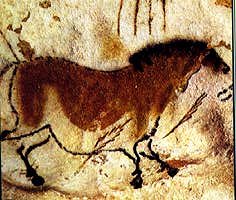
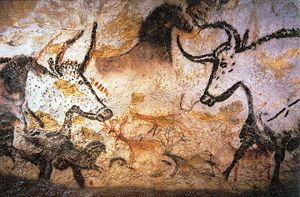
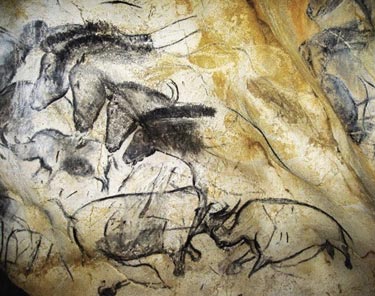
I’m actually somewhat uncomfortable calling Paleolithic renderings “art” – not because they don’t meet some standard set of criterion, but because of the very nature of the ‘calling’ itself seems to go against the experience of the makers of the art. See, there again, an assumption: “the makers of the art”, which includes a dichotomy between the producer and the produced. Our modern language is so full of this type of construction that it is almost impossible to get away from, or to recognize its influence on the content and method of our thinking – which is particularly problematic (at least if unrecognized) when we attempt to consider something like the inner experience of the people in the cultures which produced the images on the rock walls so long ago.
Paleolithic Art 2
Van James, in his book Spirit and Art, paints a picture (in the consciousness of the reader) of the process by which the art was created, including its cultural context, indicating that it had to do with a shift from participatory consciousness to one that had the seeds of self-recognition, and thus self-abstraction, as an essential component. I find this interesting because many artists throughout history, including today, mention something about the way in which one gets lost in the process of creating. This experience of the space between “me” and “my art” asymptotically approaches zero, leaving the artist with an experience of creation without “A” creator. Only retrospectively may an artist whose creating occurs in this state attribute the work rationally to some specific time period, place, and personality; but this knowledge does not need to be held in consciousness during the actual process of creation itself, and (as many artists know) may actively interfere with what might otherwise be brought forth.
Paleolithic Art 3
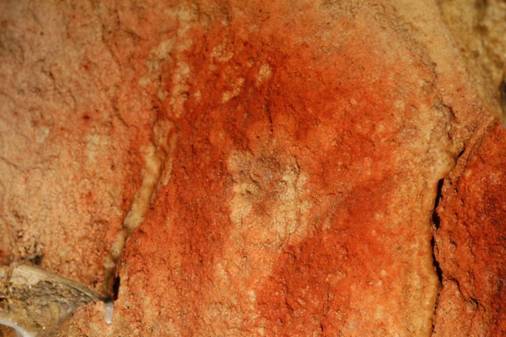
So I wonder if this experience – or LACK of experience, as the case may be – which characterizes some part of the process of artistic creation even today, may be something that was the ‘cutting edge’ of consciousness in the Paleolithic period. Jean Gebser’s “magic structure” (cf. The Everpresent Origin) speaks of this in a way similar to that of Van James, indicating that the art of this period was indicative of human beings waking up to themselves. Before this stage, (Gebser’s “archaic”), it is not possible to really speak of art at all, of creations “of” humans, because the consciousness was in identity with the world. It is only by transitioning to a consciousness of “unity” that art even becomes possible, because in “unity” is already contained the indication of multiplicity, as multiplicity is required in order for unity to be brought about (otherwise one simply has identity). Thus Paleolithic art may exemplify this transition in consciousness from identity to unity, which gives expression to sensory and magical experience in a form that takes this experience even further, strengthening it recursively through the very act of its creation. The painting of animals, of human figures, and of stenciled human hands may serve as a ‘catch’ for consciousness, by which it can step outside its mode of identity (akin to dreamless sleep) and into a mode which recognizes the beginning of division between the human being and the world (akin to dreaming sleep).
Paleolithic Art hand
So perhaps the pictures of animals and such on the cave walls are not really pictures “of”, but are rather more like techniques for transforming consciousness. We moderns are taught to pay more attention to things rather than processes, so we tend to see the results of some activity as the most important ‘thing’ to consider, i.e. the art itself. But maybe this was not always the case; maybe Paleolithic art was ‘something’ primarily in its making, in the process of its unfolding (such as in Tibetan sand mandalas, or Native American healing mandalas), and not so much in its product, the image on the wall. But, recursively, the production of the images may lead one who views it but does not create it, into a different space of consciousness – a space which invites both a ‘connection to’ and a ‘disconnection from’ at the same time. Maybe the Paleolithic viewer of Paleolithic art was both put into connection with the cultural significance of the art in an experience of magical unity with the forces identified by the culture, while also being called to experience the art in a way that called forth something from within that necessitated a concurrent experience of the without. The very experience of one’s unity with the world perhaps awakened the first seeds of dis-unity, of separation between what would eventually be one’s “self” and “the world”.
Edgar Morin, who calls for a transdisciplinary way of thinking, wrote an amazing short essay entitled “A New Way of Thinking”. (A New Way of Thinking.pdf) One of the principles of this new way of thinking involves recognizing that wholes and parts are mutually interactive: “properties emerge from the organization of a whole and may have a retroactive effect on the parts”
Consider water. Water is commonly thought to be the simple combination of two hydrogen atoms with an oxygen atom. We say “H2O” like we know exactly what we mean, and usually what we mean is something like H2O = H + H + O.
But this way of thinking is wrong; something fundamental is missing from this thinking. We cannot conceive of water as a simple addition, because in the process of coming together, the very nature of the individual pieces is changed.
A hydrogen atom in a water molecule is NOT THE SAME as a hydrogen atom in isolation. It’s very structure changes, precisely because it is now in a relationship, or rather, we could say, a continual process of relating, and this relational process has consequences for both the hydrogen and the oxygen (and the other hydrogen!).
“Water” is thus a picture of a certain ongoing relationship between hydrogen and oxygen in a complex way. The emergent properties of water coincidently retroact on the process of this relation. The properties of water are both more and less than the sum of the individual parts.
An alchemical understanding of water jives with this understanding from the realm of transdisciplinarity. Water, alchemically, can be considered “process”. It is the substantive manifestation of the principle of relation. The alchemists understood that relationship always had a transformative effect, whether on a physical substance or a soul-substance.
Dissolution was thus a phase of the Great Work; the bringing together of disparate elements via a liquid phase served to lessen the tendency to interpret the individual elements individually, as separate and isolated bits. This occurs through the careful application of heat. This ‘phase-transition’ set the stage for a further transformation, in which substances dissolved in solution could be further refined through an additional application of warmth, driving off the more volatile substances that were invisibly suspended in solution, while simultaneously the less volatiles substances precipitated out of solution and became an ash, which itself had to be purified so it could later come back into a completely new relationship with the volitalized elements.
Alchemy embodied the holographic principles held as foundations for transdisciplinarity by Morin: the whole in the part, the part in the whole, with retroactive effects and emergent effects as a consequence.

 Consider water. Water is commonly thought to be the simple combination of two hydrogen atoms with an oxygen atom. We say “H2O” like we know exactly what we mean, and usually what we mean is something like H2O = H + H + O.