I was asked to draw my dissertation (which is in its beginning stages).
Here’s what happened:
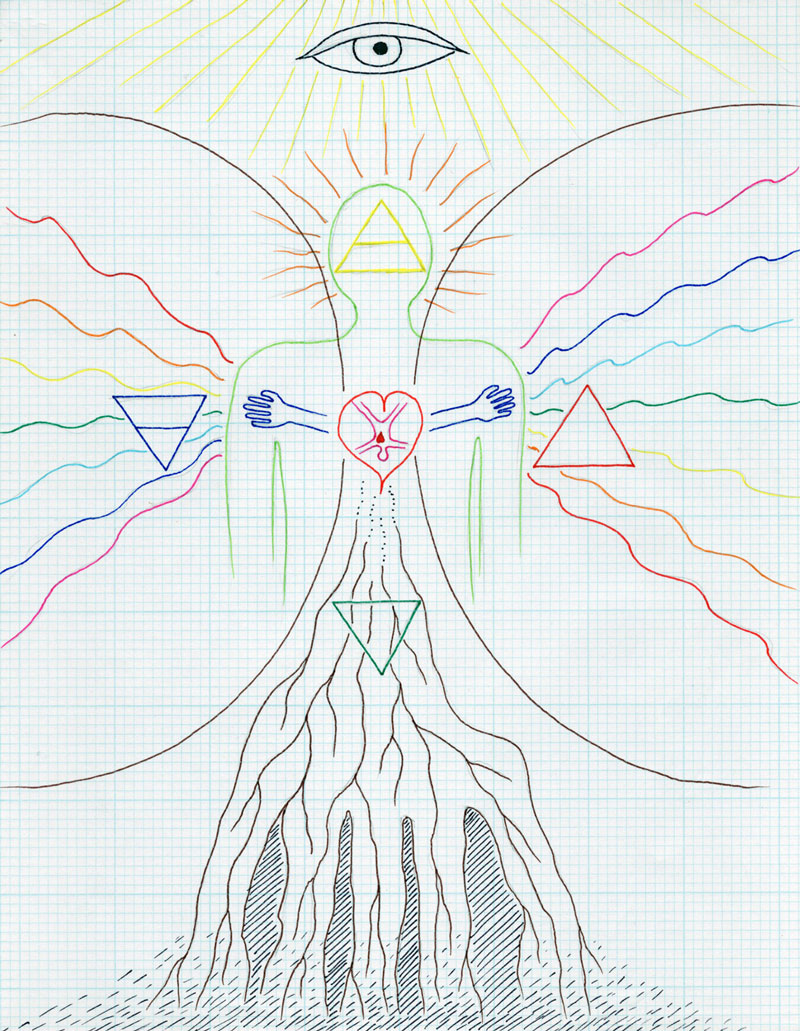
I was asked to draw my dissertation (which is in its beginning stages).
Here’s what happened:

Bifurcations are “splits” in the way a system develops from one state to the next. Think of them as two roads diverging in a yellow wood; one leads to some unknown mystery. The other leads to MILKSHAKES (stay tuned).
My understanding is that bifurcations are always relative (did that paradox slip by you?); depending upon how you look at the system you my find quite ‘steady’ states, or at least steady states within limits (which are generally set by the way you look at the system). Take a different look from a different perspective and you might find bifurcations going on at a different level while some OTHER level maintains its steadiness. This is the whole “order is maintained through change” and “change is maintained by order” song and dance. (Not familiar? Welcome to CYBERNETICS.)
Usually bifurcations occur when energy from ‘outside’ is introduced into the system. Bifurcations don’t occur just because “time passes”, but that as time passes you typically get changes in the amount of energy available for a system. The usual channels by which order is maintained through lower-level change can no longer handle the energy in the same old way… leading to a bifurcation where multiple new possible states result (but quite notably, NOT the ‘old state’–at least as far as I’m aware… Input anyone? Anyone? Beuller?). But those new states are usually less stable and more sensitive to changes in energy or initial conditions; drive the energy up even a little more and you get bifurcations of the bifurcations… and so on. But then, WHAM! More and more and more chaos produces… not more chaos, but suddenly ORDER… a very FEW possible states that sort of ‘collapse’ all the previous activity into a limited set of possibilities. WEIRD. The upshot? Add energy/action/motivation/enthusiasm/motion to a system and things can get a lot more interesting… and FAST. You know this because you have some friend who always takes things one step too far at parties.

Now this does not describe all chaotic systems, at least as far as I am aware, but does give a good picture of how chaotic systems can evolve in general. Now a friend of mine was wondering (he’s not a normal guy; he’s WAY cooler, you can tell because his name is SNAKE) whether humanity as a whole is wasting a lot of time thinking about transforming when we should just take a cue from the caterpillar, who sets up a chrysalis and can just hang out, because transformation is just going to HAPPEN, without having to do anything to produce it. Despite the fact that this is something of a bastardization of his point, it serves my purpose here.
Now it would be nice if we could just sit back and watch humanity transform like a caterpillar into a beautiful soaring butterfly… but more likely if we sat back to watch the show we’d end up with some kind of oozing slime-mold, or “Twilight“. Ummm, I could be wrong about the slime-mold thing, they are actually pretty awesome. The POINT is that a caterpillar changing into a butterfly takes a LOT of energy; it’s not a ‘quiet, relaxing period’… but one where the caterpillar more or less EATS ITSELF (“Ouroboros, table for two, I mean one?”). Have you ever tried to digest yourself? Well you do every day. Eat a big lunch and get the afternoon sleepies because your liver just got slammed with an order to break down a milkshake so it doesn’t end up in your blood, clogging your arteries. “Too much to do here!” says your liver to your consciousness. “You need to get outta here cause you are holding up my work.” Zzzzzzzzzzzzzz.
From your perspective you didn’t have to “do” anything to digest your lunch. But on a systemic level we are talking serious amounts of activity… it’s just that the activity is occurring on the basis of processes that are not readily available to your consciousness (even if you remained awake). The system as a whole is changing its state — bifurcating, if you will — because 720 calories of ice cream is a LOT of energy, which drives the system from its previous ‘steady’ state.
Now we can eat milkshakes for lunch (for the record, I have… okay DEFINITELY done this before) and have the systemic relationships activate which result in our loss of ability to influence the system effectively, or to even be aware of where it is headed… Or we can maybe snack on some almonds (or at least eat a reasonable meal–from your liver’s perspective; THINK OF YOUR LIVER!!!) and help steer the context towards one that can more robustly handle the higher-level situations (boss yelling at you, papers to write, world peace and such), which you can’t do very well when your consciousness gets kicked out by your much more powerful digestive processes.
There is some sort of dynamic harmony (not really BALANCE, which is too static) here; you need enough energy to keep the system from stagnation and ossification, but not too much energy that you drive it too fast, yielding bifurcations too quickly (cancer), which pushes the system into a new steady state by virtue of undesirable transformation (death).
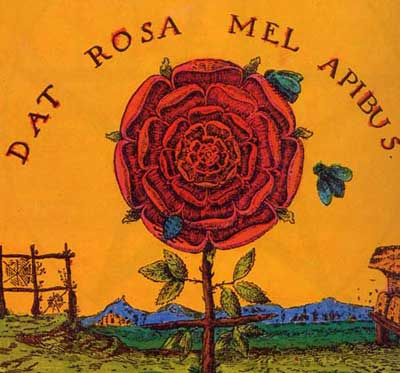
As the Rosicrucians were fully aware, you can’t avoid death, BUT YOU CAN DIE BEFORE YOU DIE. By consciously approaching these processes (rather than them approaching you–too late!), they discovered that we could have ‘little deaths’ that allow us to experience the world in a more engaged and subtle and effectively wise way. This was a form of conscious suffering.
And these sorts of processes DID have some order. There were various stages, and it was VITALLY important not do to things out of order; this could ruin the whole work. Alchemists discovered quite a few different processes (every “stage” is really a process), but to boil it all down and oversimplify it you have something like this:
1) Undifferentiated unity (prima materia)
2) Differentiation into parts
3) Purification of parts
4) Integration of parts into a new unity (what I call a “differentiated unity”)
And all of THAT can be summed up in one nice Greek word (perhaps coined by Paracelsus): Spagyrics, from spao, to tear open, + ageiro, to collect.
So in terms of alchemical processes, the WHOLE THING can be understood as a big cycle of taking apart and putting together, with the purification of the parts implied by the fact that they can be put back together again. Thus, at the very least, this is the most important and significant ‘order’ to any alchemical process. All the other sub-processes are, shall we say, bifurcations of this large gesture into smaller and smaller sub-cycles.
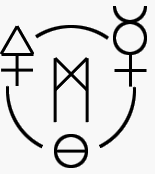
Now if you want to get real alchemical about it, it might be worth pointing out that there were three basic ‘gestures’, which was another way to understand this process. They were called Salt, Sulfur, and Mercury.
The Salt corresponds to the taking apart, the Mercury to the purification, and the Sulfur to the re-integration. You’ll find these three processes ALL OVER alchemy, precisely because they represent the WHOLE WORK. These three physical substances exhibited properties–really qualitative transformations, which we usually call ‘processes’ because we like to think we are scientific–which embodied in the material realm the qualities that were found to describe essentially ANY transformation, and came to stand for the higher-level ‘gesture’ of a three-fold transformation of unity into unity.
Simple, huh?

A response to the question: “How is chaos theory non-determinant?”
This is an interesting question, because I think it might normally be asked in the opposite way: “How is chaos theory DETERMINANT?”, because chaos theory is, well, chaotic, so it seems more logical to connect chaos with non-determinancy than with determinancy.
So to explore the question that wasn’t really asked:
The techniques which we have discovered that allow us to analyze systems that exhibit chaotic behavior are completely deterministic: they are mathematical in nature, having the feature of acting like an Ouroboros, where the output becomes the input in a recursive cycle. We can start with even very very simple systems, and show how chaotic behavior results when the system evolves, when that system’s evolution takes place in ways describable by this type of recursive mathematics (not all systems are so describable). Really the MATH isn’t the thing here, it’s rather the RECURSIVE PROCESS, RULE, or PROTOCOL that is important. The math is just a really nice and clean way of expressing the essence of what happens when a system evolves by following a recursive rule.
 So chaos THEORY is determinant in that the rules which it utilizes to describe evolving systems have the potential to be calculated EXACTLY from iteration to iteration. In other words, if we had a computer that could deal with an infinite number of digits we could theoretically pinpoint the next iteration describing the state of a system at the next moment with complete precision. BUT, there are serious caveats to this when applied to anything beyond the purely mathematical formulations themselves. REAL systems may be more or less calculable, more or less complex, and more or less willing to submit to the precision capable in theory. The determinacy of chaos theory is therefore more like a theoretical determinacy, having a dubious ontological status. I won’t get into the very crazy and amazing philosophical arguments that whirl around such things, to your immense relief. Suffice it to say that THE WORLD IS MYSTERIOUS, and we have to be careful when dealing with the connection between our thinking and our observing.
The ‘problem’ with chaos theory is that we can’t observe closely enough to know where to START our calculations, so we ALWAYS know that they are ‘wrong’ when dealing with the actual observable world. This is that ‘sensitive dependence upon initial conditions’ thing again: there is no lower limit at which a difference does not potentially make a difference, even ALL the difference. In other words, even the smallest possible change cannot be ignored. The thing is that we can never know ahead of time when such a difference may be either influential or inconsequential – we have to let the system evolve in actuality in order to find out. We can’t calculate the future states of the system (which are theoretically determined!) with much success because (depending upon the system’s complexity and initial state) as soon as we get a few iterations under our belts our calculations tend to diverge from other initial states that were infinitesimally close to the one we are actually calculating. So our results tend to be so far off from what we will later actually observe that we start calling the whole thing a theory of CHAOS, even though every step in the process is ‘determined’; hence “deterministic chaos”. So even today a large bulk of weather predictions are based not off of complex theories of high pressure and low pressure zones, temperature gradients, moisture content, and such, but rather simply off of a comparison with past ACTUALITIES. Predictions START with a comparison of the averages for a particular place for that same day in previous years, because this is often a better predictor than if we were to try and start with vastly incomplete current data. The best predictions, of course, blend the two methods, but you’ll notice that nobody (okay, this isn’t true, but such people have completely different methods for prediction) is giving weather predictions much beyond a week or two at best. This isn’t just a fault of our weather theory, but is a consequence of the RECURSIVE NATURE OF NATURE.
So what is interesting is that our understandings from quantum physics put us in the strange position of having to admit that WE CAN NEVER HAVE PERFECT KNOWLEDGE of the state of any system – no matter how simple. So we can’t even hold on to some ‘theoretical’ exactness that would be possible if only we had better instruments, or more complete observations. THERE IS NO SUCH THING AS A COMPLETE OBSERVATION — at least in the sense of what had been the promise and holy grail of physics before the s**t hit the fan with relativity, quantum mechanics, Gödel, and chaos theory. It turns out we live in a dirty universe, which is much more crazy and mysterious than we had imagined or hoped.
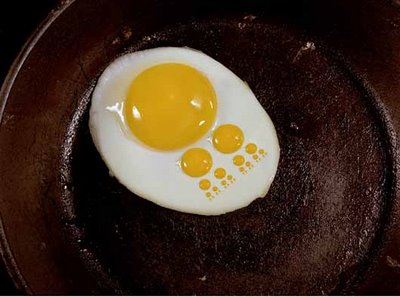
But what is key here is that chaos is not a result of linear progressions, but is more or less inherent (in systems with almost any level of complexity) when the Ouroboros steps in and finds its tail: recursion yields chaos. I find this fascinating, because so many (all?) parts of the natural world utilize recursion as a technique — particularly in the living realm, but even in the purely mineral realm as well. Whenever nature comes up with a new process it tends to repeat itself if the conditions allow it. This repetition can easily become recursive, where some aspect of the process acts upon or is acted upon by some other aspect of the process. When this happens you usually either get a complete breakdown or cessation of the process (a sort of suicide process, sometimes through growth), or you get emergent complexity, homeodynamic systems, self-regulating organization, and the basis for higher-level recursions.
At the same time, every recursive process is — although perhaps potentially infinite — embedded in a contextual situation that provides limits and boundaries to the system’s evolution. Sometimes it happens via a law of physics, sometimes as a consequence of mathematical relations in the context of physical laws (as in the increase in volume with the cube and the surface area with the square), and sometimes it’s just the seemingly contingent facts of context (it doesn’t rain that year, the food runs out, the salinity changes slightly, and so forth). The point is that these contextual limitations are not usually a part of the chaotic models proper. Rather, the chaotic models become themselves modified by through a corresponding synthetic analysis of contextual facts. The Mandelbrot fractal is what it is because it does not have to evolve in the context of anything REAL; it is an ideal form through and through. This is why we only find approximate fractals in nature, forms which approach the self-similar repetition of mathematical models. But rather than say that nature’s forms approximate mathematical laws, maybe we should say that our mathematical laws approximate nature’s forms. Maybe the laws we use to think about these forms are one of the ways that nature involves itself in a sort of grand recursion; the mathematical laws are like a high-level iteration of a process which at a lower level is much more messy and dynamic, but now has the benefit of taking place completely within the consciousness of a human being, thus allowing it to reach a new level of emergent complexity, i.e. the laws of emergent complexity themselves.
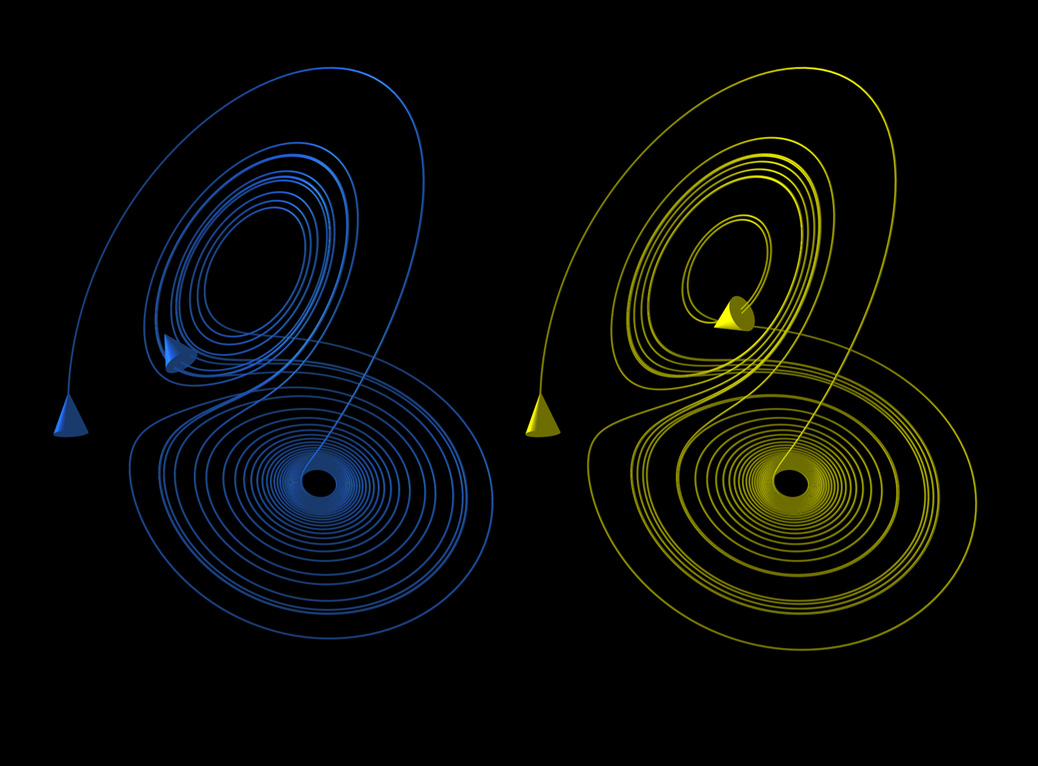
4. I don’t understand how the butterfly effect looks like the structures seen in the book…a butterfly looking pattern.
The butterfly effect is just the name, slightly arbitrary, of the idea that complex systems exhibit the characteristic by which tiny tiny tiny (infintesimally tiny) changes in one part of the system have the potential (not always actualized) to transform THE ENTIRE system, on all its scales. The Lorenz attractor kind of has the shape of a butterfly, and can be an image that is used to explain this sensitive dependence on initial conditions, but don’t worry about linking the Lorenz attractor specifically to ‘regular space’.
Drawings like that are actually drawings in what is known as “phase space”, which is simply an N-dimensional space where each dimension is represented by a change in ONE variable. The point of such diagrams is that they can incorporate simultaneous changes in many different variables at the same time (although visually there are limits on how to do this, because we are always projecting back into 2D space; holograms would help, but would only add 1 more spatial dimension in which to visualize, whereas there can be an INFINITE number of dimensions to map, depending on the phenomenon and how complex we get in our analysis).
A dimension here is just the abstract space in which any single variable can be tracked, such as distance (up/down, left/right, forward/backward, yielding 3 dimensions that can be mapped in phase space), time (adding a 4th dimension in phase space), or anything else that we want to track, like ‘population number’ or ‘frequency/color’ or ‘subjective happiness rating’ or ‘distance from Antares’ or ‘fractal dimension’ or WHATEVER.
If you wanted to plot two of those variables you could do it on a simple cartesian XY graph; this is a 2D phase space. If you want to track three variable simultaneously, you need to add an extra axis, giving a 3D phase space. But you can graph things in unique ways, for example by varying the color according to some rule that links the color with a variable, say temperature (you’ve all seen graphs and maps like this). You can use more tricks to get more data in a phase space plot, but when it gets beyond 3 or 4 dimensions most scientists (and mathematicians especially) drop the visualization completely and just stick with the math — you get tables of numbers, each ‘row’ representing, for example, the state of the thing you are tracking, including all of its possible variables at that moment. The next row would show the state at the next moment, and so forth. Then you can just choose two or three of the possible N-dimensions and graph them against each other, and then take a new set, and so forth, until you see patterns.
FROM WIKIPEDIA: BUTTERFLY EFFECT
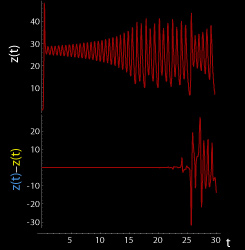
These figures show two segments of the three-dimensional evolution of two trajectories (one in blue, the other in yellow) for the same period of time in the Lorenz attractor starting at two initial points that differ only by 10−5 in the x-coordinate. Initially, the two trajectories seem coincident, as indicated by the small difference between the z coordinate of the blue and yellow trajectories, but for t > 23 the difference is as large as the value of the trajectory. The final position of the cones indicates that the two trajectories are no longer coincident at t=30.
Cool java applet showing the same principles: http://to-campos.planetaclix.pt/fractal/lorenz_eng.html
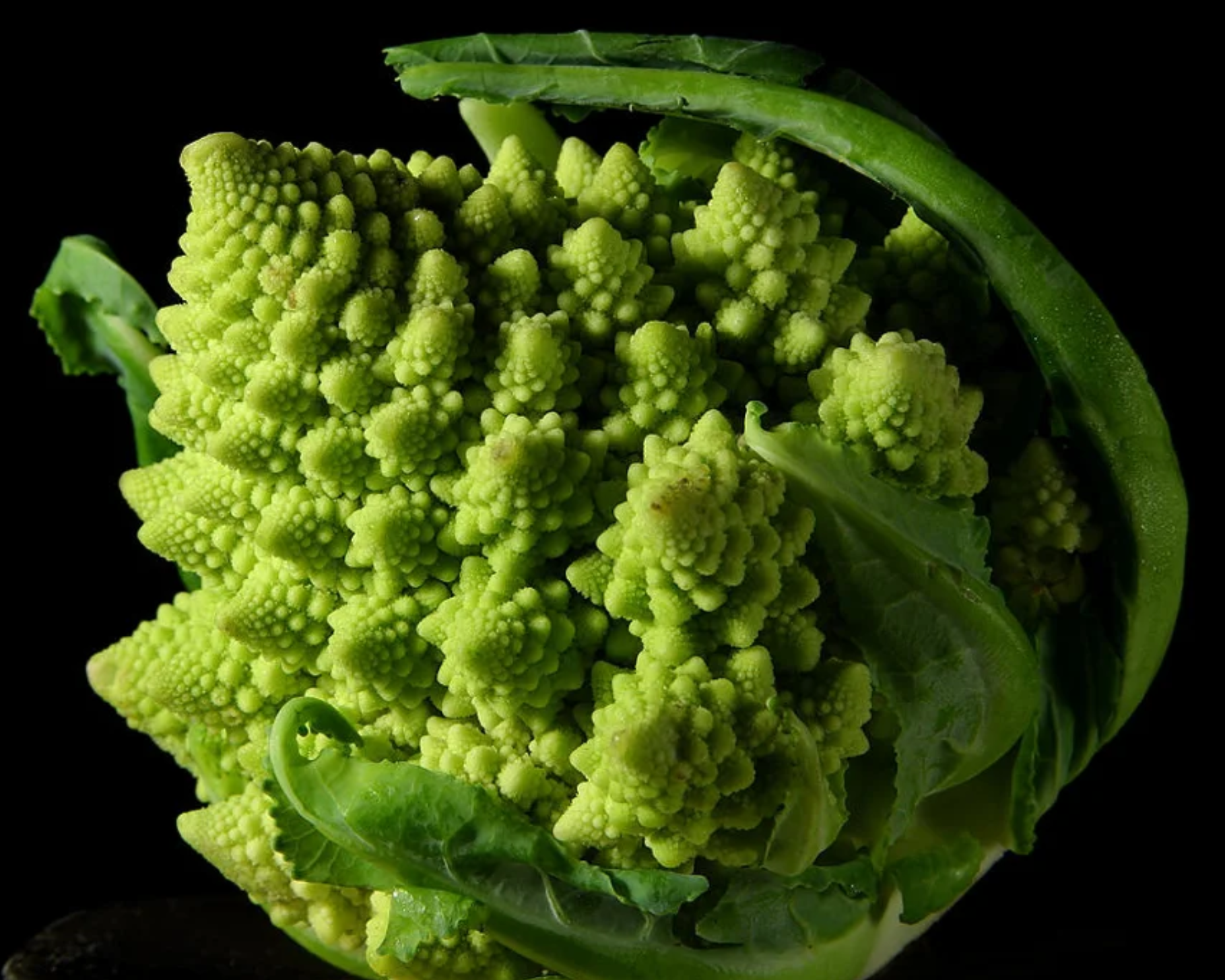
3. And so, there’s all this talk about ‘deterministic chaotic systems’… What exactly, is the stunning significance of this? I think I get that every shape in nature is ultimately created by patterns of itself within itself, but I’m confused as a biologist or physiologist or biochemist because things like continents are made of trillions of completely different molecules of matter. How does that relate to fractals?
The stunning significance of deterministic chaotic systems is that the Newtonian paradigm which equated determinism with complete predictability (ala Laplace) was shown to be WRONG. Chaos theory shows that we can have deterministic systems that are simply NOT PREDICATBLE. It is also stunning because the mathematics of fractals has helped us gain much deeper insights into some of the important vexing problems that stymied Newtonian-style thinkers (non-linear systems, fluid flow, etc.). It has fundamentally changed our view of the universe. It is often said that in the 20th century the most important epistemological advances were 1) Relativity 2) Quantum Mechanics, and 3) Chaos Theory, with 4) Goedel’s Theorem as another important, but less well-understood revolutionary idea.
Fractals are NOT only in the realm of geometrical structure; this is simply where we have the easiest access to their manifestation. Fractals can also describe the pattern of any iterated process. So you can have fractal family dynamics, in which large scale interactions are repeated on smaller scales, both in the sense of emotional scale and time scale and so forth.
Also, not EVERY shape in nature is fractal. There are plenty of non-fractal shapes, but it does appear that fractals are an intimate aspect of nature’s expression (and more accurately, evolution).
2. Does the fractal model also work for dynamic, fluid or changing shapes?
Yes, in fact this is it’s most ‘natural home’ I think. The reason is that fractals are about processes, not things, and processes are just that: descriptions of changes, not of things, and changes have a way of, well, being DIFFERENT the next time you look at them. So there are ‘orders’ or ‘levels’ of change, described by the number of levels of description required to get to the point where the pattern is invariant.
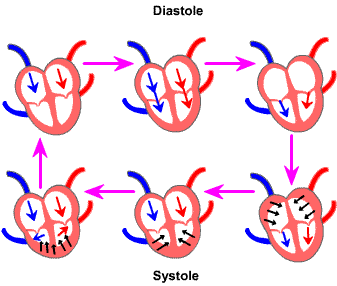
Your blood is constantly changing (systole, diastole), at this level of description there is no constant, because your blood pressure is constantly changing (lucky for us, or we’d be dead!). But at a higher level of description you get a pattern (high pressure, then lower pressure), that is invariant. You don’t get a systole and then another systole, or a succession of diastoles; they alternate. But this alternation is not constant either! The extent of the systole/diastole is ALSO constantly varying (also lucky for us, because this change, linked to what is known as ‘heart rate variability’, is strongly correlated with heart health), so it requires ANOTHER level of description to see how that is changing… and so on. At each level something ‘stays the same’ while other things ‘constantly change’. When we talk about change and constancy we have to be careful because we can never fully isolate one from the other; they are completely intertwined ‘all the way up and all the way down’.

The following four questions (one per post) were posed in a recent class. My edited responses follow.
1. So I understand that any shape in nature can be converted to a mathematical formula, right? Then you take that formula and plug in the variable related to that shape and feed the answer into the variable spot in the next equation, continuing that as many times as one wants (with potential infinite number of times). Here is where I get stuck. Does each answer produce a smaller version of the original shape or does the answer produce the snowflake-like shape of the whole, complex, product?
We do not know how to find mathematical functions for every shape in nature; indeed this is still an area of active research. Usually we can model (i.e. approximate) natural shapes with mathematical functions, but nature is a little more slippery and variable than the stark purity of mathematics proper, so we don’t get exact results. This isn’t usually a problem, however, because the whole point is that we can occasionally find mathematical functions that provide something of the… essence of the form.
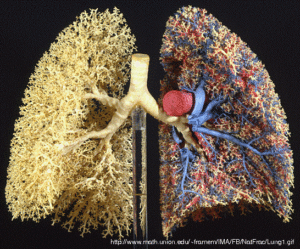
For example your lungs are fractal in nature, branching and branching and branching… but they don’t do it in only one way. Rather, they have different ‘stages’ of branching, each with a different ‘fractal dimension’, depending on how many previous branches lie before it (I can explain what a fractal dimension is if you wish in another post). (Read a single page about this from the Cellular and Molecular Life Sciences journal – slightly technical but you can probably get the basic idea through a different lens, which is always useful: http://www.springerlink.com/content/q103206u70402617/)
But to answer the question directly re: “each answer…”, most fractals both occur and are described by the taking of a single set of relations (it may be a shape), and repeating that relation/shape on different scales, with rotations, translations (moving without rotating), etc. In other words, you start with a thing and then put it through some sort of process, then take the new whole that results and do the same process to it again, and so forth. What is interesting is that a pattern emerges out of the process… and the process is primary, NOT THE THING. In fact, you can take ANY shape, and subject it to a specific process over and over, and you will get the SAME fractal form, regardless of the original shape. So each iteration (“each answer”) is a further unfolding of the process, a more ‘detailed’ rendering of the pattern inherent in the unfolding of the process.
So it’s not just a question of “smaller versions” or of reproductions of the “whole”; the pattern that defines the particular fractal is really the expression of an infinite process (usually based on some pretty simple and limited rules, like “rotate 36 degrees counter-clockwise and scale by a factor of 1/2”), which can be “reversed” (rotate 36 degrees clockwise and scale by a factor of 2) – so size has nothing to do with it, and you can start anywhere in the process with whatever you have, because the thing isn’t ‘the thing’ if you know what I mean: ‘the thing’ is the process. This is very good for nature because nature can take whatever is there and do some pretty simple things and get some very complicated results. It doesn’t have to start with a ‘grand plan’ that requires everything to be exact and fit in just the right way in order for it to ‘work’, but can just take whatever is there and MESS AROUND. This isn’t the whole story but I’m just trying to relate this to fractals specifically.