
It's Elemental

Tag: Bradford Keeney

  • Patterns in Process: Transdisciplinarity as a Background for Working with the Elemental Cycle of Transformation

    Patterns in Process: Transdisciplinarity as a Background for Working with the Elemental Cycle of Transformation

    Elemental Cycle Abstract

    This essay outlines connections between the Elemental Cycle as an archetype of transformation, transdisciplinarity, and  cybernetics.  A number of questions are addressed: the nature and importance of connecting these fields, an examination of resources and the dominant disciplinary discourses for the associated fields, and a critical examination of my assumptions, beliefs, and position.

    Introduction

    How often do we find ourselves in a position of not being able to see something unless it is first pointed out to us?  This happens all the time with the visual and other physical senses, but of course also occurs in our thinking; certain concepts seem to hide in plain sight, and unless we are cued into where and how to look for (or to think about) them, they slide on by as a part of the undifferentiated background of conceptual life.  Usually we are introduced to these sorts of concepts just like we are to new people, through a third party who is already familiar with each of us: “Seth, I’d like you to meet Recursion; Recursion, this is Seth.”  Often with this sort of introduction comes an experience: “Oh hello Recursion!  You know, I feel like you must hang out at some of the same coffee-shops as I do, but we’ve never been formally introduced.”  And so a relationship begins with a concept, and just as with human beings, you can become more intimate and familiar, get into fights, seek new levels of understanding, and go on adventures. (more…)
  • Form and content – two levels of change

    Form and content – two levels of change

    Form and Content

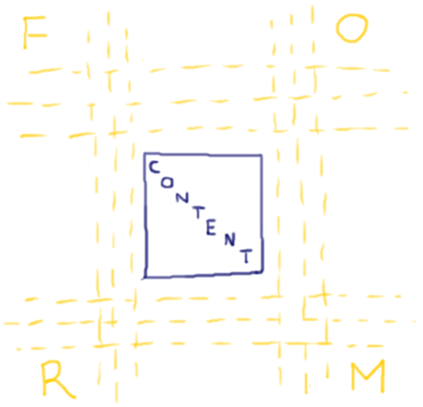
    Understanding change is a very difficult task. No aspect of our world, either experienced outwardly through our senses or inwardly through our feelings and thoughts, seems exempt from the paradoxical rule that the only constant is change. It is possible to examine the way change occurs at many levels. At the “lowest” level of examining change, we generally tend to focus on what can be called the “content.” The particular identified content (we’ll see in a minute why it is important to note that this content is “identified”) depends upon the arena in which the transformation is being studied. Generally, however, the content is the “thing” that is undergoing change, and is usually the overt focus of our attention. For example, in a chemical situation, the content would be the physical elements, such as hydrogen and oxygen in electrolysis. In a therapeutic setting, the “thing” might be one’s thoughts and feelings (in psychology), one’s bones (in chiropractics), or a family system (in family therapy).

    The content level is always present; it is always a part of the way that we encounter change. Yet in addition to looking at the content-level, we can also examine change in a different way: we can examine patterns of change. That is, we can place our attention on the way that changes in content unfold, and seek to identify similarities and differences in such patterns in order to get a deeper understanding of the “rules” that inform what happens at the content level. Paying attention to this level of change is paying attention to the process of change, rather than just its results.

    Form and Content

    This way of examining change takes place one level removed from the content level, and can thus be understood as a “higher” level. It is more abstract than the first, and because it provides the contextual rules that inform the unfolding of the processes as they appear at the content level, we can call this second level that of “Form”, or even better, “Forming”. This is spelled with a capital “F” to distinguish it from “form”, in the sense of a static outer shape or configuration. A given quadrilateral has a definite individual form, and there are an infinite number of quadrilaterals, such as the square and trapezoid. But every possible quadrilateral shares the same Form. This is the same relation between a set and an element in formal logic. The Form is a way of indicating (more…)

  • How to form a relationship with your book

    A professor of mine, Bradford Keeney, offers the following advice:

    EVERY TIME YOU READ <insert your book here>, INTERACT WITH THE BOOK IN A WAY THAT YOU HAVE NEVER INTERACTED WITH A BOOK: 

    Some possibilities: 

    *drill a hole through it
    *drill other holes 
    *underline spaces rather than words 
    *talk to the book 
    *place book under pillow or bed or tv or stereo speaker 
    *place book on serving plate and place on dining table 
    *play catch with the book 
    *add wheels to the book 
    *create a more aesthetic cover for the book 
    *cover author’s name with your name… after all in a constructivist universe, the reader is an active participant in the interaction called “reading” 
    *add your name to the author’s book, making it a collaborative writing/reading 
    *glue a mirror to the front of the book (more…)