It's Elemental

Tag: Abstraction

  • Form and content – two levels of change

    Form and content – two levels of change

    Form and Content

    Understanding change is a very difficult task. No aspect of our world, either experienced outwardly through our senses or inwardly through our feelings and thoughts, seems exempt from the paradoxical rule that the only constant is change. It is possible to examine the way change occurs at many levels. At the “lowest” level of examining change, we generally tend to focus on what can be called the “content.” The particular identified content (we’ll see in a minute why it is important to note that this content is “identified”) depends upon the arena in which the transformation is being studied. Generally, however, the content is the “thing” that is undergoing change, and is usually the overt focus of our attention. For example, in a chemical situation, the content would be the physical elements, such as hydrogen and oxygen in electrolysis. In a therapeutic setting, the “thing” might be one’s thoughts and feelings (in psychology), one’s bones (in chiropractics), or a family system (in family therapy).

    The content level is always present; it is always a part of the way that we encounter change. Yet in addition to looking at the content-level, we can also examine change in a different way: we can examine patterns of change. That is, we can place our attention on the way that changes in content unfold, and seek to identify similarities and differences in such patterns in order to get a deeper understanding of the “rules” that inform what happens at the content level. Paying attention to this level of change is paying attention to the process of change, rather than just its results.
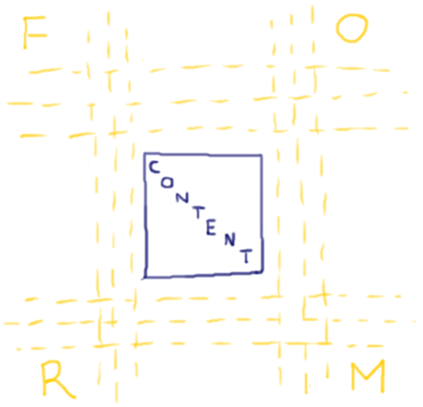
    Form and Content

    This way of examining change takes place one level removed from the content level, and can thus be understood as a “higher” level. It is more abstract than the first, and because it provides the contextual rules that inform the unfolding of the processes as they appear at the content level, we can call this second level that of “Form”, or even better, “Forming”. This is spelled with a capital “F” to distinguish it from “form”, in the sense of a static outer shape or configuration. A given quadrilateral has a definite individual form, and there are an infinite number of quadrilaterals, such as the square and trapezoid. But every possible quadrilateral shares the same Form. This is the same relation between a set and an element in formal logic. The Form is a way of indicating (more…)
  • Consequences of the discovery of perspective in art

    Consequences of the discovery of perspective in art


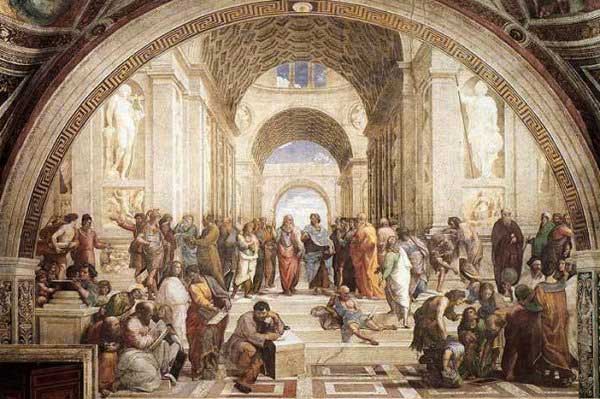
    Raphael: School of Athens
    Raphael: School of Athens

    The “discovery” of perspective was a radical point (pardon the pun) in the development of art, and was intimately tied in with a whole shifting of consciousness during the time of the Renaissance and forward, having correlative expressions in the increasing reliance upon an “objective” perspective from which to view the world.  Science in its modern form arose during this period as a methodological way of systematically removing subjectivity from observations, allowing data to be gathered which was amenable to enumeration and mathematical manipulation.  The abstraction of the observer from the observed and the dissociation of both this abstracted observer and the observed phenomenon from the ever-changing background contexts that held both provided a powerful basis for a new way of being in the world.

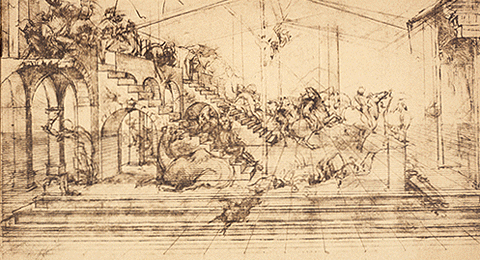
    Leonardo da Vinci: study for adoration of the magi
    Leonardo da Vinci: study for adoration of the magi

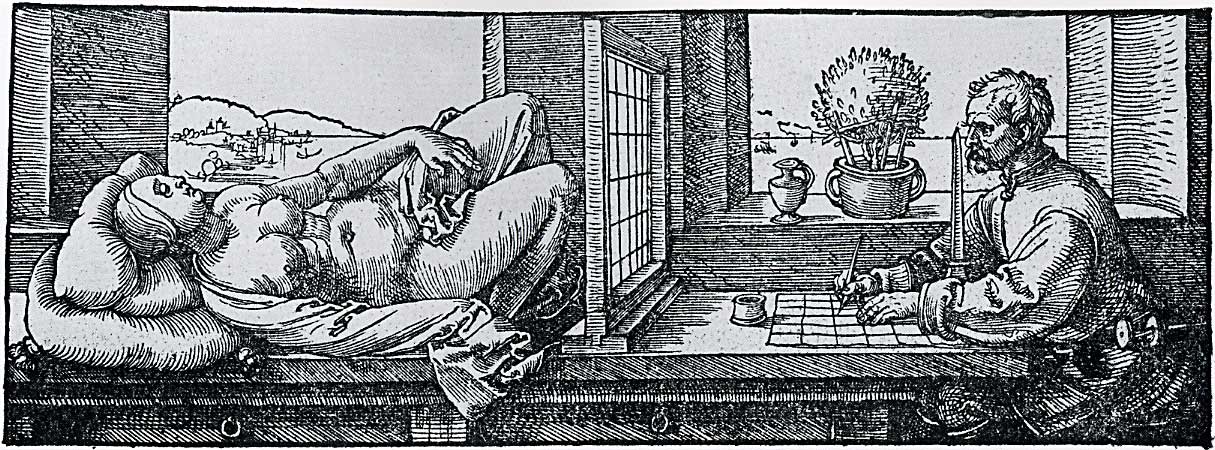
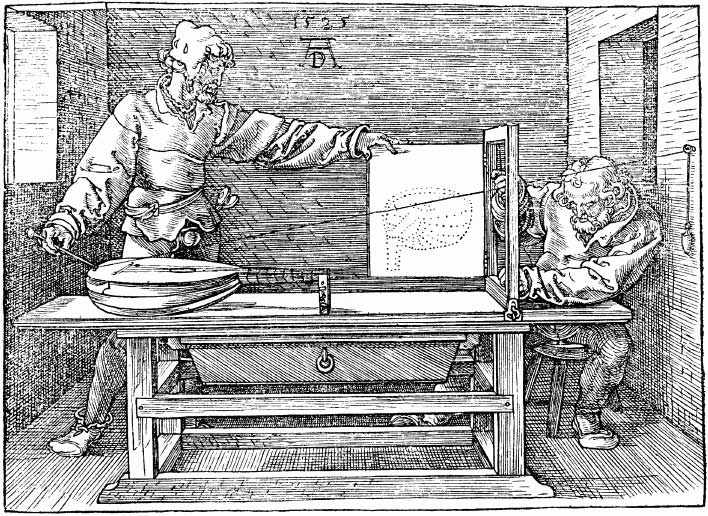
    The laws of perspective allowed the world to be visually reduced, literally, to a point.  Each point became a point in space from which the world looked a certain way, and the way it looked from one point always differed from the way it looked from any other point.  It is interesting to note that the laws of perspective, designed as a basis from which visual scenes could be rendered on canvas in a way that accurately captured the “real” experience of our visual sense, required a reduction of the very visual experience it was meant to uphold.  What I am referring to is the fact that perspective works from a single point, but the human being experiences the world through TWO such points.  The laws of perspective required the literal and figurative shutting out of fully half of our visual experience.

    durer_perspnudeThus, in both art and in science, the central feature became one of representation.  The art of the day was meant to represent in as exact detail as possible what could be viewed by a one-eyed person standing at a singular and exact location at a singular and exact moment in time.  Similarly, the science of the day strove for theories that reduced human experience to its most basic forms, thus allowing for a further abstraction into mathematical language.  Locke distinguished between “primary” and “secondary” qualities, and it was only the primary qualities that really mattered for science, because these could be objectified.  This objectification was the equivalent of restricting vision to one eye at one point; each phenomenon could be interpreted “correctly” only from a singular point of view that was completely restricted and delineated in both space and time.  The universe became a clock, and the human beings within it machines within the clock.  “Truth” became something external to the human being, something to be discovered through the fulfillment of the promises made by the new scientific methodology.

    duerer-perspective

    Truth thus became as one-pointed as perspective drawing, subject to the perfect and known limitations of a small set of rules; all deviations were to be ‘explained away’ by recourse to the completely non-personal operation of blind forces.  In art, ANYONE could presumably have the exact same visual experience as the next person if they stood in just the right spot at the right time; it took no special training or knowledge to interpret what was seen, because what was seen was reduced to its primal base: form and color in strict, law-abiding combinations.  Ironically, the point, a completely abstract dimensionless non-entity, set the tone for our experience of all the dimensions of available to our experience.

    Ultimately, however, this perspectival program was destined to destroy itself through its search for perfection.  In art, the quest to represent visual experience led beyond form and color to the wider and fuller experience of vision as a whole.  Many figures, from Goethe to Picasso, took part in a constructive dismantling of the dominant paradigm.  In science, this occurred through the discovery of relativity and quantum mechanics, and later chaos theory, which banished forever the naïve reliance upon the point-like structure of previous generations.

  • Musings on Paleolithic Art and Consciousness

    Musings on Paleolithic Art and Consciousness


    Paleolithic Art 1
    Paleolithic Art 1

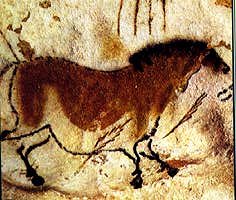
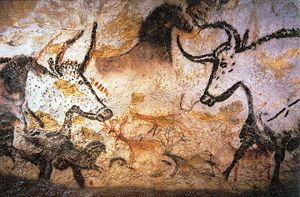
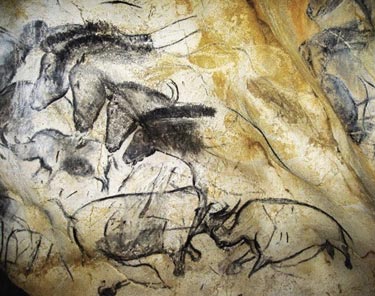
    I’m actually somewhat uncomfortable calling Paleolithic renderings “art” – not because they don’t meet some standard set of criterion, but because of the very nature of the ‘calling’ itself seems to go against the experience of the makers of the art.  See, there again, an assumption: “the makers of the art”, which includes a dichotomy between the producer and the produced.  Our modern language is so full of this type of construction that it is almost impossible to get away from, or to recognize its influence on the content and method of our thinking – which is particularly problematic (at least if unrecognized) when we attempt to consider something like the inner experience of the people in the cultures which produced the images on the rock walls so long ago.

    Paleolithic Art 2
    Paleolithic Art 2

    Van James, in his book Spirit and Art, paints a picture (in the consciousness of the reader) of the process by which the art was created, including its cultural context, indicating that it had to do with a shift from participatory consciousness to one that had the seeds of self-recognition, and thus self-abstraction, as an essential component.   I find this interesting because many artists throughout history, including today, mention something about the way in which one gets lost in the process of creating.  This experience of the space between “me” and “my art” asymptotically approaches zero, leaving the artist with an experience of creation without “A” creator.  Only retrospectively may an artist whose creating occurs in this state attribute the work rationally to some specific time period, place, and personality; but this knowledge does not need to be held in consciousness during the actual process of creation itself, and (as many artists know) may actively interfere with what might otherwise be brought forth.

    Paleolithic Art 3
    Paleolithic Art 3

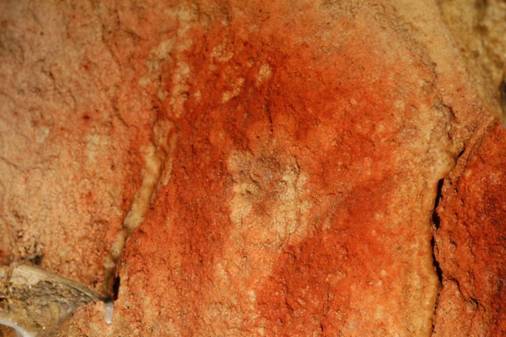
    So I wonder if this experience – or LACK of experience, as the case may be – which characterizes some part of the process of artistic creation even today, may be something that was the ‘cutting edge’ of consciousness in the Paleolithic period.  Jean Gebser’s “magic structure” (cf. The Everpresent Origin) speaks of this in a way similar to that of Van James, indicating that the art of this period was indicative of human beings waking up to themselves.  Before this stage, (Gebser’s “archaic”), it is not possible to really speak of art at all, of creations “of” humans, because the consciousness was in identity with the world.  It is only by transitioning to a consciousness of “unity” that art even becomes possible, because in “unity” is already contained the indication of multiplicity, as multiplicity is required in order for unity to be brought about (otherwise one simply has identity).  Thus Paleolithic art may exemplify this transition in consciousness from identity to unity, which gives expression to sensory and magical experience in a form that takes this experience even further, strengthening it recursively through the very act of its creation.  The painting of animals, of human figures, and of stenciled human hands may serve as a ‘catch’ for consciousness, by which it can step outside its mode of identity (akin to dreamless sleep) and into a mode which recognizes the beginning of division between the human being and the world (akin to dreaming sleep).

    Paleolithic Art hand
    Paleolithic Art hand

    So perhaps the pictures of animals and such on the cave walls are not really pictures “of”, but are rather more like techniques for transforming consciousness.  We moderns are taught to pay more attention to things rather than processes, so we tend to see the results of some activity as the most important ‘thing’ to consider, i.e. the art itself.  But maybe this was not always the case; maybe Paleolithic art was ‘something’ primarily in its making, in the process of its unfolding (such as in Tibetan sand mandalas, or Native American healing mandalas), and not so much in its product, the image on the wall.  But, recursively, the production of the images may lead one who views it but does not create it, into a different space of consciousness – a space which invites both a ‘connection to’ and a ‘disconnection from’ at the same time.  Maybe the Paleolithic viewer of Paleolithic art was both put into connection with the cultural significance of the art in an experience of magical unity with the forces identified by the culture, while also being called to experience the art in a way that called forth something from within that necessitated a concurrent experience of the without.  The very experience of one’s unity with the world perhaps awakened the first seeds of dis-unity, of separation between what would eventually be one’s “self” and “the world”.


  • Object and Process oriented languages and human development

    (Note, the Blackfoot people have a process-oriented language, which is much more strongly verb-based, while English and most other languages are object/noun based.)

    Blackfoot Indian Brave
    Blackfoot Indian Brave

    A friend of mine asked:

    Do the Blackfoot people go through a phase where they need to have conceptual boxes, and then learn to transcend the need to reify these artificial demarcations, or do they simply use a different process all together from the very start? So much of western development theory assumes that moving beyond nice neat conceptions is a phase that we can move beyond, but assumes it is a necessary phase; perhaps it is only necessary for those who are raised to think in a linear fashion?

    Which prompted the following response:

    I have this feeling that on a macrocosmic scale, humanity does have to “go through” a stage of categorical reification and abstraction in order to develop certain potentials relating to our “task” if you will, of becoming beings of freedom and love.  However, this doesn’t mean that every single human being has to do this, or in the same way (ex: the West has played such a huge role in this particular part of the human drama, while other areas have different things to bring to the play).

    I imagine that it would be possible to ‘use different processes from the start’, and while there will be similarities in developmental stages, these won’t always match up exactly depending upon what is being brought forth by the language, culture, and individual elements, and so forth.  It’s not like a Blackfoot can’t identify ‘a chair’ if they don’t want to… it’s just that doing so is a reduction or rather abstraction from a different way of understanding, just like if I were to reduce you to a particular image I had of you that came from one specific interaction, and then communicated only this aspect of you when I spoke about you to others or thought of you myself.

    Both the ‘objective’ or reified view of we weirdo Westerners, AND the process or time-sensitive view of people like the Blackfoot are ‘correct’.  The question is more, to me, about the overall appropriateness of each view given microcosmic and macrocosmic pictures of individual and collective development.  Sometimes, identifying “this chair” as a completely abstracted and separate, non-evolving object is appropriate.  Sometimes, seeing the flow of events that entwine themselves into the constantly becoming activity and relations that make up the chair through time is more appropriate.

    BUT, the imporant thing is that we develop the capacity to have both these (and other) options open to us, so we aren’t locked in by our habits of perception.  We — humanity as a whole — has won the capacity to objectify the world through a long and arduous and pain-filled path.  It is something that we shouldn’t abandon — rather we need to learn how to use this capacity responsibly, ultimately in service to the development of our freedom to become beings who can love not by virtue of a given nature (this would describe an angel), but through what has come to us only by virtue of the path we have walked, i.e. in freedom.

    Of course, this just a picture, a way to imagine.

  • on “higher” and “lower”

    ‘Higher’ is not intrinsically special by itself. Absent movement, and continuous transformation between higher and lower and lower and higher, higher becomes an irrelevant abstraction. But when experience directs us along a particular path, opens new vistas while closing and modifying others, punctuates contexts with more effective inclusivity, and actuates/accentuates the development of new capacities, ‘higher’ becomes a very real and useful way of describing the associated quality of consciousness.

    In this sense, ‘lower’ can be experienced as ‘higher’ (eg. Jung –> Shadow). As a metaphor, ‘higher’ (which, we can never forget, always comes with ‘lower’) constellates the experience of our self-contextualization around a direction of potential movement. It creates a pattern that inclusively represents a series of alternative becomings and lends potential value to their realization.

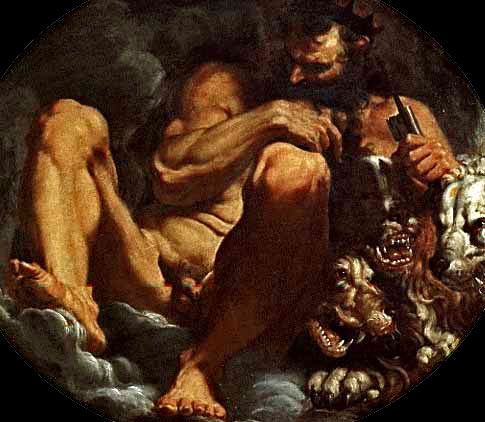
    Kept in motion, ‘higher’ and ‘lower’ are not necessarily problematic. This only happens when their constant r/evolving is artificially or arbitrarily stilled. Then ‘higher’ and ‘lower’ become weapons of Dis-tinction: the tincture made by Dis, another name for the god of the underworld, Pluto, whom only oaths and curses could reach. As the god of wealth (his name was originally Dis Pater, ‘Father of Riches’) he materializes the crystalline structures found within the Earth… not just as gold and gems, but as rigid habits of mind. His tincture keeps motion from arising through rigid constriction to form, and while this helps us to count (our money, our ideas), it obfuscates the healthy relationship (the transformation between) the ‘much’ and the ‘few’, the ‘higher’ and the ‘lower’, prejudicing one only.


    Pluto - Hades
    Pluto – Hades

    Agostino Carracci, 1592


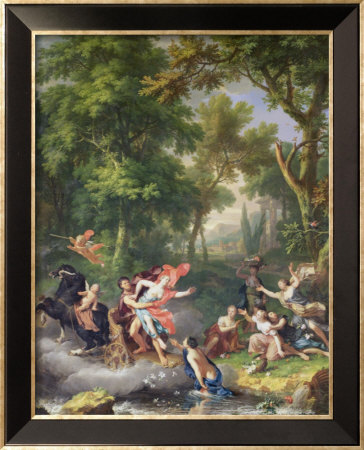
    The way out of this Dis-ease (but not ease for us) is well known: follow the trail left by Persephone, who’s name means ‘the emerging’. Persephone is a goddess (the feminine aspect is crucial) who embodies the alchemical qualities of Water: change/process (https://spiritalchemy.com/p6-metaphors.html). She was abducted by Dis Pater/Pluto (Roman)/Hades (Greek) from near her favorite haunt, a springing fountain, as she was gathering flowers (read ‘flowers’ as a verb). Her mother Ceres/Demeter, in looking over her whole domain (the Earth) found only her belt floating upon a little lake made from the tears of the Water Nymphs. Plato even said of her (in his Cratylus) that “she is wise and touches that which is in motion”.

    (The full context is interesting: “The first men who gave names [to the gods] were no ordinary persons, but high thinkers and great talkers . . . Pherephatta!–How many people fear this name, and also Apollon! I imagine it is because they do not know about correctness of names. You see they change the name to Phersephone and its aspect frightens them. But really the name indicates that the goddess is wise;for since things are in motion (pheromena), that which grasps (ephaptomenon) and touches (epaphôn) and is able to follow them is wisdom. Pherepapha, or something of that sort, would therefore be the correct name of the goddess, because she is wise and touches that which is in motion (epaphê tou pheromenou)–and this is the reason why Haides, who is wise, consorts with her, because she is wise–but people have altered her name, attaching more importance to euphony than to truth, and they call her Pherephatta.”)


    The Rape of Proserpine
    The Rape of Proserpine

    Jan van Huysum


    If we integrate the Plutonic (alchemically: Earth) with the Persephonic (Water) we prepare ourselves for Air, where what is above comes below, and what is below comes above; Persephone must spend half her time in the underworld and half above. It is in the oscillation between polarities that the ‘higher’ wisdom (in this case, represented by the seasons) can potentially manifest. Thus we see a difference between a ‘higher’ and a ‘higher-higher’: the meta-pattern remains.