Blog
-

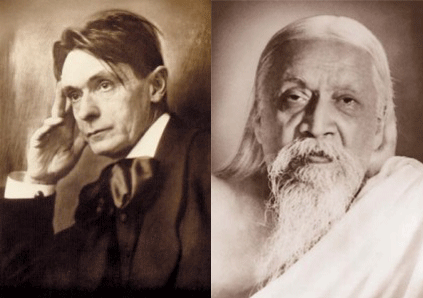
Rudolf Steiner and Sri Aurobindo: A Beginning Comparison
A cursory Google search (2009) didn’t turn up anything promising in regards to comparing Rudolf Steiner and Sri Aurobindo. Hopefully this will help:
Rudolf Steiner and Sri Aurobindo: A Beginning Comparison
Summary:
This longer essay summarizes the basic elements of the spiritual-cosmological worldviews of two of the most important modern, integrative spiritual thinkers: Rudolf Steiner and Sri Aurobindo. Upon this foundation a brief comparison is made between the two systems and the two men.
See more of my work in the Articles Section of Elements.SpiritAlchemy.com.
Special note:
Thanks to John Elwyn Kimber for pointing me to this webpage where Pavitra, a disciple of Sri Aurobindo, records her meetings with him (see pages 4 and 5 specifically). Pavitra and Aurobindo both say that they know some theosophists, and know of Steiner, and by Aurobindo’s responses I get the sense that he at least knew something about Steiner specifically. However, it seems that he is being treated primarily in the same vein as theosophy (which would make sense from the “outside”), and the references are pretty quick so there is no way to gauge from this site how deeply familiar he was with Steiner specifically, but it is good to have confirmation that he at least knew of him. Also in this text, Aurobindo states his sense that his vital plane corresponds with the theosophical astral plane, and gives his general impression of theosophy.
-
a tiny window
a tiny window gathers the worldechoes morning’s rush of lifeamazingly, my fingers trace your carved shoulderlike they have never known geometrysomebody somewhere is getting coffee,walking the dog, dressing for a long day –but not we, whose worlds have just collidedunder the gaze of a tiny windowthat no one is looking throughbecause we are beyond ourselves nowand I know this by the way your hairthreads lightly across the bow of your cheekby the way every gesture becomes musicand because when you smile I am lostagain, you have taken my watch, and found forever in the bargain –I pretend to be offended because my world is now upside downand I can’t understand why everything else isn’t fallingdrawn inexorably by the velvet honey of your eyesthis must be what yes isthis must be the future twining round our ankleslacing up our hands in unspoken prayerwhile beyond our reach the coiled leopard of timeanchors claws to earth for its inevitable leapwhy should time be linear anyway?for it is the timeless in us that is now rejoicingin this spiraling pressing of bodies and soulsupwards into the long arms of the skythrough a tiny windowa tiny window gathers the world
echoes morning’s rush of life
amazingly, my fingers trace your carved shoulder
like they have never known geometrysomebody somewhere is getting coffee,
walking the dog, glancing at a watch –
but not we, whose worlds have just collided
under the gaze of a tiny window
that no one is looking throughbecause we are beyond ourselves now
and I know this by the way your hair
threads lightly across the bow of your cheek
by the way every gesture becomes music
and because when you smile I am lostagain, you have taken my watch, and found forever in the bargain –
I pretend to be offended because my world is now upside down
and I can’t understand why everything else isn’t falling
drawn inexorably by the velvet honey of your eyesthis must be what yes is
this must be the future twining round our ankles
lacing up our hands in unspoken prayer
while beyond our reach the coiled leopard of time
anchors claws to earth for its inevitable leapwe care not of its landing
for it is the timeless in us now rejoicing
in this spiraling pressing of bodies and souls
upwards into the long arms of the sky
through a tiny window -
Song of Transformation
My first attempt at remixing/composing a song. The original vocal track is from Bisola Marignay. We partnered together to make a creation, and this is what happened:Download Song of Transformation – TransD Mix
Enjoy!
-
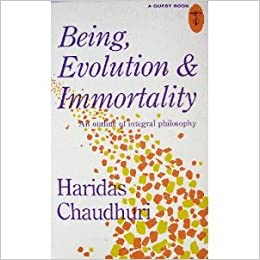
Informal review of Being, Evolution, and Immortality: An Outline of Integral Philosophy, by Haridas Chaudhuri
My general impression of this work was that Chaudhuri was writing in a very philosophical style about a topic which is far more than philosophical. The extent to which he took pains to delineate some various philosophical perspectives so that he could present the viewpoint of the integral yoga surprised me; I’m not sure exactly what I was expecting, but I kept feeling like I was back in my undergraduate philosophy program, reading and comparing different works. The intellectualism that accompanies the philosophical world has some excellent and unfortunate consequences.
In the case of this book, I felt that on the one hand it provided a strong case for the philosophical underpinnings of the integral yoga, which can be useful for those who work through and towards the difficult topics he discusses in an intellectual way. By doing this, it can be possible for the intellect to contextualize the various meanings and approaches to things like the Divine, to the Non-dual, Being, the Absolute, and so forth, in such a way as to allow the rest of the human being to begin to find a way of moving with the material at a different level. I find that sometimes the intellect, lacking this context or ability to engage, results in either an over or under-attachment to the real content that is attempting to be addressed through philosophical language. In other words, the philosophical nature of the presentation calls forth the part of ourselves that is capable of dealing with the concepts in a direct, wakeful, conscious manner, which helps to mitigate either sympathetic or antipathetic reactions which may otherwise arise in its absence.
On the other hand, presenting material like this through a philosophical standpoint also lessens its potential impact by restricting itself to a style of address whose major target is the mental part of the human being. This is true even if the content of the words include ideas like love, goodness, and so forth; what comes across is often only the shell of an experience, rather than words designed for the immediate evocation of the experience. This is not so much a criticism as just how things like this often go, because we can only write and express so much through words without seeming almost schizophrenic. It seems that Sri Aurobindo, the major synthesizer of Integral Yoga (in concert with The Mother) worked on both sides of this issue, writing both intellectually and poetically as the need arose.
In reading Being I felt like I was assuming the posture of a bird in flight, soaring over a vast landscape and beneath an even vaster sky. I had the sense of swooping down occasionally towards the Earth, or of straining my wings to fly ever higher… but never did I feel either truly connected to either the Earth or the Heavens, but rather somehow suspended in between, almost as if in a strange form of limbo. I really wanted Chaudhuri’s discussion to find much more direct and explicit contact with experiences and realities of daily life. There were a few moments where he began to speak along such lines, but I felt that he continually abandoned routes that would have put him in real connection with the “world”. This is to say that his language had a tendency to be either vague, general, or simply descriptive of classes (or classes of classes) rather than elements of classes. Take almost any paragraph as an example; these are pulled from a random 5 second search:
(Tending towards Heaven:)
“Spiritual nondualism is inspired by the concept of the Absolute as supermind. The supermind is the sovereign dynamism of ultimate reality. it is the creative light of Being. It is the all-embracing consciousness, nondualistic in structure.” (p.60)(Tending towards Earth:)
“Immortality is an attribute of enlightened consciousness. All men therefore have the potentiality of immortality by virtue of their consciousness. When the personality of an individual is harmonized and integrated, he attains enlightenment. He gains insight into his existential oneness with the all-encompassing Being. The veil of ignorance and separative consciousness is lifted from his eyes. Feelings of fear and insecurity, anxiety and personal unworthiness, are overcome. There is an enlargement of Being and joyful participation in the life of the Infinite. In one word, an individual experiences immortality here and now.” (p. 139)In the first case we have what may be the normal limit of intellectual presentation: pointing at the moon. Were he to go further he would likely need to adopt a completely different style, and for the purpose of a survey work, this may be too much to ask. In the second case, although Chaudhuri is speaking about experiences that concern the transformation of the human being from existing in an ‘everyday’ state to one that exists in constant transformation and unfolding in the light of the Divine, he never gives much more detail than is apparent here. It’s hard to describe, because it is difficult to have clear and exact words about vagueness, but I get the feeling that almost the entire bottom foundation of the integral yoga is just missing from this book. How exactly does one practice integral yoga? What does the student encounter along the way? What exactly is happening to the student when his or her consciousness begins to transform, from the perspective of the multidimensionality of the human being, and how does this relate to advancement along the path? In other words, having read this book, I do not feel I have any clear answers to these questions.
Not knowing the context around the genesis of this book, it’s hard to know why he chose to approach it as he did, but he must have had a particular audience in mind. I keep having to remind myself that this was written around 1967; I wonder how he would have approached the same central task today? Nevertheless, as a philosophical outline it succeeds admirably, and this is ostensibly (given the title) its major purpose, so I would definitely call this book a succes.
A friend of mine pointed out that Chaudhuri puts forth a certain strength in the presentation of ideas about things which are more than ideas, given an impression that “this is how it is”, with no room for argument. I have a sense of how this happens (although whether this describes Chaudhuri’s case I have no idea, I’m only providing this perspective as my own). It’s not so much that the often absolutist tone of the presentation is meant to discount or override any alternate conception so much as it is an expression of the minds inability to fully conceptualize the extent of the topic that it is dealing with. This results in the mind reaching its limits; our words too, reach their limits. The experiences that lie beneath the philosophical considerations, and which give rise to them, although having a ‘word-like’ nature (logos), are not words in the normal sense. Thus all philosophical expression, when placed in service of what lies forever beyond it, can only be a sort of veil that covers what is otherwise unknown. But in the process, the veil assumes a certain shape, and certain tendencies for motion, as it falls lightly or heavily across the Mystery. Good philosophical discourse will be like a supple silk, capable of shifting delicately in response to its wearer (the Divine, or Being in Chaudhuri’s case) without either falling off, being too transparent and thus difficult to see, or too thick as to obscure what lies beneath — all while remaining self-connected, strong, and breathable.
But once a fabric is chosen, certain limits are necessarily adopted. In other words, getting into the frame of mind in which the human being is pouring attention into the intellectual contextualization of spiritual topics leads the mind into areas that it would not otherwise go; it is creating a space and exploring it at the same time, on the one hand coming up against its own limitations while discovering its own movements through a kind of self-necessity (in the clearest cases, this is expressed as “logic”). (Re: p.48, “Thought is not a mere process of mirroring. It is a creative function. In distinguishing definable features of reality, it also creates them in a profound sense.) Once certain choices have been made as regards to the style of approach, much of the rest ‘falls out’ in a way that is unavoidable; when standing within the perspective it seems directly and manifestly obvious that specific conceptions require a certain kind of expression. It just seems natural. So we end up with things like: “[Ideas] are not unalterably fixed truths.” (p. 49) and “The truth is that Being is multidimensional.” Each statement is formed and expressed from a perspective which gives rise to the necessity of each, while taken together they indicate that the chosen approach is self-limited (for those of you that are familiar with Goedel’s incompleteness theorem, this is an example of how it occurs linguistically).
This post is already too long, but this gives some general impressions. There are many details that I have comments or questions about, but I’ll leave these aside. I can add in closing that the philosopher in me found this work engaging, and it invites much in the way of philosophical discussion. For example, he has a tendency to simply state, almost by fiat, that such and such divisions or dualisms expressed elsewhere are overcome or united within integral nondualism… but the philosophical details he gives to back up his claims are far less detailed and clear than I would like them to be. I suspect this also may be due to the introductory nature of the work, and he has others which hopefully fill this gap.
-
A little perspective on science in light of Kuhn, relativism, and Eastern philosophy
Much is owed to the ideas of Thomas Kuhn and his thoughts on science, which rightfully and helpfully recontextualize the practice of science in light of wider realities of human complexity. However, flowing out of postmodern trends, it is easy to then think of science as completely relative and just like any other knowledge domain. Similarly, those interested in alternative ways of knowing, such as mystical, shamanic, and spiritual, may make similar claims, pointing out that science is heavily dependent upon processes that are not as objective as we once assumed.
This is all well and good, a necessary stage on the path to a wider and deeper way of knowing that is not restricted to any singular method now present. I would therefore like to offer, on one side, something of a picture of science that is less characterizational and hopefully more subtle than might often be found in the debates surrounding this issue, in an attempt to keep us from overcategorizing and oversimplifying what are very complex and subtle realms.
It is true that there are limits to the practice of science: personal, cultural, psychological, economic, etc., and that these limits do have some relationship to the content of the science performed. However, the claims concerning the complete relativism of scientific knowledge are too strong. The arguments which support that view are selective and do not do justice to the features that make scientific knowledge different than other forms of sociologically constructed knowledge.
In the first place, we must be clear that the knowledge claims made by science are always and intrinsically (if not explicitly in their actual communication) tentative, at least to some extent. Science makes no claims to absolute knowledge beyond all possible modification; rather it offers conceptualizations that are continually taken through a highly refined process whereby those ideas that have the support of the greatest diversity and depth of experimental and logical lines of reasoning are held to be the most likely version of events.
Key to this process is the continual and purposeful reintroduction of the possibility for falsity through experiment. Kuhn is able to write his critique of science preciselybecause science is built to overturn itself. It is this very feature which allows it to continue its almost complete dominance in providing practical, testable, and predictiveknowledge claims concerning the physical world. Such dominance is not simply a measure of cultural values, although these play a part. Rather, its dominance is due %(primarily) to the fact that it provides a method for the generation of ideas which have direct, testable links to patterns in human experience. In other words, it works; it suggests solutions and provides a foundation upon which such solutions can be approached.
Science has a firm basis in empirical experience. It is true that were human beings constituted differently, with different sensory capacities, we would experience the world quite differently. However, to say that these differences would lead to a radically different set of ideas about the nature and operation of the world at a very fundamental level is not only not necessarily true, but likely simply wrong. Indeed, one of the reasons for the continued demonstrable power of the scientific process is precisely that it is capable of moving beyond human sensory capacities to a more general set of relationships between abstract properties (say, the property of quantum spin). We are capable of forming new ideas which, through their connection with other ideas, leads to propositions which have definite, falsifiable results in a public arena. Every time a new idea is tested experimentally and not found to contradict predictions, evidence for the validity of both the individual idea and the underlying connections the formed the basis for the new idea in the first place mounts. This does not mean that such an idea is taken to be absolute or objectively true; rather, it means that until we have a better idea, which has more explanatory and practical value, there is no sufficient reason to not use this idea as a foundation for the continued process of scientific exploration. Whether or not the idea is “true” in some ultimate sense is, frankly, beyond the scope of science. Unfortunately, it is the misunderstanding of this subtle point upon which much of the criticisms of science are based. Equally unfortunately, even plenty of scientists seem to live under the same misapprehension, at least unless pressed, so the error is widespread.
It bears pointing out that the process upon which science relies does not restrict science to exploring only physically testable propositions. The scientific process lends itself very well to a study of the material world, but is in no way limited to this domain; it is founded upon an epistemology of human experience, not an ontology. For this reason, the content of any idea is potentially amenable to scientific exploration, including ideas that arise from experiences that are considered spiritual in nature. The question is not whether the content of the ideas link directly to any material conception, but rather whether or not it is possible for the ideas to be falsifiable, repeatable, and capable of being linked coherently to the content of other ideas which enjoy the same benefits. It is one of the most powerful features of science that ideas which do not fit this description are not held up as representing scientific claims to knowledge. In other words, unlike many other disciplines, the criterion for selection of scientific ideas is very strict. This results in both a vast arena of ideas that are simply not capable of acting in a scientific capacity (“Betty Crocker has the best cookbook”), while at the same time requiring more robustness of the ideas that are admitted (“two masses attract each other in exact accordance with their relative masses, the square of their distance from each other, and a ratio which is constant in all situations”). Thus, scientific knowledge achieves a level of generic applicability that far outstrips knowledge claims made by (arguably) any other discipline that claims to produce knowledge.
Science concerns itself, in the broadest way, with questions concerning the nature of the universe, its parts, their behaviors and interrelationships, and the discovery of patterns that are thus manifested. The fact that we do discover — I emphasis discover even though arguments have been made to the effect that all discovery is invention — regular patterns in our directed experience of the world is remarkable. Even though the perception of these patterns requires some very particular sensory apparatus, the patterns thus revealed do not seem to rely solely on the particular approach made to them. Thus a more generalized concept is reached which links a variety of different avenues of evidence into a coherent whole which has consequences for each of the various domains which it touches. Most often this takes the form of mathematical relationships, but not always.
It should also be admitted that the scientific process is restricted to those parts of the universe which can submit themselves to conceptualization in the human mind. It is simply beyond the capacity of science to reach into non-conceptual domains, although these may very well be part of human experience in general. At the same time, it is not therefore the case that science cannot say anything about such experiences. This would only follow if it was the case that there were no links between such experiences and the parts of the universe which were amenable to conceptualization. Whether this is the case or not is a question for metaphysics, or perhaps for direct spiritual apprehension, but certainly not for science. But it is precisely on the basis of these non-scientific types of perception that the likeliest answer to this question is that such linkages do exist, and that the universe is vastly interconnected amongst all its levels. In this case, science can serve as a supplementary support to experiences which lie outside its normal domain, by offering up to such experience the relationships and patterns that are found to hold in its more restricted domain.
For this reason, science and spirituality indeed can — and even must — live together in mutual support. It is always possible to hold a different paradigm, with different knowledge claims and a different epistemology, and within such different systems the world appears differently. However, despite the relative and contextual nature of differing epistemologies, it is not therefore necessarily valid to say that all epistemologies are ‘essential equal’, which is the same thing as saying that they are all equally arbitrary. For some purposes, chosen by human agents, some epistemologies are vastly superior to others.
Just as science has real difficulty in dealing with experiences that do not have a strong or identifiable basis within the physical part of reality when compared to metaphysical or spiritual systems, so too metaphysical or spiritual systems have real difficulty in dealing with the very obstinate details of physical experiences. Each tends to shuffle the claims of the other into a sort of quarantine bin, where it is dealt with in a way that does not do justice to the depth and breadth of the other’s experience. It is very difficult to coherently cross this dissolute but entrenched lined: the bulk of our scientific knowledge does not come from meditative or transcendent experience, and the bulk of our spiritual knowledge does not come from scientific experience. Of course claims can be made that, in India in particular, something of a spiritual-science has been more or less continually developed for thousands of years, but the object of this type of science is quite far removed from the goals and achievements of modern science. The point is simply that as advanced as any system of spiritual science might be, none has yet produced knowledge claims that are as far reaching, inter- and intra-coherent, evidentially supported from multiple, diverse disciplines, and practically efficacious as that produced by modern science.
-
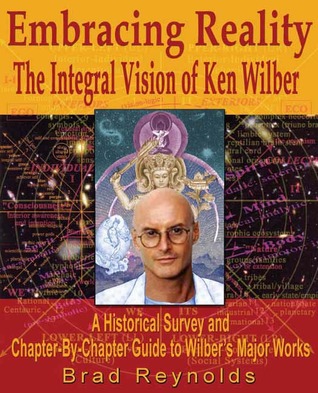
Response to Ken Wilber and “Embracing Reality” by Brad Reynolds – A Critical Perspective
Embracing Reality offers two things, something of a semi-biographical contextualization of the development of Wilber’s thoughts and writings, and a series of more-or-less detailed summaries of those same works. For anyone who is not familiar with the different phases of Wilber’s thought, this is a nice reference work, and was most edifying for its picture of the development of Wilber’s thinking. I appreciated the detailed descriptions of some of his personal influences and struggles, but I couldn’t quite get over a kind of sticky feeling about the author’s undisguised near-worship of the man. It felt like the whole book was kind of an apology for Wilber’s work. There’s nothing wrong with this, of course, (particularly if the author presents it in this way, which isn’t the case here) but it doesn’t give me the feeling that I’m getting a balanced perspective on his work, as there is little to no criticism of him or his ideas in the whole book.
To help remedy this, if anyone is interested, here is a lengthy and equally unbalanced criticism of Wilber’s work by a very outspoken critic of his work, available as a free PDF download at http://www.normaneinsteinbook.com/ . These two offerings certainly don’t add up to a balanced perspective, but at least it fleshes out the field a little, and gives an idea of the kind of interactions that Wilber seems to spark, for any who wish to get involved in such a thing. Honestly for me, having skimmed and read about 2/3 of the Norman Einstein book, I’m both grateful for an alternate perspective and frustrated by the seeming lack of ability for coherent critical dialogue to take place between Ken Wilber and his critics.
On the one hand, and this characterizes what seems to be a pattern in general, I find acrimonious and personal criticisms between Ken and critics that is full of what strikes me very clearly as quite non-enlightened and non-integral type of communication from both sides. On the other hand it seems there are some criticisms that are simply ignored for whatever reason.
In any case, when I really try to get a sense for the gestalt of both Wilber and the communities that he inspires (both as ‘followers’, critics, and others), I am met with quite a variety of perceptions and feelings that it is hard to integrate into a coherent vision.
A few things stand out, however (all of these I completely accept as my personal experiences, which obviously reveal as much or more about me as they do of Wilber):
1) Wilber is unabashedly intellectual. Not a bad thing, by any means, in and of itself, but I actually mean this in part as a criticism. Something happens when one’s intellectual ideas move beyond themselves, and flow out naturally into the rest of the natural aspects of a human life: the feelings and the will. Try as I might, I have yet to find much evidence that satisfies my purely personal sense that this is the case for Wilber; I experience him much more as an enlarged head sitting atop a less developed torso and even less developed limbs, with some kind of blockage at his neck which both grants him great capacity for intellectual speech while stifling its ability to be infused with a balanced and integrative flow of feelings and a truly holistic basis in action. His actual physical visage reinforces this sensation, with his bald head, thick neck, prominent brows and thin lips, along with a physically well-developed lower body. Rudolf Steiner, whom I hold in the highest regard, mentions something very apropos to this point about the dynamic interrelationship between different aspects of the human being undergoing esoteric development, (from his book How to Know Higher Worlds, available free at http://wn.rsarchive.org/Books/GA010/English/GA010_c01.html):
“In all spiritual science there is a fundamental principle which cannot be transgressed without sacrificing success, and it should be impressed on the student in every form of esoteric training. It runs as follows: All knowledge pursued merely for the enrichment of personal learning and the accumulation of personal treasure leads you away from the path; but all knowledge pursued for growth to ripeness within the process of human ennoblement and cosmic development brings you a step forward. This law must be strictly observed, and no student is genuine until he has adopted it as a guide for his whole life. This truth can be expressed in the following short sentence: Every idea which does not become your ideal slays a force in your soul; every idea which becomes your ideal creates within you life-forces.“
I get the sense from Embracing Reality, which describes Wilber’s voracious appetite for intellectual works, as potentially problematic in leading to an overdevelopment of intellectual forces at the expense of a more coherent and balanced progression of all aspects of the human being. Of course, all this is meant in full awareness that the content of Wilber’s intellectual works (to some extent ironically, I feel) describe a somewhat similar perspective to the one Steiner mentions above.
2) Wilber seems to have a very large number of ‘followers’, many of whom emulate Wilber’s style and mannerisms, physically as well as in speech and patterns of thought. Emulation, as I understand it, does not fit very well into a path of esoteric development except in a very strict devotional type situation (which is increasingly rare, requiring the relinquishment of one’s ego in totality to a teacher, and which — I would argue — does not at all describe the vast majority of not all of Wilber’s followers, who tend to (with much variation) have very strong personal egos).
3) Perhaps because of this element of ego-enhancement (again, recognizing this as a personal judgment, on the basis of my interactions with a variety of people who to a greater or lesser extent embodied this characteristic, as well as through the admittedly not terribly comprehensive research regarding Wilber that I have done in my master’s program at JFKU and PhD program at CIIS (in both places there is no shortage of Wilber fans)), Wilber makes himself available to, and even incites quite strongly, polarization and criticism from a number of fronts, with equally staunch ‘defenders’. In the midst of the ensuing debates, because of the tendency for an increased need for interdifferentiation and the drawing of intellectual lines in the sand on behalf of both ‘sides’ (which will just get blown away by the first strong wind anyway), the pattern seems to be one that easily slides into confrontation, even actually inviting such. My sense is that some not insignificant portion of Ken’s ideas stem from the ongoing development of these types of confrontations, i.e. I get the feeling that definite portion of his thinking arises out of the smoldering ashes of a combative, polarizing milieu. I am, obviously, suggesting that the way in which a thought content comes to be represented in a human soul is not capable of being separated from the content itself. The process of the thinking that produced the thought has consequences for the thought itself. One could even, perhaps, speak of karma here, in the sense of actions which have lasting effects both in the world and for oneself.
4) I deeply admire Wilber’s principle that every system and perspective is “true but partial”. But this, in the context of the above criticisms, seems to lead him into a difficult situation (because true integration is generally born through suffering, it seems) where, lacking (I am open to discovering otherwise as I continue engaging with his work) a very… hygienic interdevelopment of the whole personality along with its capacities, he seems forced to rely upon the basis from which is strengths have flowed. For Wilber, this again lies squarely in the intellectual domain. It seems that the major path forward is one of continuous distinction and differentiation between and among concepts from the widest possible sources — but it keeps the flavor of distinction that remains powerful primarily in the conceptual realm due to the (relative) absence of a comprehensive integration of the feeling and the willing aspects with the intellectual.
These are difficult things to speak of, and who am I to make such sweeping judgments? I can only say that I am open to discovering otherwise, and that I feel that I am able to make this kind of criticism in part because Wilber is explicitly speaking about precisely the types of issues I am raising here (in Wilber-speak this would refer to lines, levels, states, stages, transcend/include, quadrants, etc.). As a willingly public figure who addresses the breadth and depth of material that Wilber does, and on the basis of the strength of various claims he makes (particularly in the realm of esoteric development), he expressly places himself in a position of inviting discussion of the extent to which he has directly and actually embodied the very principles he is espousing.
Reynolds takes some pains to provide what I consider to be a weak response to this criticism, which he brings up as variations on a single theme, (paraphrased): ‘Ken has meditated for x number of years and thus isn’t merely thinking about these things; he has experienced them directly’, i.e. his oft-cited satori event, his living in the continuous awareness of the non-dual, etc. I do not doubt the sincerity of his practice, or even (okay, I actually do have some doubts here, I’ll admit) his personal claims concerning his enlightenment experiences. However, this simply has no necessary bearing on the content of Wilber’s ideas. The question is whether or not, when the ideas were formed, and when they were written down, was the activity present in Wilber’s being one that was permeated through and through with the quality of the enlightenment experiences which are supposed to form the ‘practical’ foundations for his intellectual claims? The moral strength, in addition to the actual professed content that provides the bedrock out of which his thinking flows, changes dramatically as a result of the answer to this question.
My experience of concepts which flow dynamically from a human being who is in the midst of direct experience of the more subtle, spiritual worlds, is that their content serves the activity of their realization. That is to say, enlightened words about enlightenment serve to enlighten. I would even venture to say that with regards in particular to esoteric concepts, how the concepts come into being, and how they are communicated speaks more directly to their truth than their explicit content, which is the least important part of the whole interaction, taken from a spiritual perspective. Spiritually, the actual form of the words, and the concept itself, exists in us as a corpse of the living activity of the thinking that produced them. The very job of some paths of esoteric development is precisely to learn how to re-enliven these dead, outer concepts into concepts with awaken within is in a way that is directly imbued with the same spiritual source out of which the oringinal concepts were born. It is upon this basis that it becomes possible to evaluate their contente in a non-trivial way.
There is plenty more to say, including much praise for the synthesis of traditions that Wilber has done, along with the popularization (always a double-edged sword for non-exoteric content, but a double edged sword that nevertheless must be swung… just hopefully with skill) of integral concepts and at the very least a furthering of the discussion/thinking and actions based on an underlying idea of spiritual progress, inclusion of all levels of reality, the need to make distinctions in realms that often and easily turn into a new-age, unpalatable mishmash of ideas and practices from various places that dilute their potential effectiveness when taken so radically out of context. But this is already quite long, for which I apologize!
-
Francisco Varela and Ethical Know-How
This post is about bringing forth a different way of speaking about ethics, which is usually bogged down with a load of ridiculously unquestioned Western philosophical THOUGHT baggage, which keeps ethics locked nicely away in principles which themselves are never acted, only known.
For this reason, Varela’s idea that perception is based in ACTION is profound. Passive perception is not possible – we are not capable of being ‘only’ receivers; we are always embedded in our perception through its enactment. This enactment helps co-create the very world that is perceived through its selection — through recurrent sensori-motor feedback loops — out of the infinitely vast number of possible ways to perceive.
THEN: Thoughts are not divorced from the world either, but arise from the recurrence of sensori-motor feedback loops — the very same loops that constitute the enactment of our perception and the (re/co)discovery of the world, now not only perceptually, but CONceptually. The ability to perceptually guide action leads to the formation of CONCEPTS. !?!?!? “The cognitive self is its own implementation: its history and its action are of one piece.” (p. 54)Hence: “experience both makes possible and constrains conceptual understanding across a multitude of cognitive domains.” (p. 16)
This provides the lynchpin by which Varela connects cognitive science to ethical know-how. The coupling between self-world-percept-concept that occurs within our sensori-motor feedback loops provides a habitual basis for our future interactions with ourselves and the world. We are autopoetical morphisms arising spontaneously in a given environment out of the evolving background of previous sensori-motor-cognitive couplings. We continually enact our enactment… Varela calls these microworlds and microidentities, because they are completely context-dependent; the type of action, the mode of thinking, the quality of sensation: all these are predicated on their past instantiation.
For this reason it is not enough to ‘think about’ ethics, for ethics can never be divorced from the acts which constitute it. Each microworld calls forth something new (or something old) from our microidentities, just as our microidentities uniquely call forth new microworlds. But to speak of microworlds and microidentities is too reifying. There are no such things, as Varela well knows.
Nevertheless, ethics requires cultivation. We are gardens in which seeds for ethical know-how must be planted and grown with care; we cannot depend solely upon the coupling strategies we have inherited from our own past. Cultivating ethical know-how is synonymous with the dispersal of our reliance upon these very couplings through the realization of their emptiness. We move from unknown knowing to known knowing, and onward to unknowable knowing. To get there (where there IS no there), requires practice. Not practice of injunctions, but of their essential dissolution into the same emptiness that the self no longer occupies.
How does this relate to ethical action? By allowing it to make its appearance out of the uniqueness of the moment. When we are full of everything that we have been, we obscure what we might be; because we always encounter more in the world than we have put there ourselves, it is not enough to remain oneself. By practicing the pattern of patternlessness, we become keyed to the unfolding of the uniqueness of the moment. It is a paradox: we must habitute ourselves to ahabituation, we must practice not practicing…
-
The Matrix and Anthroposophy video
This lecture presentation was given at the East Bay Waldorf School in 2007 (see flyer below). It explores the Matrix trilogy of movies from the perspective of spiritual science. Close attention is paid to the actual events in the “text” of the movies, with an eye towards illuminating features concerning the major characters and plot elements in a coherent, symbolic, and mythological perspective. In particular the movies are shown to be uniquely understandable from the perspective of Steiner’s anthroposophical insights concerning human evolution.
The video is based upon this essay, but (particularly because of some very astute questions from the audience) also contains a number of details that I was unable to put into the original paper.
httpv://www.youtube.com/watch?v=MAobTuY08Vg
-
The Amazing Frank Chester – upcoming lecture!!!
Trust me, YOU DON’T WANT TO MISS THIS!!!
Frank Chester (find out about his initial work here, and read reviews of his work here) has just returned from a very well received presentation of his research on the Chestahedron at Sunbridge College in Spring Valley, New York. Many in the audience expressed disappointment afterwards that they had not notified their friends to attend these lectures because they did not realize that they would be witness to such an astonishing presentation.Frank will be repeating these lectures this week in Fair Oaks at the Anthroposophia Conference as listed below. For those who wish to attend single lectures apart from the rest of the conference, the charge is $10 for students and $20 for adults
This is a good time to invite your friends and associates if they would like to hear about his discoveries, because Frank is planning on cutting back on his lecture schedule after this week so he can return to his research. You may download an attachment to this email, which provides some written information that may be helpful towards understanding what Frank’s work is about.
Frank will be presenting his work on the following dates:
April 23-26 Anthroposophia Conference (PDF Flyer)
Rudolf Steiner College, Fair Oaks, CA
Friday, April 24 7:15 pm – 9:15 pm “Imagineering of the Heart”
Saturday, April 25 2:00 pm – 3:30 pm “Transformation”
Sunday, April 26 11:00 am – 1:45 pm Question and Answers