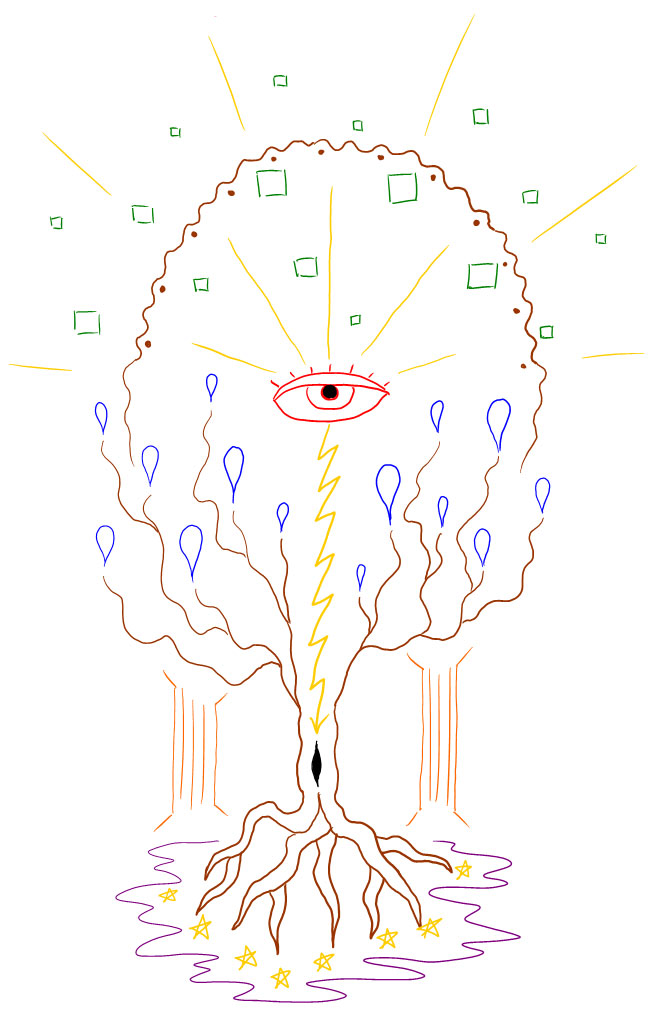
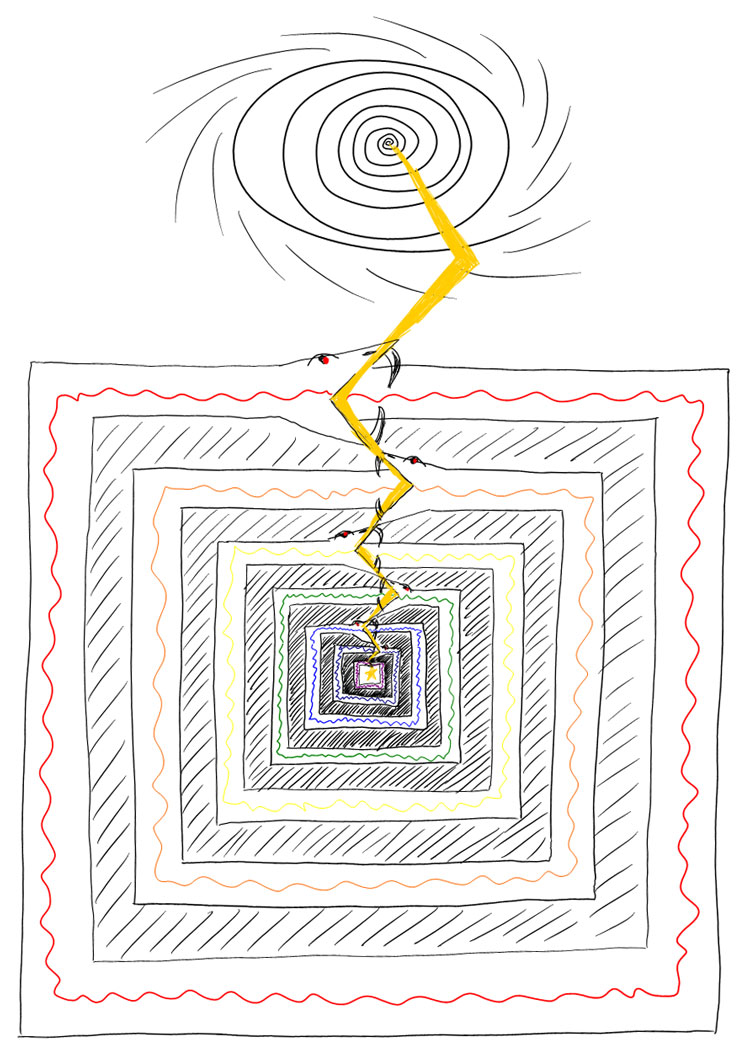
Are you fascinated by the beauty of forms in the natural world? Do you sense something amazing at work out there, like an intelligence that lies just beneath the surfaces of things? Then I invite you to read a new essay that explores the building of a new aesthetic consciousness that seeks to connect us with natural processes in a way that is truly transformative. I follow threads from alchemy into the genius of Goethe, and end with intimations brought forth by Rudolf Steiner, and even include some home-made animations as a part of a practical exercise for you to work with. You are invited to come and participate in opening a new set of eyes…
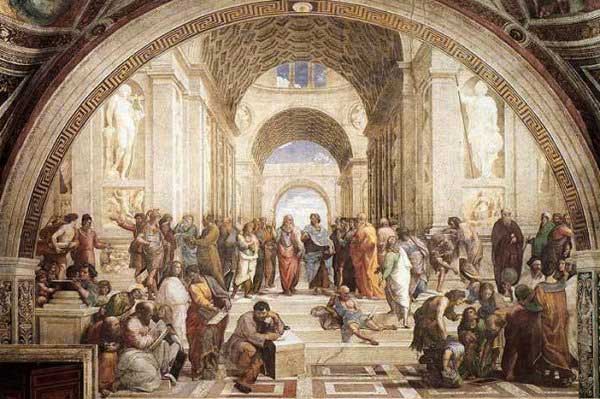
The “discovery” of perspective was a radical point (pardon the pun) in the development of art, and was intimately tied in with a whole shifting of consciousness during the time of the Renaissance and forward, having correlative expressions in the increasing reliance upon an “objective” perspective from which to view the world. Science in its modern form arose during this period as a methodological way of systematically removing subjectivity from observations, allowing data to be gathered which was amenable to enumeration and mathematical manipulation. The abstraction of the observer from the observed and the dissociation of both this abstracted observer and the observed phenomenon from the ever-changing background contexts that held both provided a powerful basis for a new way of being in the world.
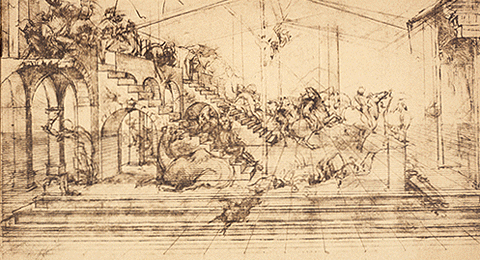
Leonardo da Vinci: study for adoration of the magi
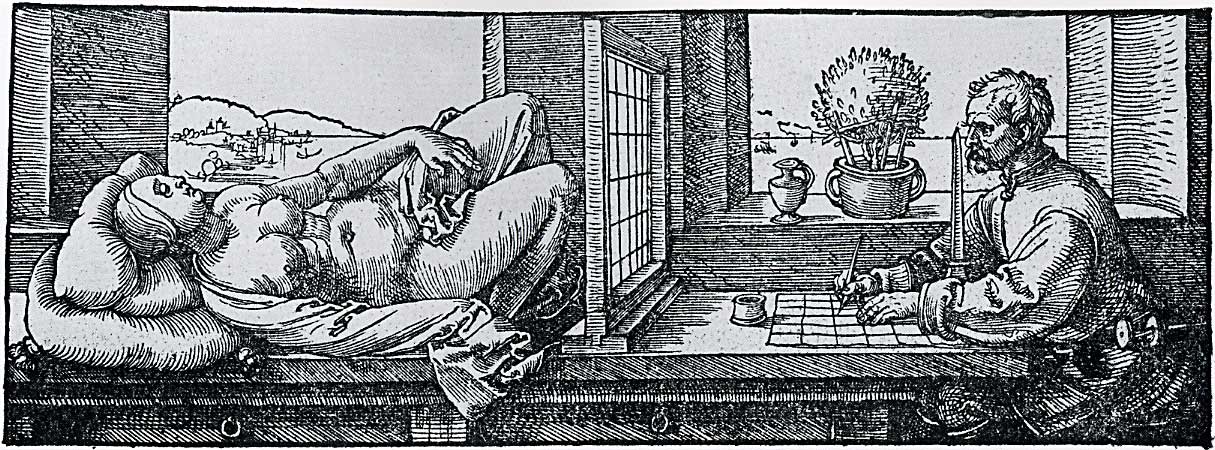
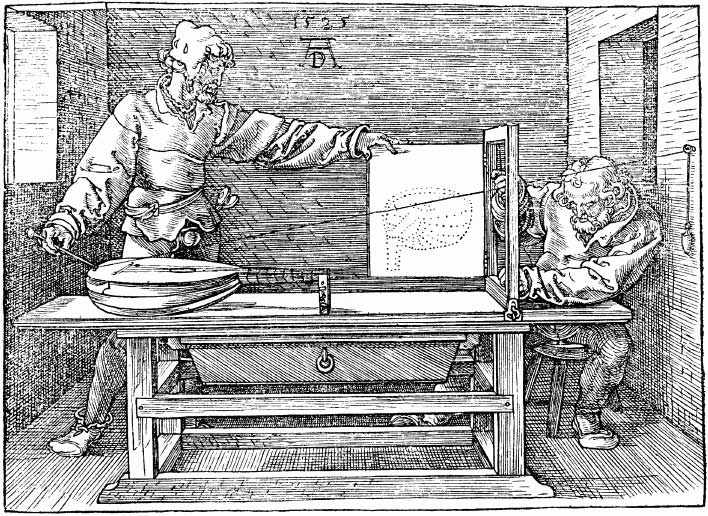
The laws of perspective allowed the world to be visually reduced, literally, to a point. Each point became a point in space from which the world looked a certain way, and the way it looked from one point always differed from the way it looked from any other point. It is interesting to note that the laws of perspective, designed as a basis from which visual scenes could be rendered on canvas in a way that accurately captured the “real” experience of our visual sense, required a reduction of the very visual experience it was meant to uphold. What I am referring to is the fact that perspective works from a single point, but the human being experiences the world through TWO such points. The laws of perspective required the literal and figurative shutting out of fully half of our visual experience.
Thus, in both art and in science, the central feature became one of representation. The art of the day was meant to represent in as exact detail as possible what could be viewed by a one-eyed person standing at a singular and exact location at a singular and exact moment in time. Similarly, the science of the day strove for theories that reduced human experience to its most basic forms, thus allowing for a further abstraction into mathematical language. Locke distinguished between “primary” and “secondary” qualities, and it was only the primary qualities that really mattered for science, because these could be objectified. This objectification was the equivalent of restricting vision to one eye at one point; each phenomenon could be interpreted “correctly” only from a singular point of view that was completely restricted and delineated in both space and time. The universe became a clock, and the human beings within it machines within the clock. “Truth” became something external to the human being, something to be discovered through the fulfillment of the promises made by the new scientific methodology.
Truth thus became as one-pointed as perspective drawing, subject to the perfect and known limitations of a small set of rules; all deviations were to be ‘explained away’ by recourse to the completely non-personal operation of blind forces. In art, ANYONE could presumably have the exact same visual experience as the next person if they stood in just the right spot at the right time; it took no special training or knowledge to interpret what was seen, because what was seen was reduced to its primal base: form and color in strict, law-abiding combinations. Ironically, the point, a completely abstract dimensionless non-entity, set the tone for our experience of all the dimensions of available to our experience.
Ultimately, however, this perspectival program was destined to destroy itself through its search for perfection. In art, the quest to represent visual experience led beyond form and color to the wider and fuller experience of vision as a whole. Many figures, from Goethe to Picasso, took part in a constructive dismantling of the dominant paradigm. In science, this occurred through the discovery of relativity and quantum mechanics, and later chaos theory, which banished forever the naïve reliance upon the point-like structure of previous generations.
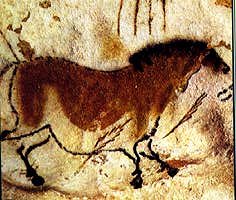
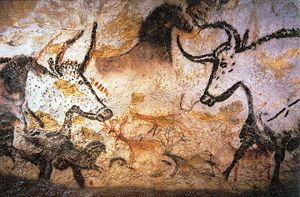
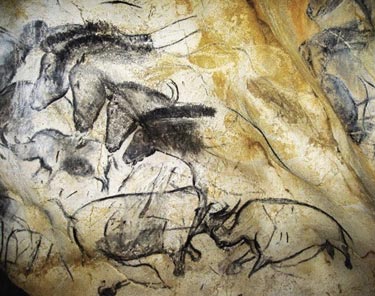
I’m actually somewhat uncomfortable calling Paleolithic renderings “art” – not because they don’t meet some standard set of criterion, but because of the very nature of the ‘calling’ itself seems to go against the experience of the makers of the art. See, there again, an assumption: “the makers of the art”, which includes a dichotomy between the producer and the produced. Our modern language is so full of this type of construction that it is almost impossible to get away from, or to recognize its influence on the content and method of our thinking – which is particularly problematic (at least if unrecognized) when we attempt to consider something like the inner experience of the people in the cultures which produced the images on the rock walls so long ago.
Paleolithic Art 2
Van James, in his book Spirit and Art, paints a picture (in the consciousness of the reader) of the process by which the art was created, including its cultural context, indicating that it had to do with a shift from participatory consciousness to one that had the seeds of self-recognition, and thus self-abstraction, as an essential component. I find this interesting because many artists throughout history, including today, mention something about the way in which one gets lost in the process of creating. This experience of the space between “me” and “my art” asymptotically approaches zero, leaving the artist with an experience of creation without “A” creator. Only retrospectively may an artist whose creating occurs in this state attribute the work rationally to some specific time period, place, and personality; but this knowledge does not need to be held in consciousness during the actual process of creation itself, and (as many artists know) may actively interfere with what might otherwise be brought forth.
Paleolithic Art 3
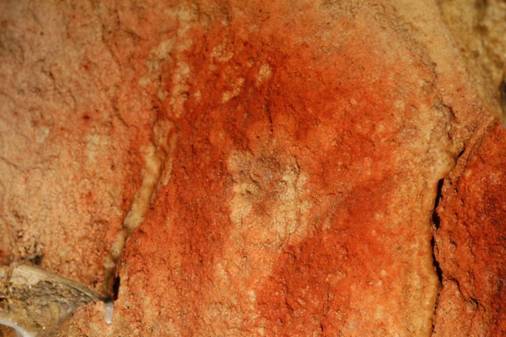
So I wonder if this experience – or LACK of experience, as the case may be – which characterizes some part of the process of artistic creation even today, may be something that was the ‘cutting edge’ of consciousness in the Paleolithic period. Jean Gebser’s “magic structure” (cf. The Everpresent Origin) speaks of this in a way similar to that of Van James, indicating that the art of this period was indicative of human beings waking up to themselves. Before this stage, (Gebser’s “archaic”), it is not possible to really speak of art at all, of creations “of” humans, because the consciousness was in identity with the world. It is only by transitioning to a consciousness of “unity” that art even becomes possible, because in “unity” is already contained the indication of multiplicity, as multiplicity is required in order for unity to be brought about (otherwise one simply has identity). Thus Paleolithic art may exemplify this transition in consciousness from identity to unity, which gives expression to sensory and magical experience in a form that takes this experience even further, strengthening it recursively through the very act of its creation. The painting of animals, of human figures, and of stenciled human hands may serve as a ‘catch’ for consciousness, by which it can step outside its mode of identity (akin to dreamless sleep) and into a mode which recognizes the beginning of division between the human being and the world (akin to dreaming sleep).
Paleolithic Art hand
So perhaps the pictures of animals and such on the cave walls are not really pictures “of”, but are rather more like techniques for transforming consciousness. We moderns are taught to pay more attention to things rather than processes, so we tend to see the results of some activity as the most important ‘thing’ to consider, i.e. the art itself. But maybe this was not always the case; maybe Paleolithic art was ‘something’ primarily in its making, in the process of its unfolding (such as in Tibetan sand mandalas, or Native American healing mandalas), and not so much in its product, the image on the wall. But, recursively, the production of the images may lead one who views it but does not create it, into a different space of consciousness – a space which invites both a ‘connection to’ and a ‘disconnection from’ at the same time. Maybe the Paleolithic viewer of Paleolithic art was both put into connection with the cultural significance of the art in an experience of magical unity with the forces identified by the culture, while also being called to experience the art in a way that called forth something from within that necessitated a concurrent experience of the without. The very experience of one’s unity with the world perhaps awakened the first seeds of dis-unity, of separation between what would eventually be one’s “self” and “the world”.
There’s something amazing about alchemical imagery. Deep spiritual symbolism, specific practical advice about transformation, archetypal aspects, meditative visualizations, and esoteric mysteries can exist together all in ONE image. For how many other works of art can the same be said?
In my opinion there is not enough alchemical imagery out in public on display, so to help remedy that situation I have made up some alchemical t-shirts and other products. Wear ’em and strike up a conversation about something unusual and profound.
 Are you fascinated by the beauty of forms in the natural world? Do you sense something amazing at work out there, like an intelligence that lies just beneath the surfaces of things? Then I invite you to read a new essay that explores the building of a new aesthetic consciousness that seeks to connect us with natural processes in a way that is truly transformative. I follow threads from alchemy into the genius of Goethe, and end with intimations brought forth by Rudolf Steiner, and even include some home-made animations as a part of a practical exercise for you to work with. You are invited to come and participate in opening a new set of eyes…