It's Elemental

Author: Seth

  • First and Second-Order Epistemologies

    First and Second-Order Epistemologies

    Gregory Bateson (1991) famously said that we “cannot claim to have no epistemology. Those who so claim have nothing but a bad epistemology” (p. 178).  Bateson is calling for self-reflection in our epistemology.  He wants it to be recursive, so that in our production of knowledge we do not delude ourselves into thinking that the means of production is independent of what is produced.  Bradford Keeney, cybernetic epistemologist, family therapist, modern day New Orleans-style shaman, and student of Gregory Bateson, notes that recursive epistemology has roots in second-order cybernetics and the recognition (1983) that “any distinction drawn is drawn by an observer. … An observer observes by drawing distinctions. … The starting point of epistemology is therefore an observer drawing distinctions in order to observe” (p. 24). This leads us to a fundamental recursion or non-linearity at the very start of any epistemological endeavor. While non-recursive epistemologies try to mitigate this kind of loopiness, cybernetic epistemology embraces it as the very heart of knowing, using it as a creative generator of change and transformation. Working with a non-lineal epistemology leads to a different kind of knowing, one which “emphasizes ecology, relationship, and whole systems. In contrast to lineal epistemology, it is attuned to interrelation, complexity, and context” (Keeney, 1983, p. 107).

    The consequences of lacking a self-reflexive epistemology are dire, leading to real practical and ethical dilemmas.  The structure of the sequence often goes something like this:

    • Knowledge is produced on the basis of a non-reflexive epistemology (Bateson’s “bad” epistemology). Ex: You performed an act found to be illegal.
    • The knowledge produced is thus assumed to be “objective” and “true” (i.e. independent of the means of its production; ignorant of its genesis). Ex: It doesn’t really matter why you did what you did, you are beholden to the law as written.
    • This tends to have a psychologically limiting effect with respect to alternative knowledge and especially alternative modes of knowledge production.  One’s viewpoint becomes ossified. Ex: The judicial system limits its treatment of you as a whole human being only to what is allowable within the strictures that the law defines. You become identified with your act.
    • The unreflective assumption of the “truth” of the knowledge becomes justification for its projection, often forcefully, onto other people and processes in the environments surrounding the knower.  A sense of conviction that the world is “like this” leads to inflexible protocols in our institutions and in our modes of interaction with others.  In other words, outer processes are also ossified; they become sclerotic. Ex: Now, instead of being a whole human being who with a completely full and complex life that included the illegal act, your identity shifts to that of a criminal. Your identity shifts, and you are now identified with the label “criminal,” and the judicial system creates places called prisons designed largely to maintain this distinction of your new identity.

    The unintended effects of this kind of lineal process knowledge production could fill multiple volumes, from the most subtle aspects of daily life to world-historical events. But recursive epistemology is not in opposition to lineal epistemology; it is rather meant to be a way of maintaining complexity and subtlety (and ideally, wisdom) by calibrating the linearity of standard epistemological practices through higher-order recursion.

    Calibration and Self-Calibration.

    But what does it mean to have a self-reflexive epistemology?  The difference between the two types of epistemologies, non-self-relfexive and self-reflexive, can be described by the first and second order difference.  A non-self-reflexive epistemology is a first-order epistemology, a process of creating knowledge that operates in a linear fashion.  The knowledge it generates is not explicitly connected to the process of its generation, and thus does not act as a potential corrective to its mode of production.  Epistemology is a tool for knowing; but with a non-self-reflexive epistemology, the tool’s operation does not change the tool, so that no matter what job it is called to do, it re-instances any new creations in the manner and style of its past processes—regardless of what might be new in the situation it encounters.  The kind of newness that comes from a linear epistemology is (more…)

  • Video Games and Spiritual Development, a preliminary analysis

    Video Games and Spiritual Development, a preliminary analysis

    Introduction

    Video games are a huge global phenomenon, driving well over $70 billion dollars in sales in 2011—a number that is only rising year by year.  For comparison, global music sales in 2011 was about $16 billion, while global theater tickets was about $33 billion.  This has consequences—largely unexplored—for people that are interested in spiritual development.  It is thus important to look at the phenomenon of video games from a spiritual perspective, because almost no one growing up today can avoid them.  The time in which human beings could develop spiritually without the presence of modern technologies is essentially over, and video games are now deeply integrated into the fabric of modern society.  Their ubiquity means that human beings who wish to undertake spiritual development will often do so in contexts that are not devoid of video games.  We can thus ask the question, how might video games impact spiritual development? (more…)

  • Contributing artist at New Forms Technology

    Contributing artist at New Forms Technology

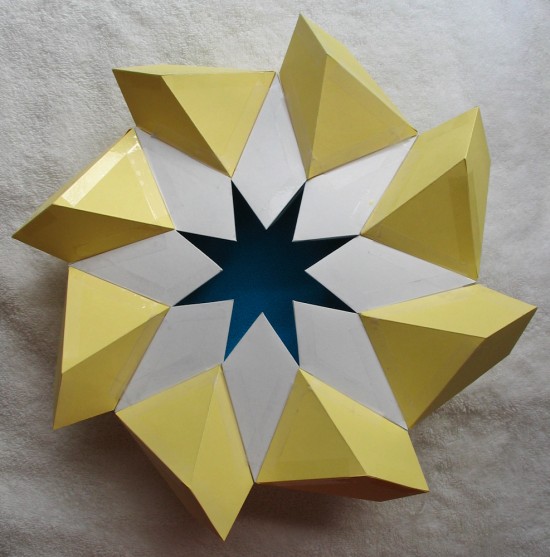
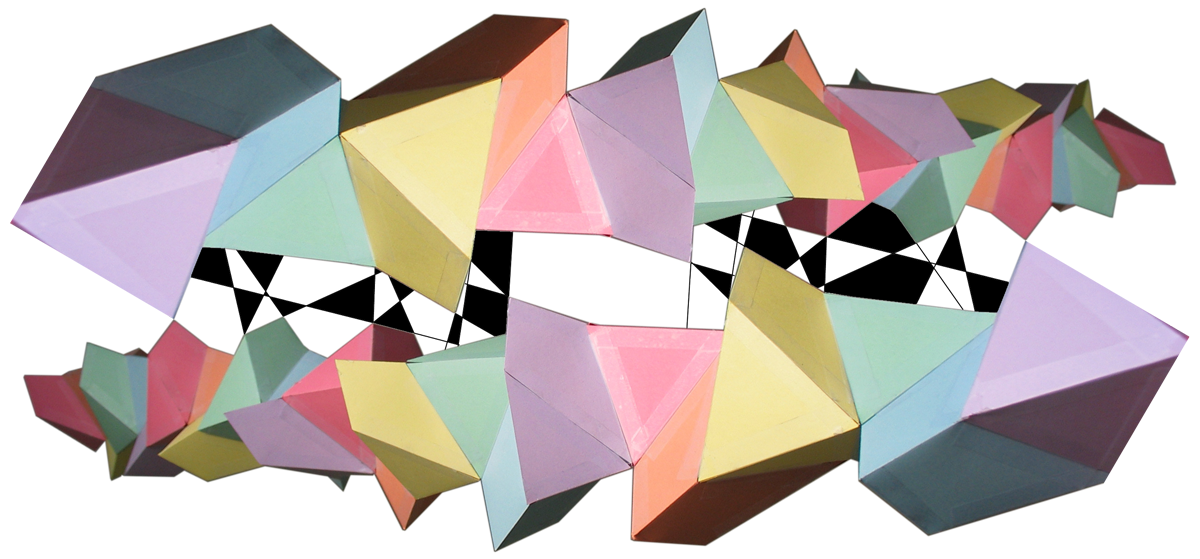
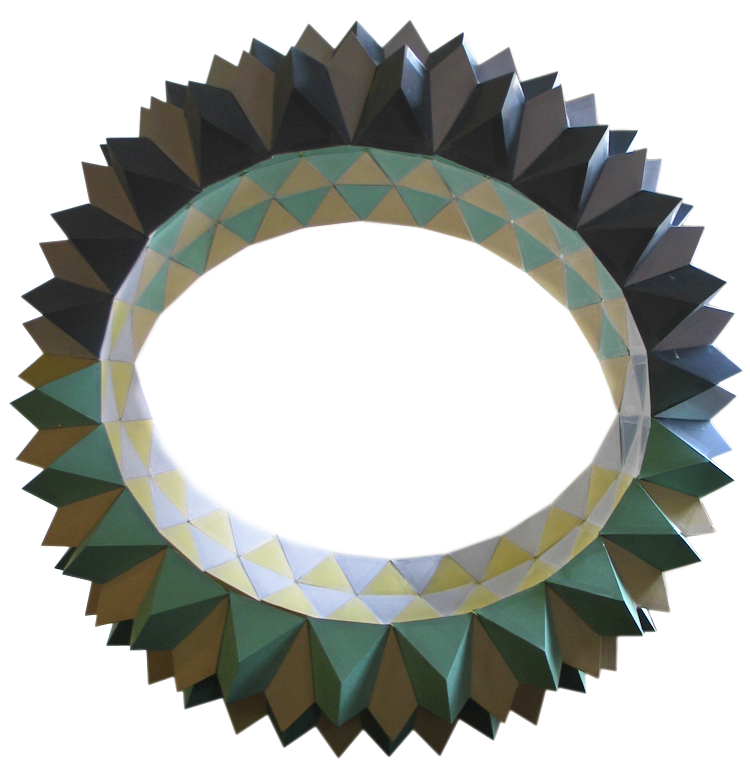
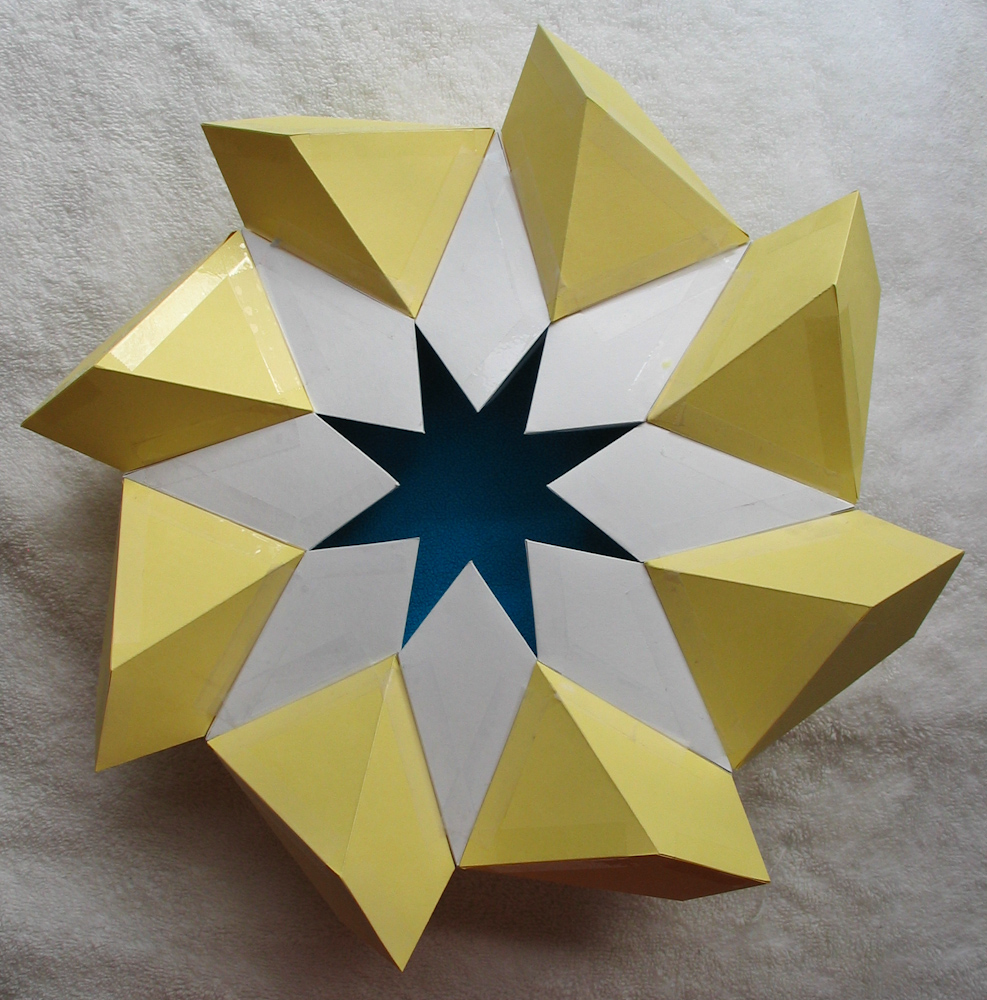
    If you don’t know about the discovery of the Chestahedron, a volume with seven faces of equal area, you should check it out at New Forms Technology (shameless plug: I’m the webmaster).

    I have been experimenting with the form in its sculptural capacity, and have come up with some interesting designs that are featured on the site, which you can see here.

    Below are a few samples of my work, click for larger:


    Chestahedral Columns

    Chestahedral Rings

    Chestahedral Star

  • do not think about this

    do not think about this

    footprints

    do not think about this
    it is not here for your pleasure
    not waiting self-less
    for some deathly embrace
    as if it were not already perfect
    and rising starkly, gently behind you
    perusing the pages of your eyes
    passing no judgment

    straighten your back
    and fly into the sunset
    as you were meant to –
    objectless, void, unsundered
    by the sheer presence of its wings
    will you be lifted
    footprints trailing clouds
    into what has always known you

    pulling the threads of your heart
    it makes your fists close hard
    about what you can never grasp
    the light to your shadow
    a silence around your music
    forgeless and forging
    you become its thoughts
    it is no it
    I AM

  • Observing the Observer: Exploring a Cybernetic Epistemological Recursion

    Observing the Observer: Exploring a Cybernetic Epistemological Recursion

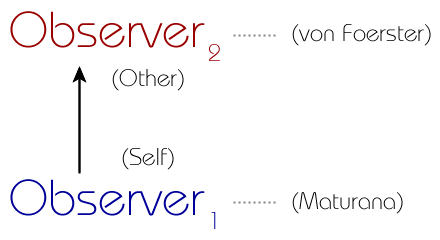
    All epistemologies are observer-dependent; i.e. there is no single epistemology that applies to all possible observers, because every observer is unique in some way.  The necessary inclusion of the observer in any description of the world is a deeply obvious and yet profound principle.  It was neatly expressed in Heinz von Foerster’s article Cybernetics of Cybernetics, where he builds off of Humberto Maturana’s phrase “Anything said is said by an observer,” by indicating that “Anything said is said to an observer” (2003, p. 283) (figure 1).  This is in contrast to the view that anything said is simply… said, as if into a vacuum.  This older view, championed by the scientific revolution, took up the principle that statements could simply be true or false, and were about the world but not really of the world (the roots of these two views can be traced back to Plato and Aristotle).  Cybernetic epistemology modifies this assumption by re-introducing the observer as a part of the world.

    Figure 1: Observers 1 and 2
    Figure 1. A cybernetics of description following Heinz von Foerster. There are two different observers involved in any description; observer 1 is the describer, and observer 2 is the one to whom the description is directed.

    (Side note: it is important to indicate that perspectives on just what this word “observer” might mean can be helpfully explored also through esoteric methods.  In an significant way a central—perhaps even the central—aspect of esoteric practice involves the closing of the loop of observation.  Esoteric practice in general (always with caveats) can be thought of as the experiential exploration of the cybernetic epistemological injunction that no description of reality can be complete without an integration of the describer in the description.)

    While von Foerster links the principle explicitly to the social realm (2003, p. 284) by distinguishing (more…)

  • Sleep, Dreams and Video Games

    Sleep, Dreams and Video Games

    How you use your attention in waking life has definite effects in your dreaming life.  The following is my distillation of some insights from anthroposophy in this regard, which I offer as one way of looking at this phenomenon, specifically around the issue of video games and dreaming.  This post should provide an appropriate background if necessary.

    If people are comfortable with the terms, we can talk about how the astral body (the subtle body that allows something outside to become something for us inwardly; i.e. the sense-body, which we share with animals) gains its content in large part by reflecting itself off of the etheric body (the less subtle body that keeps your body from becoming a corpse, which we share with the plant realm).

    When you spend hours of time focusing your senses on particular stimuli (i.e. a video game) your are patterning your etheric body through physiological repetitions: the movements of your eyes, hands, breathing, etc., and more importantly in the endocrine responses and other physiological changes that go along with the particular game experience.  Knowing why this is important needs a little background first.

    xbox-360-controller

    When you go to sleep, and you are no longer imposing your astral body on your etheric (i.e. choosing where to direct your attention and what sensations you will seek and avoid) your etheric body starts to (more…)

  • Reality, Process, and Mathematics

    Reality, Process, and Mathematics

    All the qualities of the physical world exist through the interrelations of things to each other. What Moleschott says is correct for physical existence: ‘All existence is an existence through qualities. But there is no quality that does not exist through a relation.’ Just as everything of a soul nature contains something in itself by which it points to something outside itself, so conversely, a physical thing is so constituted that it is what it is through the relation to it of something outer.
    (Rudolf Steiner, Riddles of the Soul, Mercury Press, 1996, p. 69.)

    For such a philosophy, the relations that connect experiences must themselves be experienced relations, and any kind of relation experienced must be accounted as ‘real’ as anything else in the system.
    (William James, Essays in Radical Empiricism, Cosimo, Inc., 1912/2008, p. 20)

    In aesthetic epistemology, notions of “reality” are replaced by “patterns in process.”  “Things” are (ontologically) patterned processes.  We mistake the nature of the universe when we presume that “things,” to be, must “be” from the bottom up: on the basis of some “substance,” which THEN interacts in processes to yield what we experience (the first coherent expression of this began with the atoms in the void hypothesis of Leucippus and Democritus in Ancient Greece).  We assume that it is silly to speak of patterns of process without some kind of “thing” that we can point to as an indicator that the process is proceeding.  Because of the way our senses are involved in cognition, we tend to count as “real” only what can be made apparent to us through our senses (or their extensions via instruments). This is a huge presumption on our part.  What if we tried to conceive of “substance” as a secondary phenomenon?  What if process (thing-less process) is more primary?  In this view, things are precipitates (momentary nodes, relatively ‘still’ areas of patterned processes) of higher-order relations… not relations between THINGS but relations qua the activity of relating.  This may sound abstract, but this is because we are trained to think of reality in terms of substances (sub-stances: the “underneath-standings,” the bits from out of which a universe gets built).

    The best example of one way that this can look is given in the field of mathematics.  Mathematics has no atoms, not even metaphorical atoms; it is entirely substanceless.  Rather, mathematics has, at its base, processes and their relations.  Even numbers aren’t the basis of mathematics,  (more…)